Guides / Process
Designing Machined Titanium Parts: A Guide for Engineers, in the Order You Decide Things
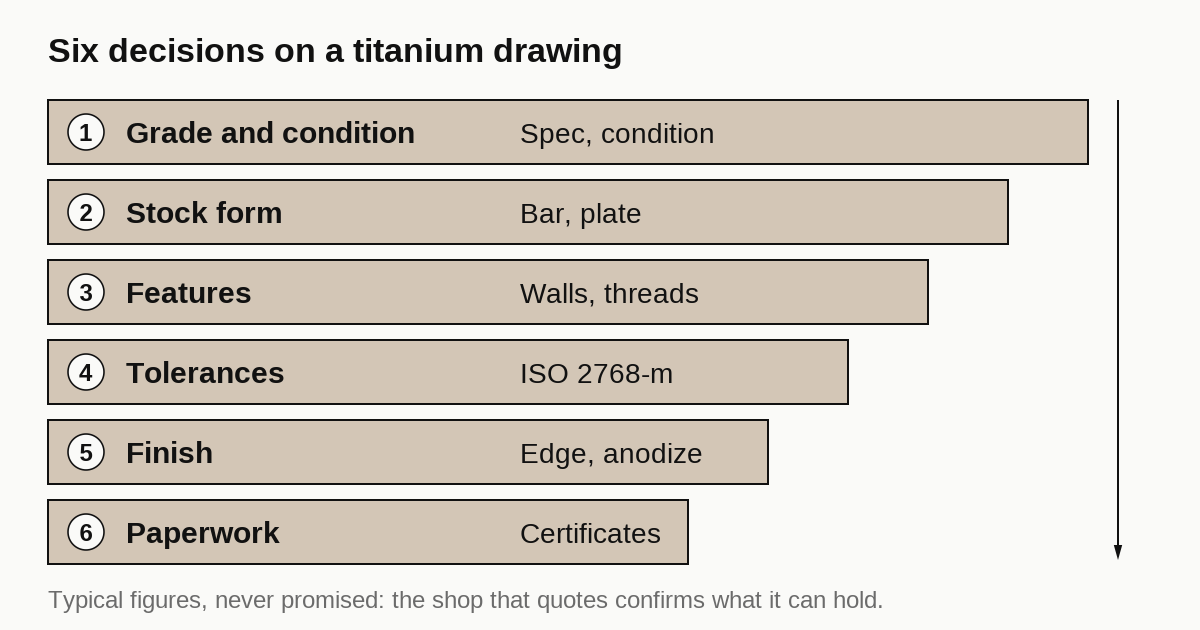
A design engineer settles six things on a machined titanium drawing, and the order matters because each one narrows the next: grade and condition, stock form, features, tolerances, finish and paperwork. Most of the price is fixed by the time the drawing is released, so a decision made late costs more than one made early. This guide goes through the six in that order and sends you to the guide for each, with the typical figures our guides use.
Every figure below is typical, not promised. We own no machines. The shop that quotes confirms what it can hold on your geometry, and the drawing owner decides the grade and the specification.
1. Grade and condition
Start with the requirement, not the name. Corrosion alone usually points to Grade 2. Load and weight point to Grade 5 (Ti-6Al-4V), whose minimum tensile strength is 895 MPa against 345 MPa for Grade 2 in the distributor tables we use. Toughness or an implant standard points to Grade 23. Long service above about 400 °C moves you to a near-alpha alloy, because published limits put Ti-6Al-4V at roughly 315 to 400 °C.
| Question | Guide |
|---|---|
| Which grade fits the requirement? | Choosing a titanium grade and the grades chart |
| Grade 2 or Grade 5? | Grade 2 vs Grade 5 |
| Which CP grade, 1 to 4? | CP grades compared |
| Is titanium the right metal at all? | versus aluminium, stainless, alloy steel and Inconel |
| Hot service? | High temperature alloys |
| What does the shop propose in place of my grade? | Approving a grade substitution |
Condition belongs on the same line as the grade. Annealed and solution treated and aged (STA) are different working conditions, and STA cuts harder, with the order of heat treatment and machining changing both price and risk. Read annealed or STA before you write the condition. The grade reference lists the designations side by side, with cells we cannot verify marked as such.
2. Stock form and size
The blank is a large share of the cost of a titanium part, so the form and size are design decisions, not purchasing ones. Decide whether the part is a bar, plate, tube, forging, casting or printed part before you draw the features.
| Route | When it pays | Guide |
|---|---|---|
| Bar or plate | First articles, prototypes, a few dozen parts, most jobs | Sizing a blank, buy to fly calculator |
| Near-net forging | Most of the blank would be chips and the quantity carries a die | Forging vs bar |
| Casting | A shape cast near-net, with stock left to clear the alpha case skin | Machining castings |
| Printed | Geometry that cannot be cut, or a blank that would waste most of its weight | Printed vs machined |
Size the blank from the finished envelope, add the allowance the bar needs, then round up to the bar size that exists. A blank one size too big can add more to a quote than any saving in cycle time. For the cost logic of the whole drawing, see how to reduce the cost of a machined titanium part.
3. Features the shop can cut
Titanium punishes features that other metals forgive. The figures below come from our guides and are the starting points a shop uses.
| Feature | Typical rule of thumb | Guide |
|---|---|---|
| Thin wall | Up to 5 to 1 height to thickness is routine, 5 to 1 up to 10 to 1 moderate, above 10 to 1 needs support or staged removal | Thin wall parts |
| Internal corners | Radius of roughly a quarter of the pocket depth, and a second look at anything under 3 mm in a pocket deeper than 15 mm | Ten drawing decisions |
| Holes | Up to about 5 times diameter is routine, deeper needs pecking, through-spindle coolant or a gun drill | Drilling titanium |
| Threads | Titanium on titanium galls, so name a treatment, an insert or a different mating material | Threading without galling |
| Edges | State an edge break size, because burrs are tough to remove and deburring can rival machine time | Edge breaks |
| Complex form | Five axes when deep pockets or impeller shapes need it | Five-axis parts |
Three behaviours sit under these rules: work hardening, springback and residual stress. The part moves away from the cutter, heat stays local because conductivity is low, and a flat part can bow once it is unclamped. Our work hardening guide explains each and what to write on the drawing. If the part is welded, read alpha case first, and for spark erosion see the EDM guide and its recast layer.
4. Tolerances
The most common expensive habit is a tight block tolerance on every dimension, which prices the whole part at the level of its hardest feature. Set a general tolerance that is adequate, and call out the features that matter one by one.
| Approach | What the shop has to do |
|---|---|
| Tight tolerance on every dimension | Finish pass and inspect everything |
| ISO 2768-m general plus two or three called out | Rough to size, finish and inspect the features that matter |
Our tolerance guide lists typical general dimensions of plus or minus 0.05 mm as routine and 0.02 mm as achievable with care. It also lists fitted bores at 0.02 mm routine and 0.01 mm with care, and it says to discuss anything tighter first. Name the datum that matters, and say where flatness matters and on which section, because that is the trigger for a stress relief between roughing and finishing. See titanium tolerances.
Need a quote for this part? Get a titanium quote
5. Finish
Titanium does not rust, so a finish is rarely about protection. It is about appearance, wear, cleanliness or a specification written downstream, and knowing which one you are buying keeps the cost honest. As machined is a real answer on surfaces that need nothing.
- Appearance and anti-galling: Type II anodizing to AMS 2488 helps against galling on titanium threads and sliding faces, and it does not hide tool marks. See anodizing and heat discoloration.
- Wear: the right coating depends on what is failing. In one controlled study of Ti-6Al-4V the fatigue cost ran from about 5.5 percent for DLC to about 50 percent for TiN, so check cyclic loading before you choose. See wear coatings.
- Cleanliness and surface layers: see surface finish and pickling and chemical milling.
Say whether heat treatment or a coating comes before or after the finishing pass, since process temperature can change the condition you specified.
6. Paperwork the part must carry
The material line should cite a specification and its revision, not only a grade. Our guide to specifications for the RFQ compares the common ones, and the callout reference shows how to read them. Decide the certificates early, since each one is real work: the mill certificate guide covers heat numbers, and tests such as ultrasonic testing and penetrant inspection belong on the RFQ only when the part needs them. Asking for everything narrows the supplier list and raises the price; asking for nothing and needing a certificate after the parts are cut usually means cutting them again.
Control the revision as well. Old revisions reach the machine through small gaps such as an old attachment or a saved copy, which is why revision control matters on a material this expensive. If the part goes to a defence customer, classify the drawing before it travels, as in our export control guide. Industry shortcuts: aerospace and medical.
Cost and lead time, once the drawing is fixed
Quantity changes price through setup: five prototypes cost far more each than fifty because the fixed block of programming, fixture, tool trial and first-article inspection spreads over fewer parts. See prototype cost and batch size and price breaks. Lead time is usually about the bar, not the machine, as the stock forms guide explains, and the lead time guide shows it step by step.
A short drawing review
- Is the grade chosen from the requirement, with specification, condition and a substitution rule?
- Does the blank size exist, and is the buy to fly ratio acceptable?
- Are walls, corners, holes and threads inside the rules above, or called out on purpose?
- Is the general tolerance set, with two or three features called out and a datum named?
- Does each finish have a reason, and is its place in the sequence stated?
- Are the specification, revision and certificates written, and is the export classification known?
Send the drawing through the RFQ form when the review passes. We reply within 24 business hours with one itemised quote, made by a partner shop that cuts titanium. Questions on a drawing before that can go to .
Sources
- Choosing a titanium grade: our decision path and its source list
- Ten drawing decisions that decide what your titanium part costs
- Titanium tolerances: what is routine, what is expensive
- Thin wall titanium and wear coatings on titanium, with the fatigue study cited there
- Editorial standards: how every figure on this site is sourced
Frequently asked questions
What should a design engineer decide first on a titanium part?
Start from the requirement the part has to survive, such as load, temperature, a fluid or a forming step, and only then name a grade. Choosing Grade 5 by habit and checking afterwards is the most common wrong turn. The grade then sets the specification, the stock forms you can buy and the heat treatment condition.
Which drawing decisions change the price of a titanium part most?
Stock form and size come first, because bar costs several times more per kilo than aluminium and chips carry much of it away. Tolerance on every dimension comes next, then thin walls, deep holes and small internal corners. Each is covered by a guide linked below, with typical figures.
Is ISO 2768-m a sensible general tolerance for machined titanium?
Our tolerance guide treats ISO 2768-m as the right default for machined titanium and calls out two or three features tighter. A shop assumes it anyway when the title block is silent. The shop that quotes confirms what it can hold on your geometry, so treat all such figures as typical.
When should a titanium part be a forging, a casting or a print instead of bar?
When most of a machined blank would become chips and the quantity carries a die, a near-net forging can pay. A casting leaves an alpha case skin you must machine through, and a print wins when the geometry cannot be cut. For a first article or a few dozen parts, bar is usually cheaper and faster.
Need a quote for this part?
Send the drawing. We send one itemised quote for the finished parts and reply within 24 business hours.
Get a titanium quote