Guides / Grades
CP Titanium Grades 1, 2, 3 and 4: Which One to Name on a Machined Part
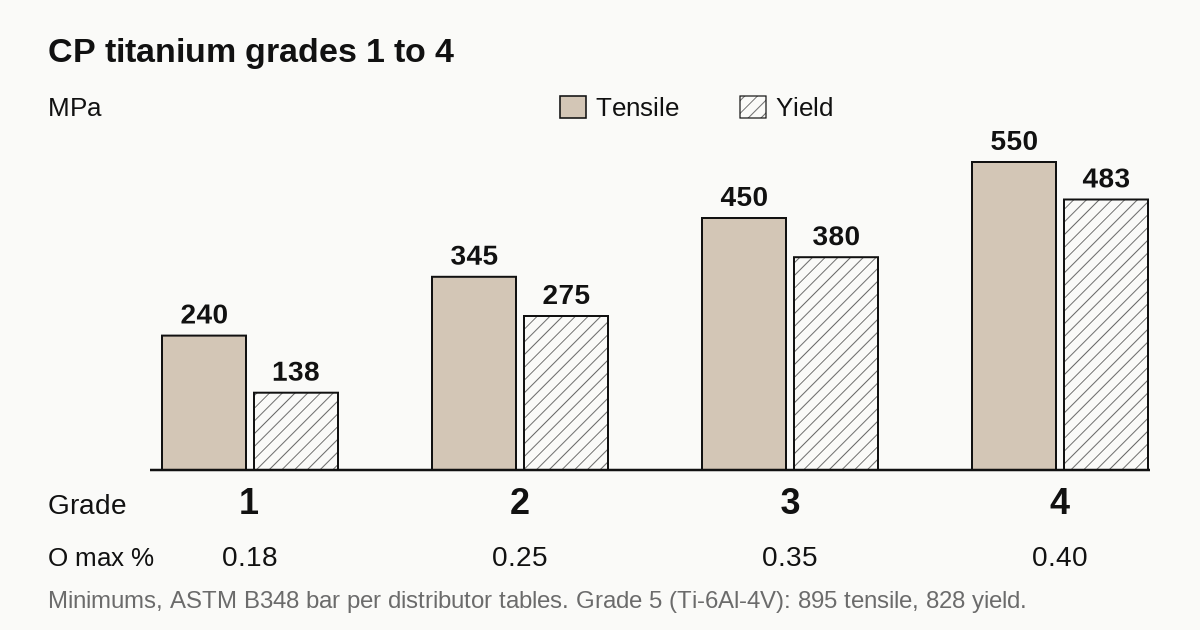
The four commercially pure (CP) titanium grades differ in one thing a buyer can control: how much oxygen and iron the heat is allowed to carry. That sets the strength. As listed for ASTM B348 bar, minimum tensile strength steps from 240 MPa on Grade 1 to 345, 450 and 550 MPa on Grades 2, 3 and 4. Corrosion behaviour barely changes between them. So the choice is a strength and forming decision: Grade 2 by default, Grade 4 when the part needs more strength without alloying, Grade 1 when it must be formed and Grade 3 only when a specification asks for it. This post is part of our guide to titanium grade selection.
Figures below are specification minimums as printed by distributors. We did not read the ASTM text, which is paywalled, so the edition on your drawing governs. Every figure is typical, never a promise.
The four grades side by side
| Criterion | Grade 1 | Grade 2 | Grade 3 | Grade 4 |
|---|---|---|---|---|
| Maximum oxygen | 0.18 percent | 0.25 percent | 0.35 percent | 0.40 percent |
| Maximum iron | 0.20 percent | 0.30 percent | 0.30 percent | 0.50 percent |
| Minimum tensile | 240 MPa (35 ksi) | 345 MPa (50 ksi) | 450 MPa (65 ksi) | 550 MPa (80 ksi) |
| Minimum yield | 138 MPa (20 ksi) | 275 MPa (40 ksi) | 380 MPa (55 ksi) | 483 MPa (70 ksi) |
| Minimum elongation | 24 percent | 20 percent | 18 percent | 15 percent |
| Thermal conductivity | 16.0 W/m K | 16.4 W/m K | 19.9 W/m K | 17.2 W/m K |
| Where it fits | Most formable, lowest strength | Default for corrosion service | Specified rarely | Strongest CP grade |
Strength and elongation: Corrosion Materials CP datasheet and Rolled Alloys grade table, which agree on every cell shown. Chemistry: FW Metals CP page and the Rolled Alloys table (the Corrosion Materials sheet gives chemistry for Grade 2 only; Rolled Alloys prints Grade 4 oxygen as 0.40 in one table and 0.10 in another, and we used 0.40, as FW Metals does). The Grade 1 yield minimum is the one cell that differs between tables: FW Metals and Makino (“170 to 310”) list the Grade 1 yield minimum as 170 MPa, and our Grade 4 guide uses “around 170 MPa”; Rolled Alloys and Corrosion Materials print 20 ksi (138 MPa), which is the figure used here. The edition on the drawing governs. Thermal conductivity: Makino, 2021. Role column: FW Metals and Corrosion Materials descriptions, plus our grades chart post for Grade 3.
How oxygen sets the grade
Titanium dissolves oxygen, and the oxygen locks the crystal structure, which raises strength and lowers ductility. The CP grades are the same metal with the oxygen limit raised in steps. That is why the chemistry table and the strength table are the same table read two ways. The Corrosion Materials datasheet puts the whole family at 99 percent minimum titanium and says each grade has slight chemistry differences that change mechanical properties and design capability.
ASTM B348 covers all four, as annealed bar and billet. It also lists H grades, such as Grade 2H, which are identical to the numeric grade except for a higher guaranteed minimum tensile strength of 58 ksi (400 MPa), intended mainly for pressure vessel use. Name 2H only if your pressure code asks for it, because it is Grade 2 with a stricter tensile floor.
What the strength steps mean for a part
Read the yield minimum against the stress your part sees, then add your own margin. The table shows the first CP grade whose minimum yield clears a given requirement.
| Required minimum yield | First CP grade that clears it | Note |
|---|---|---|
| 250 MPa | Grade 2 (275 MPa) | Grade 1 at 138 MPa does not |
| 300 MPa | Grade 3 (380 MPa) | Grade 2 at 275 MPa falls short |
| 400 MPa | Grade 4 (483 MPa) | Top of the CP family |
| 500 MPa | None | Needs an alloy, for example Grade 5 at 828 MPa |
This is arithmetic on minimums, not a design check. The design owner sets the margin, and a heat normally tests above the minimum. The point is the jump: Grade 2 to Grade 4 raises the yield minimum by about 75 percent, while Grade 4 to Grade 5 raises it by about 70 percent again but brings the alloy’s cost, cutting speed and paperwork with it. Our Grade 4 guide sets out where that trade tips the other way.
Corrosion: the same family
Corrosion Materials states that corrosion resistance is similar across the four CP grades while mechanical properties vary with oxygen and iron. Its datasheet names Grade 2 as the grade of choice for most industrial work needing good ductility and corrosion resistance, and says Grade 2 resists seawater and marine atmospheres. So moving from Grade 2 to Grade 4 does not buy corrosion performance. It buys strength.
When Grade 2 starts to pit in a hot chloride crevice, the answer is a different family: palladium grades such as Grade 7 or Grade 12. Those are covered in our Grade 7 and Grade 12 guide.
Cutting behaviour across the four
Makino, a machine tool maker, published a test of Grade 2 against Ti-6Al-4V. In its table Grade 2 has a thermal conductivity of 16.4 W/m K against 6.7 for Ti-6Al-4V, about 2.4 times higher, so more heat leaves in the chip. Makino ran a 20 mm end mill in Ti-6Al-4V at 50 m/min for about 60 minutes of tool life, then raised the speed on Grade 2 until it reached the same 60 minutes. That happened at 145 m/min, a factor of 2.9. In a separate test with a 76 mm cutter, Grade 2 cut with about 2,000 to 2,400 N less force than Ti-6Al-4V at the same engagement. These are one tool maker’s tests on its own cutters, so treat them as directional.
Our older guides quote a more cautious typical figure of around 80 m/min for Grade 2 in production. The two do not conflict: a lab test at a fixed tool life and a shop’s working figure answer different questions. Ask the shop what it runs.
Between the CP grades themselves we found no public cutting data. Makino’s table gives thermal conductivity of 16.0, 16.4, 19.9 and 17.2 W/m K for Grades 1 to 4 and the same 105 GPa modulus for all four, which says the heat behaviour is similar. Strength is what differs, so a stronger grade should load the tool more. The shop’s own record settles it.
Need a quote for this part? Get a titanium quote
Stock, standards and certificates
Bar to ASTM B348 is the normal call for a machined CP part. Plate and sheet take ASTM B265, so say which form you mean. Implant and dental drawings name a different standard and fix the grade themselves, which our medical parts guide explains.
We found no public stock-position data by grade. In our own guides, Grade 2 is the CP grade shops usually find on the shelf, and Grades 3 and 4 are sometimes a mill order that adds weeks. A certificate also cannot move a heat between grades: a bar certified as Grade 2 is not a Grade 3 bar however it tests.
Which grade to name
- Grade 1: the part is formed after machining, or ductility matters more than strength. Expect the lowest strength of the four and a soft, gummy cut.
- Grade 2: corrosion is the reason for titanium, the load is mild and the part may be welded. This is the default and the easiest grade to buy.
- Grade 3: a specification or pressure code names it. Do not pick it on strength alone, because Grade 4 usually clears the same bar with the stronger margin.
- Grade 4: the part needs CP corrosion behaviour and more strength than Grade 2, or the drawing comes from an implant standard that names it.
- Grade 5 or another alloy: the yield requirement is beyond 483 MPa.
What it costs to pick wrong
A grade chosen too low fails in service or at the first test: Grade 2 on a part that needs 400 MPa yield has a minimum of 275. A grade chosen too high costs time more than money you can see. Grade 4 where Grade 2 would do can add lead time if bar is a mill order, and it may machine slower. We found no public price comparison between CP grades, so ask for quotes in both grades on the same drawing. The shop knows its stock and its tool life.
What to put on the RFQ
State the grade number, the standard and the form: for example Grade 2, ASTM B348 bar, annealed. Add one line on the service, such as seawater, welded or formed afterwards, so the shop can say whether a different CP grade would do. Say if a certificate must name the heat number. For the full decision path from requirement to grade, read our guide to titanium grade selection. Send the drawing through the RFQ form and we reply within 24 business hours with one itemised quote.
Sources
- ASTM B348/B348M-25, scope, grade list and H grades
- Corrosion Materials, titanium Grades 1 to 4 datasheet (chemistry, minimum properties, welding, corrosion)
- Rolled Alloys, titanium grades and relative properties (oxygen, iron and minimum properties per ASTM B348)
- FW Metals, commercially pure titanium (grade descriptions, Grade 1 yield 170 MPa)
- Makino, Machining Titanium Part 3, 2021 (thermal conductivity, modulus, Grade 2 tool life test)
Frequently asked questions
What is the difference between Grade 1, 2, 3 and 4 titanium?
All four are commercially pure titanium. They differ in the oxygen and iron the heat is allowed to carry. More oxygen gives more strength and less ductility, so the minimum tensile strength steps up from 240 MPa on Grade 1 to 550 MPa on Grade 4, as listed for ASTM B348 bar.
Is Grade 4 titanium harder to machine than Grade 2?
Expect it to be, because it is stronger: the minimum tensile strength is about 60 percent higher. We found no public cutting data that compares the four CP grades with each other, only Grade 2 against Ti-6Al-4V. Ask the shop what it runs on each grade.
Can CP titanium be heat treated to get more strength?
Not in the way Ti-6Al-4V can. The strength of the CP grades comes from the oxygen and iron in the melt, which is why the grade number rises with those elements. If a part needs more strength, name the next grade or an alloy and check the stock before you change the drawing.
Which CP grade should I name for a welded titanium part?
Grade 2 is the usual choice. A distributor datasheet says it welds with MIG or TIG, with inert gas shielding to prevent oxygen pickup and embrittlement, and needs no preheat or post heat. If the load needs more strength than Grade 2, look at Grade 4 and confirm the weld procedure with the shop.
Need a quote for this part?
Send the drawing. We send one itemised quote for the finished parts and reply within 24 business hours.
Get a titanium quote