Guides / Process
3D Printed vs Machined Titanium: When Powder Bed Fusion Beats Cutting from Bar
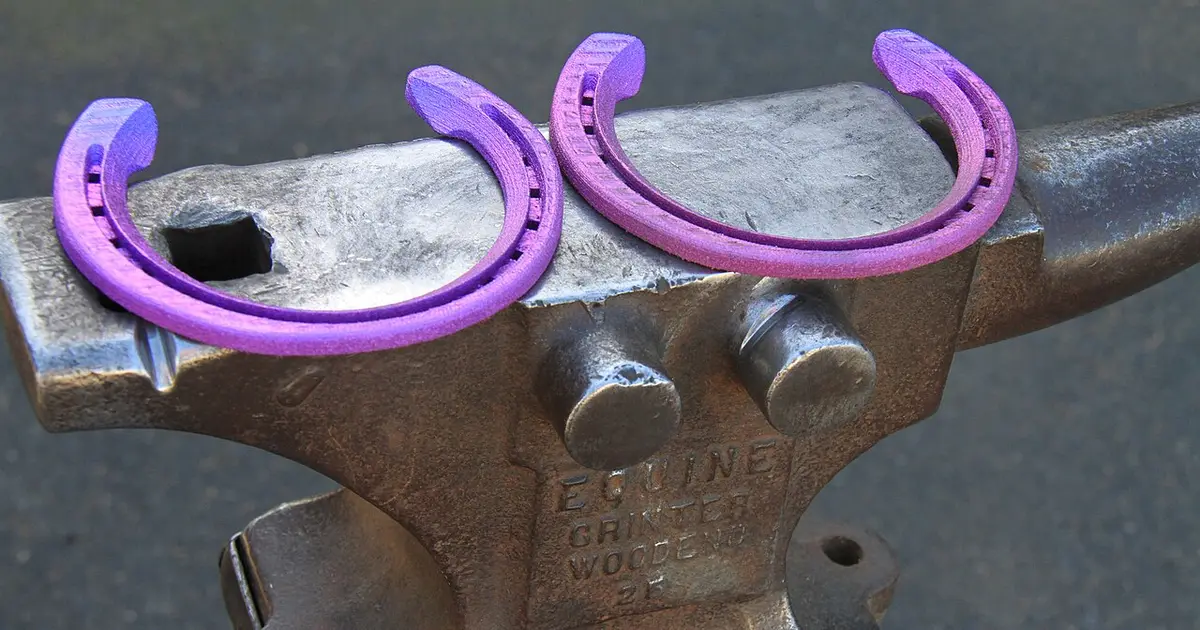
For most titanium parts, machining from bar costs less than printing and gives a better surface. Printing wins in two situations: when a machined blank would waste most of its weight as chips, and when the geometry cannot be cut at all, such as internal channels or lattice. In between, the answer depends on the surface, because fatigue life in printed titanium is set by the skin of the part more than by the metal inside.
How the two routes differ
Machined titanium starts as a solid bar, plate or forging with a mill certificate and removes everything that is not the part. Laser powder bed fusion builds the part layer by layer from powder. A recoater spreads a thin layer, a laser fully melts the cross section and the cycle repeats under argon or nitrogen. Layers are typically tens of micrometres thick, and the machine adds supports that anchor the part and carry heat away. Ti-6Al-4V is one of the standard printable alloys.
That difference shows up in five places on a quote.
| Machined from bar | Printed (powder bed fusion) | |
|---|---|---|
| Starting form | Mill bar, plate or forging with certificate | Atomized powder, part built to near net shape |
| Waste | Buy to fly sets the chips | Supports and powder handling, far less bulk waste |
| Surface | Ra 0.8 to 3.2 µm routine | Ra about 6 µm as built (one study, below) |
| Internal flaws | Wrought structure, ultrasonic testing available on bar | Porosity possible, usually closed by hot isostatic pressing |
| Geometry | What a cutter can reach | Internal channels, lattice, merged assemblies |
Build volume is a limit too. One common machine has a build envelope of 250 × 250 × 325 mm, and a few reach about 1 m in each direction. A large simple part is often easier to machine than to print.
Fatigue and the as-built surface
A printed surface is rough because it is made of partly melted powder grains and layer steps. A study by Kelly and co-workers measured as-built printed Ti-6Al-4V at Ra 6.00 µm. Wrought reference material in the same study measured Ra 1.02 µm. After chemical cleaning the printed surface measured Ra 1.27 µm, and after mechanical polishing Ra 0.38 µm.
All the test bars had been hot isostatic pressed (HIP) at 920 °C and 1000 bar for 120 minutes, and no internal void porosity was seen in the solid bars. The fatigue results then separated by surface alone, tested to two million cycles at a stress ratio of 0.1:
- As built: 200 MPa maximum stress
- Chemically cleaned: 350 MPa
- Mechanically polished: 450 MPa
That is a factor of more than two between the as-built and polished surface on the same metal. The study’s wrought specimens were waterjet cut with sharp corners and performed below the polished printed bars, which the authors attribute to their surface and corners. Do not read it as printed titanium beating wrought. Read it as evidence that the surface condition on a printed part decides whether it survives cyclic load.
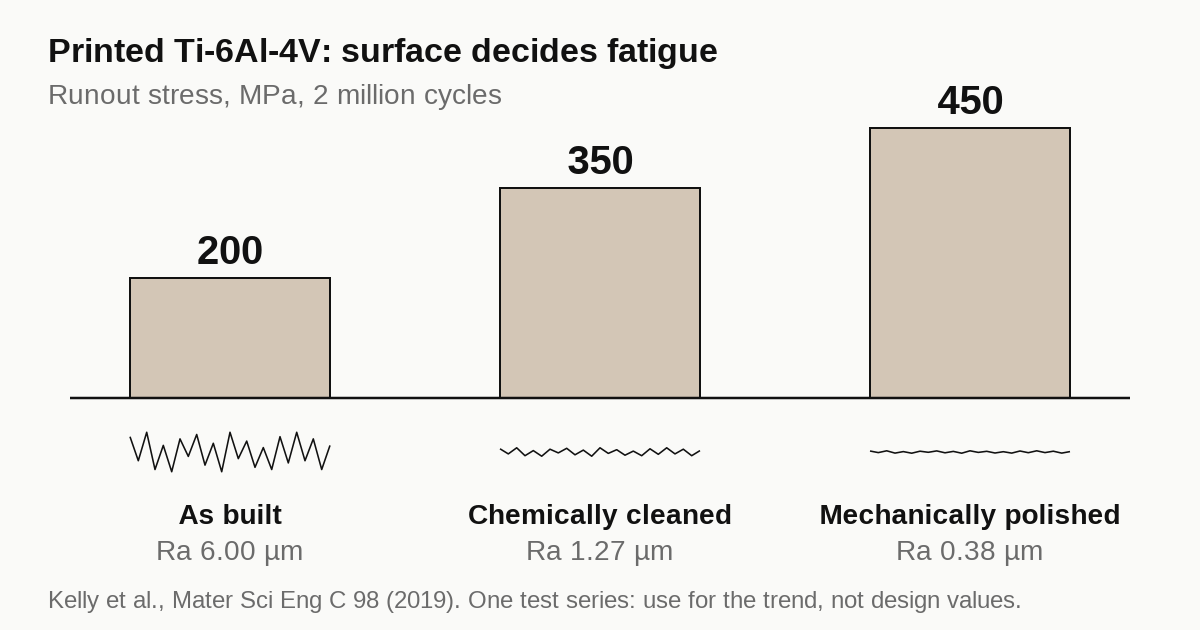
The mechanism is the one the authors describe: once internal porosity is reduced, rough surfaces become the main sites where fatigue cracks start, which is why mechanical and chemical surface treatments are commonly used on printed titanium. The test bars were small (3.2 mm thick) and built vertically, so a large part with a different build orientation will not behave identically. Use the figures for the trend, not as design values.
The practical consequence: a printed bracket that only carries static load can ship as built. A printed part with fatigue loading needs a finished surface, and on complex internal passages that is where printing gets hard, because a cutter or polishing medium cannot always reach inside.
Where printing pays and where it does not
Printing tends to win when:
- The machined blank has a very poor buy to fly. The scrap value guide treats ratios above about 10 to 1 as the point where waste becomes a real cost, and the buy to fly calculator tells you where your part sits.
- The part has internal cooling channels, lattice or consolidated assemblies a cutter cannot make.
- The quantity is low and the design is still changing, so a forging die or a long fixture is not justified.
Machining tends to win when:
- The part is prismatic, with flat faces, bores and threads. Printing then adds cost and still needs machining.
- The drawing carries tight tolerances or sealing surfaces. See the tolerance guide for what machining routinely holds.
- Fatigue is the design driver and the geometry allows a machined surface everywhere.
- The customer wants a conventional mill certificate and bar-based traceability without extra qualification work.
A hybrid is common. The part is printed to near net shape with extra stock on the datum faces, then HIP-ed and machined. It combines low waste with a machined interface. The shop that machines it needs to know the part is a printed blank, because supports, residual stress and distortion change the fixturing and the cut plan.
There is no public price survey comparing the two routes on the same part. Printing cost depends on build height, support volume, HIP, stress relief, finishing and inspection. Machining cost depends on buy to fly and cycle time, as the machining cost guide explains. The only reliable comparison is two quotes on one drawing.
Need a quote for this part? Get a titanium quote
Standards and qualification
ASTM F2924 covers Ti-6Al-4V made by full-melt powder bed fusion such as laser and electron beam melting. It sorts parts into three classes by feedstock, sets chemistry, microstructure and minimum tensile requirements, and allows supplementary requirements (S1 to S16) to be added to a purchase order. ASTM F3001 covers the ELI grade and includes requirements for hot isostatic pressing and certification. Both describe parts that are often, but not always, finished by machining, grinding, EDM or polishing.
Regulated sectors add their own rules. NASA-STD-6030 sets requirements for additively manufactured flight hardware, and the FDA’s 2017 guidance on additively manufactured medical devices sets out the testing and characterization it expects. Neither is a shortcut: qualification effort is part of the price of a printed part in these fields. We do not hold or claim any certification, and a printed part still needs a shop whose own quality system fits your sector. Ask the shop for its own evidence.
What to put in the RFQ
If you want a price on both routes, send one RFQ that says so.
- Tell the shop whether you will accept a printed blank, and in which grade (Ti-6Al-4V or ELI).
- Name the standard (ASTM F2924 or F3001) and the class, or the customer specification.
- Call out HIP and the heat treatment if you need them, and say which faces are fatigue critical.
- State Ra on those faces, and which faces are machined after printing.
- Ask what test coupons accompany the build and what the report contains.
- Ask for the quantity at which the price changes.
Send the model and drawing with the RFQ form and replies arrive within 24 business hours. The shops that answer will quote the machined route and tell you whether they machine printed blanks. If cost is the main question, the design-for-machining guide shows the drawing changes that lower a machined price before you compare.
For when printing is one lever among several, read our guide to how to reduce titanium machining cost.
Sources
- ASTM F2924-14(2021): Additive Manufacturing Titanium-6 Aluminum-4 Vanadium with Powder Bed Fusion
- Kelly et al., “The Effect of Surface Topography and Porosity on the Tensile Fatigue of 3D Printed Ti-6Al-4V Fabricated by Selective Laser Melting”, Materials Science and Engineering C, 2019
- Selective laser melting (Wikipedia): process, supports, build envelope
- NASA-STD-6030: Additive Manufacturing Requirements for Spaceflight Systems
- FDA: Technical Considerations for Additive Manufactured Medical Devices, 2017
Frequently asked questions
Is 3D printed titanium as strong as machined titanium?
Static strength can match wrought material after hot isostatic pressing, but fatigue depends on the surface. In one published test series the as-built surface carried 200 MPa to two million cycles, a polished surface 450 MPa. Printed parts that see cyclic load are usually machined or finished on the critical faces.
Do 3D printed titanium parts need machining?
Almost always on critical faces. The as-built surface is grainy, supports leave marks and tight tolerances or sealing faces are cut afterwards. ASTM F2924 itself notes that parts are often finished by machining, grinding, EDM or polishing.
Is 3D printing titanium cheaper than machining?
Only in certain cases. It wins when machining would turn most of a large block into chips or when the geometry cannot be cut at all. For simple prismatic parts, machining from bar is usually cheaper. No public price survey exists, so compare quotes for both routes on the same drawing.
What standard covers printed Ti-6Al-4V parts?
ASTM F2924 covers Ti-6Al-4V made by full-melt powder bed fusion, and ASTM F3001 covers the ELI grade. F2924 sorts parts into classes by feedstock and sets chemistry and tensile requirements, and buyers can add supplementary requirements to the purchase order.
Need a quote for this part?
Send the drawing. We send one itemised quote for the finished parts and reply within 24 business hours.
Get a titanium quote