Guides / Process
How Shops Cut Threads in Titanium Without Galling or Broken Taps
Threads are small features with a large effect on a titanium quote. They sit at the end of an operation list, after the part is nearly finished, so a failed thread scraps the whole part with all of its machining time in it. Titanium punishes threading in two ways. Cutting it is hard on taps and thread mills. Using it is hard on the threads themselves, because titanium on titanium galls.
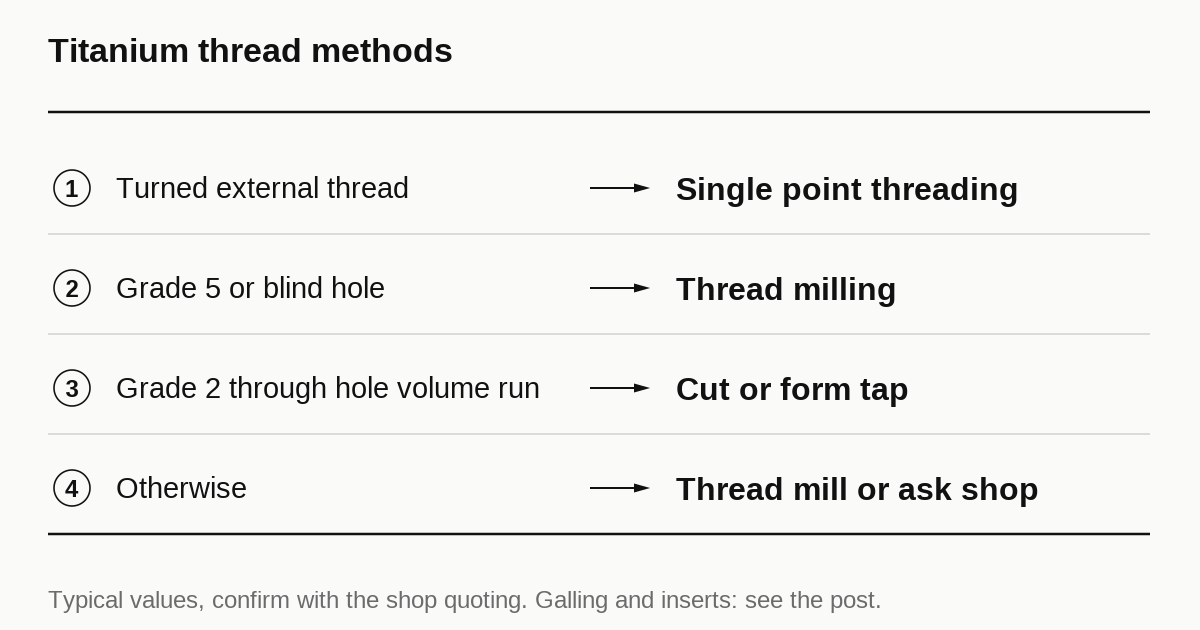
This guide covers the main thread methods, what each does well and badly, and what to put on a drawing and RFQ so the shop quotes the right process the first time.
Why titanium threads are difficult
The cutting side resembles any other titanium operation: heat stays at the edge, the material work hardens when a tool rubs and chips pack in small spaces. A tap fills a hole with chips that have nowhere to go, so a tap in titanium fails more often than a tap in steel.
The service side is galling. Under sliding pressure titanium welds to itself and to some other metals, and its protective oxide film wears through easily. A bolt turning into a tapped hole drags the thread flanks across each other, and material transfers from one to the other until the joint seizes. A seized titanium thread usually has to be drilled out.
Designers handle galling with materials and coatings. Shops handle the cutting with the right tool and process. Both belong on the drawing.
The main ways to make a thread
| Method | Best for | Typical limits |
|---|---|---|
| Cut tapping | Through holes, commercially pure grades, larger quantities | Chips pack in blind holes, tap breakage |
| Roll or form tapping | Grade 2 and similar soft grades, strong threads without chips | Needs correct hole size, harder in Grade 5 |
| Thread milling | Grade 5, blind holes, deep holes, large threads | Longer cycle than tapping, needs a machine that can interpolate |
| Single point threading on a lathe | External and internal turned threads | Several passes, depth reduced each pass |
| Thread insert (helical coil) | Wear-prone or repeatedly assembled joints | Extra part and hole size, drawing must call it out |
Many shops default to thread milling for Grade 5 because a thread mill cuts with a light, intermittent load. If the cutter breaks, it breaks as a small piece in an open thread, not wedged in the hole like a tap. The cycle is longer, but the scrap risk is lower. Taps still have a place on shallow holes in Grade 2 or on production runs where the tap life has been proven.
Cut tapping in titanium
When a shop does tap titanium, the usual measures are consistent:
- Spiral flute or spiral point taps, chosen so chips are pushed ahead of the tap in a through hole or pulled back in a blind hole.
- Reduced thread engagement. Tapping at around 65 to 75 percent engagement keeps torque down. The last few percent of thread height add little holding strength.
- Sharp, correctly coated taps from a tool maker that lists titanium on the data sheet.
- A generous drill depth in blind holes, so the tap does not bottom out in its own chips.
- Lubricant fitted to the job. Tapping paste or oil, applied to the tap and the hole, in the quantity the shop has proven.
- Counted tap life. Replacing taps on a set number of holes instead of when they break.
Even so, the thread depth in a blind hole decides the risk more than any tool setting. Three diameters of engagement is often plenty. Ten is a different job. Drilling titanium covers the hole itself, which has to be right before any thread goes in it.
Thread milling
A thread mill moves in a helix around the inside of a pre-drilled hole, or around the outside of a boss, and cuts the thread form in one or more passes. Because the tool is smaller than the thread, the cut is light, chips are small and coolant reaches the edge.
For a buyer, three points matter:
- The thread diameter and pitch can be adjusted by changing the programme, so a slightly oversize or undersize result is correctable without scrapping the part.
- A single cutter can make threads of several diameters at the same pitch.
- The cycle is longer than tapping, and that time shows in the quote when a part carries many threads.
Shops that thread mill regularly also tend to know the effect of climb direction and pass count on thread finish. Ask whether the shop thread mills Grade 5 as a standard process.
Need a quote for this part? Get a titanium quote
Single point threading on the lathe
External threads on turned parts, and internal threads in bores, are commonly cut with a single point insert over several passes, with the depth of each pass reduced as the thread form deepens. The principle is the same as other turning in titanium: sharp insert, steady feed, strong coolant delivery and no dwell. The titanium turning guide covers inserts and chip control for the same lathe.
Thread whirling is a common alternative on sliding-head machines for long, fine screws. Whether it is available is a question about the shop’s equipment, not a drawing requirement.
Specifying threads so they survive use
Several drawing decisions cut galling risk more than any shop skill.
Mate dissimilar materials where you can. A steel or nickel alloy fastener in a titanium tapped hole galls less than titanium in titanium. Check the galvanic and temperature consequences for your environment before choosing.
Use a surface treatment. Anodizing a titanium thread can reduce galling, and dry film lubricants are used on titanium fasteners. Dimension changes apply, so the thread class has to be defined before or after treatment. Titanium anodizing explains what the process does to dimensions.
Add inserts for repeated assembly. If a joint will be taken apart often, a helical thread insert in the titanium part moves the wear to a replaceable component.
Name the thread class and standard. Common choices are UN classes such as 2A and 2B for inch threads and tolerance classes such as 6g and 6H for ISO metric threads. A shop will confirm what it can hold and gauge.
Keep blind thread depth short. Give the thread a defined useful length and a relief, so the tool does not run to the bottom.
Common thread problems
| Problem | Likely cause | Fix a shop might use |
|---|---|---|
| Torn or rough flanks | Dull tool, chips recut, wrong hole size | Fresh tool, more coolant, correct pilot diameter |
| Oversize thread gauge result | Tool wear or climb pass error | Adjusted toolpath or offset |
| Broken tap in hole | Chip packing, engagement too high | Switch to thread milling, EDM removal if needed |
| Seized bolt at assembly | Galling | Dissimilar fastener, coating, anti-seize |
| Bell-mouthed thread entrance | Chamfer too small or tool wander | Lead-in chamfer on the hole |
What to ask on the quote
- Which method does the shop propose for each thread: tapping, thread milling or turning, and why?
- Does the shop treat Grade 5 threads differently from Grade 2 ones?
- What engagement does the quote assume, and does it meet the drawing’s thread class?
- How does the shop gauge threads: go and no-go gauges, thread plug gauges or measurement on a machine?
- What happens if a tap breaks: is the part replaced at the shop’s cost?
- Does any surface treatment come before or after threading, and does the thread class apply before or after it?
Add the thread callouts to the drawing before you send it, and attach it to the RFQ form. Replies arrive within 24 business hours. For how thread count and hole depth feed into the price, see titanium design for machining.
Frequently asked questions
Why do titanium threads gall?
Titanium tends to weld to itself and to other metals under sliding pressure, and its oxide film breaks easily. When a bolt turns in a tapped hole, the thread flanks can pick up material from each other and seize. Dissimilar fastener material, a dry film lubricant or an anodized surface reduce the risk.
Is thread milling better than tapping in titanium?
For Grade 5 and for blind or deep holes, many shops prefer thread milling. A broken thread mill is a small fix and the cutter works with a light radial load. Tapping is faster and common in commercially pure grades, but a broken tap in titanium is hard to remove and can scrap the part.
How much thread engagement does a tapped hole in titanium need?
Shops often tap titanium at a reduced thread engagement, commonly in the range of 65 to 75 percent, because the last few percent of engagement add little strength and a lot of tap torque. Check the drawing's thread class and any specification for engagement, and let the shop confirm what it can hold.
Need a quote for this part?
Send the drawing. We send one itemised quote for the finished parts and reply within 24 business hours.
Get a titanium quote