Guides / Finishing
Wear Coatings on Titanium: Nitriding, DLC and PVD Compared on Fatigue, Heat and Fit
For wear on titanium there is no single best coating, and the right one depends on what is failing. If the part slides and galls, a hard thin film such as TiN, CrN or DLC works, or a diffusion treatment such as nitriding. If the part sees cyclic loading, the coating can cost fatigue strength, and in one controlled study of Ti-6Al-4V the price ran from about 5.5% for DLC to about 50% for TiN. The rest of this guide shows where those numbers come from, what each process does to the part and what to write on the RFQ.
Why bare titanium needs help
Titanium wears and galls in sliding contact. The paper behind most of the numbers below says that titanium’s low shear resistance and the weak protection from its surface oxide restrict use of the base metal as received in friction applications, so a surface treatment is required. Wikipedia’s galling entry lists titanium among the metals prone to it, and names thin-film coatings such as titanium nitride and diamond-like carbon as ways to reduce it, along with lubricants, surface hardening and a different mating material. Our threading guide shows the same problem on threads, and the custom bolts guide covers it for fasteners.
The routes side by side
| Route | What it is | Typical layer | Process temperature | Source |
|---|---|---|---|---|
| PVD TiN | Hard ceramic film, gold colour, cathodic arc | about 4 µm, about 2500 HV | 450 °C | Costa et al. 2011 |
| PVD CrN | Hard ceramic film, cathodic arc | about 4 µm, about 2200 HV | 450 °C | Costa et al. 2011 |
| DLC (WC:H) | Tungsten carbide doped diamond-like carbon, thin Cr interlayer | about 2.4 µm, about 1200 HV | 180 °C | Costa et al. 2011 |
| Plasma nitriding | Nitrogen diffused in, nitride layer plus diffusion zone | 3.8 µm nitride layer, 10.4 µm diffusion zone | about 720 to 730 °C, 4 h | de Castro et al. 2019 |
| Gas nitriding | Furnace nitriding, compound layer plus case | 9.4 to 11.7 µm compound layer, 68 to 116 µm case | 854 °C, 10 h | Solar Atmospheres, Thermal Processing 2017 |
These are single studies on specific lots, with different tests and geometries, so compare them only as a map of what exists. They are not guaranteed values for your part. A coater’s own process data beats any table here.
What the fatigue test showed
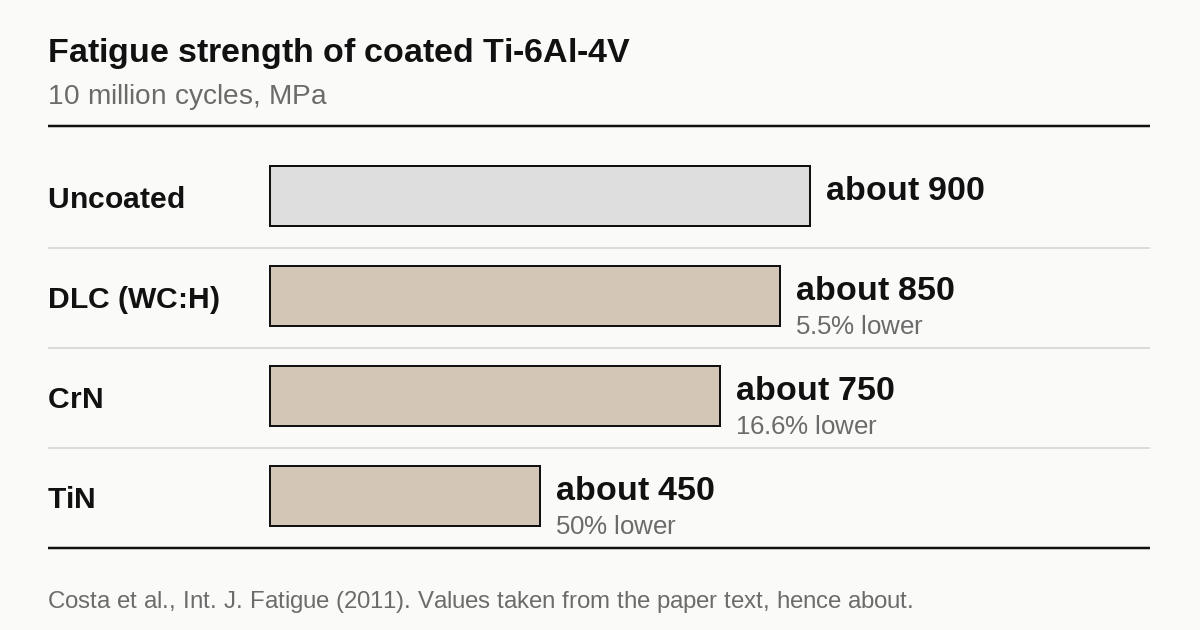
Costa and co-authors at UNESP in Brazil tested annealed Ti-6Al-4V (ultimate tensile strength 1270 MPa, ground surface Ra about 0.98 µm) in axial fatigue at R = 0.1, with the run-out set at 10 million cycles. The bare metal survived 900 MPa. Coated specimens did worse across the board. At 10 million cycles the paper reports a maximum stress reduction against the base metal of 16.6% for CrN, 50% for TiN and 5.5% for DLC, which puts the high-cycle strengths at about 750, 450 and 850 MPa. At 900 MPa the bare metal ran out while the TiN, CrN and DLC specimens failed at 19,212, 16,506 and 87,989 cycles.
The authors point to defects in the coating and to the crack path. Cracks started in the coating and ran into the base metal. They attribute the DLC result to fewer defects and to its chromium interlayer, which they say acted as a barrier to crack growth, and they note that cathodic arc evaporation ejects macroparticles that raise the defect count. Scratch testing at 70 N showed no delamination for any coating, and DLC cracked least. The same paper cites earlier work in which a thermal spray WC-Co-Cr coating on Ti-6Al-4V cut axial fatigue strength at 10 million cycles from 900 MPa to 400 MPa, so the worst coatings are not PVD ones.
Read it for the order, not the percentages. It is one process route, one alloy condition and one specimen shape. It does not cover nitrided or anodized titanium.
Nitriding, with the fatigue answer less clear
Nitriding diffuses nitrogen into the surface, so the hardened layer grows from the part itself instead of being added on top. A materials reference gives the titanium range as 650 to 1000 °C for 1 to 100 hours, against 490 to 530 °C for steel, and warns that oxygen from impurities in the process gas or from furnace leaks builds a brittle alpha phase at the surface.
Fatigue results for nitrided Ti-6Al-4V depend on parameters. In a 2019 plasma nitriding study (4 h at about 720 °C, nitride layer 3.77 ± 1.46 µm, diffusion layer 10.37 ± 2.58 µm), rotating bending at R = -1 gave longer lives for the nitrided specimens at higher stress, for example 35,000 against 6,700 cycles at 610 MPa. At lower stresses and long lives the nitrided and untreated specimens behaved similarly. The authors link that to rougher surfaces after nitriding (Ra 0.38 to 0.62 µm, up more than 50%) and note the study used one set of parameters.
A vacuum processor’s preliminary gas nitriding study on Ti-6Al-4V sheet (854 °C, 10 h, three nitrogen pressures) reports compound layers of 9.4 to 11.7 µm and case depths of 68 to 116 µm, with the highest oxide content (33%) in the layer formed at the lowest pressure. It measured no wear and no fatigue, and the authors call the work ongoing. Treat it as a view of layer structure, not a performance claim.
Need a quote for this part? Get a titanium quote
DLC and PVD, and what they cost in fit
Wikipedia gives DLC friction coefficients of 0.05 to 0.20 against polished steel and notes the internal stress that makes DLC hard also makes it hard to bond, which is why interlayers are used. On titanium, high-energy carbon impacts can form a carbide layer that bonds to the DLC. PVD is a vacuum process and mostly line of sight, so recesses and blind holes need fixture planning.
Dimensions: a film adds its thickness to every coated face. A 4 µm film adds about 8 µm to an outside diameter, which matters on a close fit and not at all on a loose one. PVD coatings in the study copied the substrate: TiN and CrN Ra measured about 1.06 and 1.08 µm on a substrate of 0.98 µm. Finish before you coat, because the film shows what is underneath. Our surface finish guide lists Ra values, and the anodizing guide covers the oxide-film alternative.
Process temperature and your heat treatment condition
Process heat can change the part. A supplier datasheet gives the age step for solution treated and aged Ti-6Al-4V bar as 975 to 1025 °F (about 525 to 550 °C), and the beta transus as 1825 ± 25 °F. A PVD cycle at 450 °C stays below the aging temperature, and a DLC cycle at 180 °C sits well under it. Nitriding at 720 °C or 854 °C goes above it. We found no source that says what that does to a given part, so ask the coater whether the temperature changes your condition, and whether distortion or sizing changes need an allowance. Heat in air also discolours titanium, as in our heat discoloration guide.
What to put on the RFQ
- The failure you are fixing. Sliding wear, galling, fretting or friction. Say which.
- Loading. If it sees cyclic load, state it and ask for fatigue data on the coating route.
- Coating or treatment and thickness, with the way thickness is measured and where.
- Surface finish before coating, and any polish after.
- Fits and masked areas, with thickness added per side.
- Heat treatment condition, and the maximum process temperature you allow.
- Adhesion and inspection, such as a scratch test or hardness check, if required.
- Certificates from the coater, plus the part certificates in the mill certificate guide.
Send the drawing through the RFQ form and we reply within 24 business hours with one itemised quote, made by a partner shop that cuts titanium. Which coaters a shop uses is for the shop to confirm.
Sources
- Costa et al., “Fatigue behavior of PVD coated Ti-6Al-4V alloy”, International Journal of Fatigue 33 (2011) 759-765
- de Castro et al., “The Effect of Plasma Nitriding on the Fatigue Behavior of the Ti-6Al-4V Alloy”, Materials 2019, 12(3):520
- Thermal Processing: Gas nitriding of titanium (Solar Atmospheres, March 2017) (vendor preliminary study)
- Total Materia: Gas Nitriding of Titanium Alloys, Part One (temperature and time ranges, oxygen risk)
- Galling (Wikipedia), Diamond-like carbon (Wikipedia) and Physical vapor deposition (Wikipedia)
- Rolled Alloys: 6Al-4V datasheet (STA aging temperature, beta transus)
Frequently asked questions
Which wear coating is best for Ti-6Al-4V?
It depends on what fails. For sliding wear and galling, TiN, CrN, DLC and nitriding all help. For fatigue-critical parts, one controlled study found DLC cost the least fatigue strength (about 5.5% at 10 million cycles) and TiN cost the most (about 50%). Nitriding results are mixed and depend on parameters.
Does a coating reduce the fatigue life of titanium?
In a test of PVD coated Ti-6Al-4V, every coating lowered fatigue strength against the bare metal. The size of the loss ranged from about 5.5% for a DLC coating to about 50% for TiN. Plasma nitriding extended life at high stress in another study but made no difference at high cycle counts.
Can you nitride titanium?
Yes, but at 650 to 1000 °C for 1 to 100 hours according to one materials reference, which is much hotter than PVD. Oxygen in the furnace gas builds a brittle layer. Ask the processor about atmosphere control and whether the temperature changes your heat treatment condition.
Is anodizing a wear coating for titanium?
Anodizing grows an oxide film from the part's own surface and is mainly chosen for colour and finish. It is a different film from nitride or DLC. Our anodizing guide explains Type II and Type III. If wear or fatigue matters, ask for test data on the route you pick.
Need a quote for this part?
Send the drawing. We send one itemised quote for the finished parts and reply within 24 business hours.
Get a titanium quote