Guides / Cost
Titanium Prototype Cost: Why Five Pieces Cost So Much Each and How to Read the Quote
Five titanium prototypes cost far more per piece than fifty because the shop does the same preparatory work for both orders and spreads it over fewer parts. That fixed block is programming, a fixture, a trial of cutting tools on the new geometry and a first-article inspection. Run time and bar cost scale with the number of parts, setup does not. So the price per piece falls steeply at first and then flattens, and the way to read a prototype quote is to find out where the fixed block ends and the per-part cost starts.
The formula behind every quote
Cost-modelling software documents the setup term plainly. In aPriori’s cost model guide, amortised batch setup is setup time multiplied by the sum of the labour rate and the direct overhead rate, divided by batch size. A manufacturing platform’s cost guide puts it in words: setup is “a fixed cost paid per batch, not per part.”
Written for a titanium job, in hours before any rate is applied:
Hours per part = setup hours ÷ quantity + run hours per part
Material and tool wear then sit on top, per part. The rest of this guide uses that shape.
What sits inside titanium setup
- Programming and proving the toolpath. A new part needs a program written, checked and run through at slow feeds the first time. Speeds and feeds on titanium leave less margin than on aluminium.
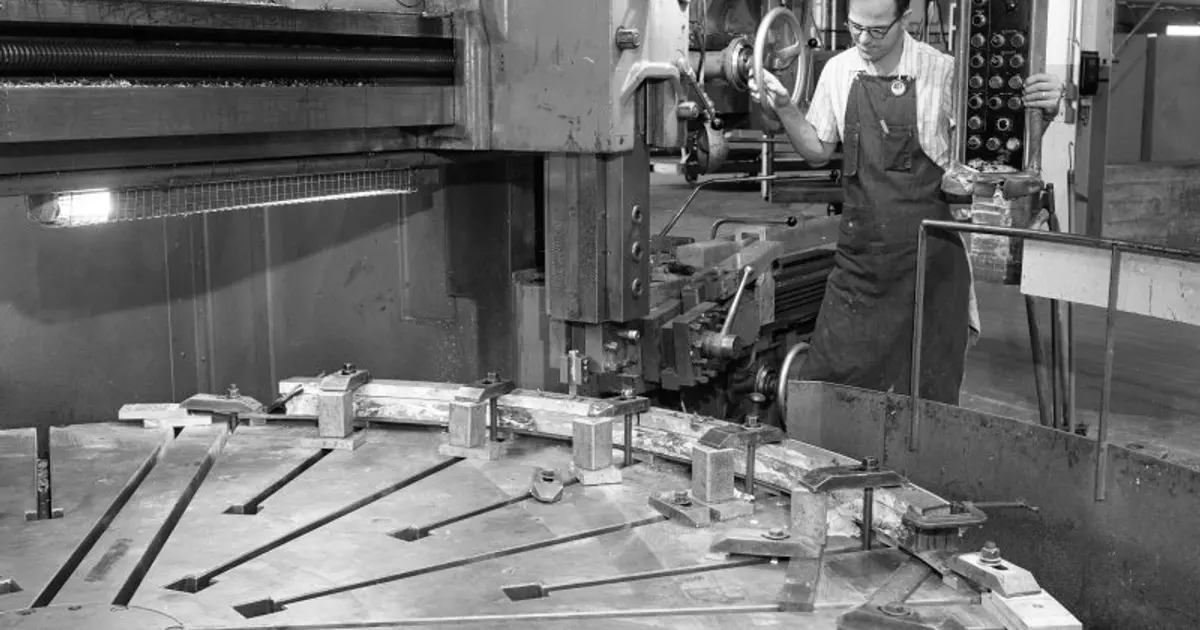
- Fixture. The fixture holds a part that is stiff enough to cut and soft enough not to crush. The photograph above, a 1963 archive picture titled titanium frames machining, shows a long frame, titled in the archive as titanium frames, held down by a row of clamps on a large table. Thin parts need more support, as in our thin wall guide.
- Tool trial. First cuts on a new geometry show where chips pack, where the tool deflects and where heat builds. The shop adjusts before the production feed is set.
- First-article inspection. The first piece is measured fully, for the drawing’s tight features, before the rest are cut.
- Material buying and paperwork. Standard bar may be on a shelf, but certificates and any special requirement are arranged per order. See stock forms and lead time.
Our guide to how shops quote titanium lists fixturing as one of the traps in a quote, because shops often treat it as an afterthought and then price it badly.
How much the break really is
The shape depends on the ratio of setup hours to run hours. This table is arithmetic on assumptions, not a price list. We do not hold verified setup hours for titanium work, and no public survey exists, so the ratios are labelled as assumptions.
| Setup hours as a multiple of run hours per part | 5 pieces as a share of the 50-piece total | Cost per part at 5 compared with at 50 |
|---|---|---|
| 5 | 18% | 1.8 times |
| 20 | 36% | 3.6 times |
| 50 | 55% | 5.5 times |
| 100 | 70% | 7.0 times |
Worked example, with setup of 20 hours and run time of 1 hour per part. One piece takes 21 hours in total. Five take 25 hours, or 5 hours per part. Fifty take 70 hours, or 1.4 hours per part.
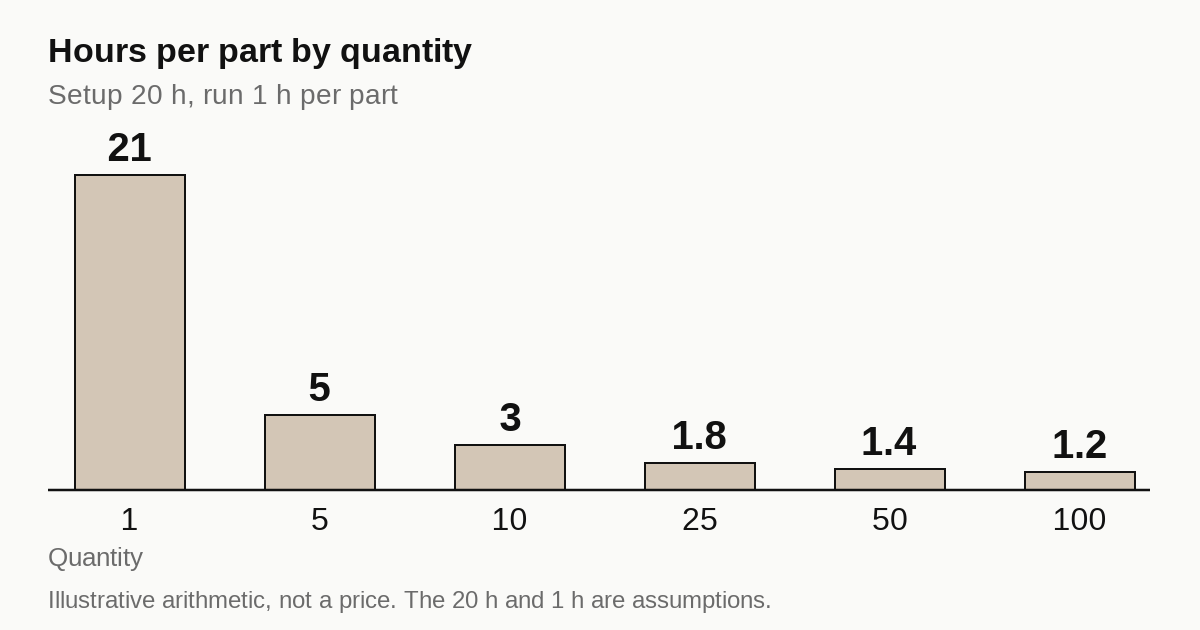
So the headline “five pieces cost nearly as much as fifty” is not true in total cost. In this example five pieces cost about 36% of fifty. It is true that a part at five costs between about two and seven times a part at fifty in the table above, and the multiple gets bigger the larger setup is against run time. A simple, quick-to-cut part has a setup that dwarfs its run time. A long titanium part with deep pockets has a large run time, so setup matters less.
What does not shrink with quantity
- Run time. Each part still takes its cycle, and titanium cycles are long because feeds and speeds are limited by heat. See titanium machining cost.
- Tool wear. A manufacturing platform’s own cost guide gives a tool wear or scrap charge of about €0.50 per part for hard alloys such as titanium against about €0.075 for aluminium. It is a vendor figure and directional, but it shows the idea: tool cost follows the number of parts cut.
- Material. Bar goes on every part, and most of it becomes chips. The buy to fly calculator shows the ratio for your shape. Our stock forms guide notes that a shop that knows a quantity is coming may buy a full bar instead of a cut length, so telling the shop what repeats can change the material line.
- Per-part inspection and certificates. Each piece still needs measuring, and each certificate is checked.
The same platform page says reducing setups from 4 to 2 can cut the per-part price by roughly 30 to 40%. Fewer setups means fewer fixtures and fewer opportunities to hold tolerance between faces, which is a design question for you and the shop. Our design for machining guide covers features that force extra setups.
Need a quote for this part? Get a titanium quote
How to ask for a fair prototype quote
- Ask for breaks. Request the same drawing at 1, 5, 25 and 50 pieces, as separate lines.
- Ask for the setup line separately. A quote that shows setup and run hours lets you see where the money goes. A single lump price hides it.
- Give a forecast. “5 now, 200 over the next year” changes what a shop will invest in a fixture or a proven program.
- Ask about credit or reuse. If production follows, can the fixture and program be credited or reused? Put it on the quote.
- Loosen tolerances on prototype-only features. Tight tolerance raises setup and inspection time. See what to put on a drawing.
- Weigh the alternative. For complex internal geometry a printed prototype may compete at five pieces, with a different fatigue profile. Our 3D printed versus machined guide covers the trade.
- Keep the lot together. Splitting five pieces into five orders pays the setup five times.
If you cannot tell whether a quote is fair, send the same drawing to more than one shop and compare the setup and run lines side by side. No public shop-rate survey exists for titanium prototypes, so the best benchmark is two or three quotes on the same drawing.
What to put on the RFQ
State the quantity breaks you want. State the forecast. State the material and condition. State the tolerance and finish for each critical feature, and mark the features that matter only for production. Send the drawing through the RFQ form and we reply within 24 business hours with one itemised quote, made by a partner shop that cuts titanium. The shop sets its own setup hours and price, and the comparison is yours to make.
For the other levers on a titanium quote beyond quantity, read our guide to how to reduce titanium machining cost.
Sources
- aPriori Cost Model Guide, Accounting Calculations (amortised batch setup formula)
- MakerVerse, How Are CNC Manufacturing Costs Calculated (vendor page, figures directional)
- Arithmetic in the table and chart: ours, from the formula above, with stated assumptions
Frequently asked questions
Why is a titanium prototype so expensive per piece?
Setup is charged once per batch: programming, fixture, tool trial and first-article inspection. With five parts, each part carries a fifth of that fixed block. With fifty it carries a fiftieth. Run time, tool wear and bar do not shrink the same way. The quote's setup line shows how much of the price is fixed.
How much cheaper is each part at 50 than at 5?
It depends on how large setup is against run time. In our illustrative model, with setup 20 times the run hours per part, a part at 50 costs about 28% of a part at 5. If setup were only 5 times run time, the saving would be about 45%. Ask the shop for the breaks on your own drawing instead of guessing.
Should I order more prototypes than I need?
Sometimes. If the extra parts have a use, such as test pieces, spares or a pre-production lot, the added cost per piece is only the run hours, material and tool wear. Do not order spares as a bargain if they will sit on a shelf, because titanium bar is a major cost on every piece.
Can I get the fixture or program credited to production?
Ask in writing when you place the prototype order. Some shops will credit or reuse a fixture and proven program when the production order follows. It is a commercial agreement with the shop, not a standard term, so put the quantity forecast and any credit on the quote.
Need a quote for this part?
Send the drawing. We send one itemised quote for the finished parts and reply within 24 business hours.
Get a titanium quote