Guides / Process
Annealed or STA: How Heat Treatment Changes Titanium Machining
An RFQ says “Ti-6Al-4V, STA”. The quote comes back higher than the same part in annealed bar, with a longer lead time and a question about when the heat treatment happens. All three follow from the same fact: solution treated and aged titanium is a different working condition from annealed titanium, and the order of operations changes both the price and the risk.
This guide explains what the two conditions are, what each does to cutting, and how to decide where heat treatment sits in the sequence.
Annealed and STA in plain terms
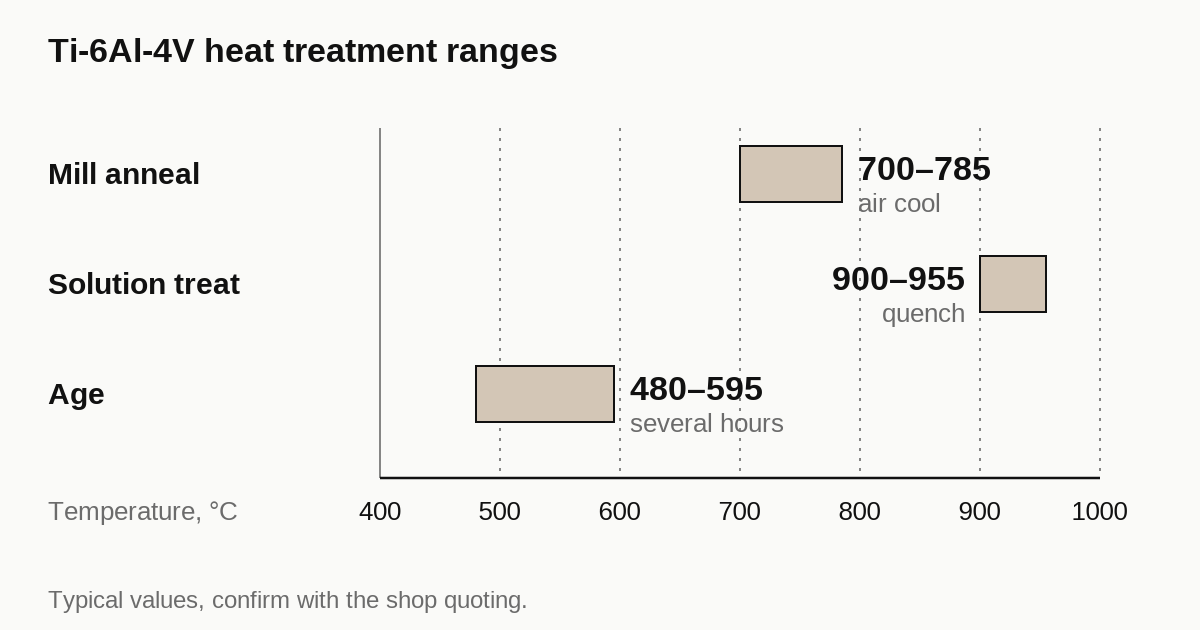
Annealed. Ti-6Al-4V is usually supplied mill annealed. The metal is held at roughly 700 to 785 C and cooled in air. That produces a stable, ductile microstructure with a typical tensile strength near 900 to 1,000 MPa. Most titanium machining quotes assume this condition.
Solution treated and aged (STA). Two steps. First, the metal is heated to roughly 900 to 955 C, held and quenched, usually in water. That locks in a fine structure. Then it is aged at roughly 480 to 595 C for several hours, which precipitates strengthening particles. The result is higher strength, typically around 1,100 MPa and above, with lower ductility.
| Item | Annealed | STA |
|---|---|---|
| Typical tensile strength | around 900 to 1,000 MPa | around 1,100 MPa and above |
| Typical hardness | around 32 HRC | around 38 HRC |
| Ductility | Higher | Lower |
| Cutting speed | The baseline | Typically lower |
| Tool wear | High | Higher |
| Distortion risk in heat treatment | None | Real, from the quench |
| Depth of effect | Full section | Limited, see below |
Temperatures, times and hardness depend on the specification and the heat treater, and these figures are typical, not promises. The specification on your drawing names the cycle, and AMS 2801 is commonly called out for titanium heat treatment. The heat treater and the shop will confirm what applies.
Why STA cuts harder
The aged particles block dislocation movement, which is what raises the strength. They also resist the cutting tool. The same properties that make titanium hard on tools in annealed condition, low thermal conductivity and high strength at temperature, get more pronounced.
In practice shops typically lower surface speed from the annealed baseline and plan for shorter insert life. Heat concentrates at the edge, so coolant delivery matters more. The numbers in titanium speeds and feeds are annealed Ti-6Al-4V starting points, and the tooling and coolant guide explains how to adjust the setup as strength rises.
Work hardening also matters. A tool that rubs instead of cutting hardens the surface further, as the work hardening guide describes.
The depth problem
Ti-6Al-4V has low hardenability. The quench cools the outside quickly and the centre slowly, and the alloy only strengthens fully where the cooling is fast enough. A commonly quoted limit for through hardening is a section around 25 mm. Thicker sections reach full strength near the surface and lower strength inside.
Two consequences follow.
- A thick part may not reach STA strength through the section. If the drawing needs minimum properties at the centre, check the specification and the section size with the heat treater before quoting.
- Rough machining first can help. Removing material before heat treatment reduces the section the quench has to cool, and moves the useful strength closer to the finished surface.
Some alloys harden much deeper. Beta alloys are the example, and the beta titanium guide covers them.
Where heat treatment goes in the sequence
There are three common routes.
Rough, heat treat, finish. Most stock removal happens in the annealed condition, the part goes to heat treatment with machining allowance left, then finish machining brings it to size. This is the usual route for parts with tight tolerances. The shop cuts the bulk in softer metal and removes any distortion and surface effects at the end.
Heat treat the bar, then machine. The material arrives in STA condition and every cut is in the hard state. Simple logistics and no distortion step, and it works for small parts or light stock removal. Tool cost is higher.
Machine to size, then heat treat. Only for parts that tolerate size change or have loose tolerances. A quench can warp thin or complex parts, and the shop cannot recut after.
Thin walls and long slender parts are the high-risk cases. The advice in titanium thin wall parts applies, and a shop may propose fixtures during heat treatment or extra stock to cut away afterward.
Surface effects after heat treatment
High temperature in air grows an oxygen rich surface layer called alpha case. It is brittle and has to be removed. Vacuum or inert atmosphere furnaces reduce it, and a finishing cut or chemical removal handles what remains. See titanium welding and alpha case for what it is and how shops check for it.
If the part has no finish machining step after heat treatment, ask the shop how it will deal with the surface. The surface finish guide lists the options.
The quench also has timing limits. Specifications restrict how long a part can take to move from the furnace to the quench tank, and the limit tightens for thin sections. A heat treater who holds the relevant approvals knows the figures for your specification. Ask who does the heat treatment, because a shop often sends it out.
Need a quote for this part? Get a titanium quote
Cost and lead time
STA adds cost in four places.
- The heat treatment itself, which a shop usually buys from an outside processor.
- Transport and queue time, because the part leaves the shop twice in the rough, treat, finish route.
- Harder cutting, if any machining happens after treatment.
- Verification, including hardness checks, tensile coupons and records.
Lead time rises by the length of the outside process queue. The cost guide shows where those items enter the total.
Checking the result
Heat treatment is verified, not assumed. The usual checks are simple, and they belong in the quote.
- Hardness testing. A hardness reading on the finished part or on a test piece shows whether the treatment worked. It is quick and cheap, and it does not replace a tensile test where the specification requires one.
- Tensile coupons. Some specifications require a test bar to go through the furnace with the parts and be pulled afterward. That adds cost and time, and it provides the strongest evidence.
- Furnace records. Time and temperature charts show the cycle ran as specified. Ask for them where the drawing requires traceability.
- Surface checks. Visual inspection for scale and discolouration, and a check for alpha case if the specification asks for one.
If a part fails, the cause is usually one of three things: the quench was too slow, the section was too thick for the alloy or the ageing cycle drifted. The heat treater can usually tell which from the records, and a shop that keeps them can resolve the question quickly.
When STA is not worth it
Some parts get specified in STA by habit. Before you pay for it, check whether the design needs the strength. Many parts in annealed Ti-6Al-4V carry their loads with margin, and annealed material is cheaper, quicker and easier to cut. Ask the designer or the drawing owner whether the STA callout comes from a calculation or from a template. If it comes from a calculation, keep it. If not, a shop may be able to quote both conditions side by side so you can see the difference.
What to put on the RFQ
- Alloy and specification: Ti-6Al-4V and the specification for the starting material.
- Heat treatment condition: annealed or STA, with the heat treatment specification and revision.
- Required properties: minimum strength or hardness, and where on the part it applies.
- Sequence: whether you expect machining before or after treatment, or want the shop to propose it.
- Section size: the thickest section, because depth of hardening depends on it.
- Verification: hardness testing, tensile coupons and records you need.
- Surface requirement: alpha case limits or removal, and the inspection method.
- Certificates: heat treatment record plus mill certificate. See the mill certificates guide.
Send the drawing and the points above through the RFQ form and shops that cut titanium will reply within 24 business hours. The grade reference shows which grades respond to heat treatment and which do not.
Frequently asked questions
What does solution treated and aged mean for titanium?
It is a two step heat treatment. The part is heated to a high temperature in the alpha beta range and quenched, then aged at a lower temperature for several hours. For Ti-6Al-4V it raises strength above the annealed condition.
Is STA titanium harder to machine than annealed?
Yes, typically. Hardness and strength go up, so shops run lower surface speeds and see faster tool wear. Many shops rough machine annealed material and heat treat before finish machining.
Does heat treatment work on thick titanium sections?
Only to a limited depth for Ti-6Al-4V. The alloy has low hardenability, so the centre of a thick section does not reach the same strength as the surface. A common rule of thumb is around 25 mm, and the shop or heat treater will confirm for your section.
Should titanium be machined before or after solution treating and aging?
For tight tolerances the usual route is rough machining in the annealed condition, heat treatment with machining allowance left, then finish machining to size. That removes distortion and surface effects at the end. Machining to size before heat treatment only suits parts that tolerate size change, because a quench can warp thin or complex parts.
What section size limits STA on Ti-6Al-4V?
Ti-6Al-4V has low hardenability, and a commonly quoted limit for through hardening is a section around 25 mm. Thicker sections reach full strength near the surface and lower strength at the centre, so check the specification and the section size with the heat treater before quoting.
Need a quote for this part?
Send the drawing. We send one itemised quote for the finished parts and reply within 24 business hours.
Get a titanium quote