Guides / Finishing
Heat Discoloration on Machined Titanium: What the Colour Tells You and What to Do About It
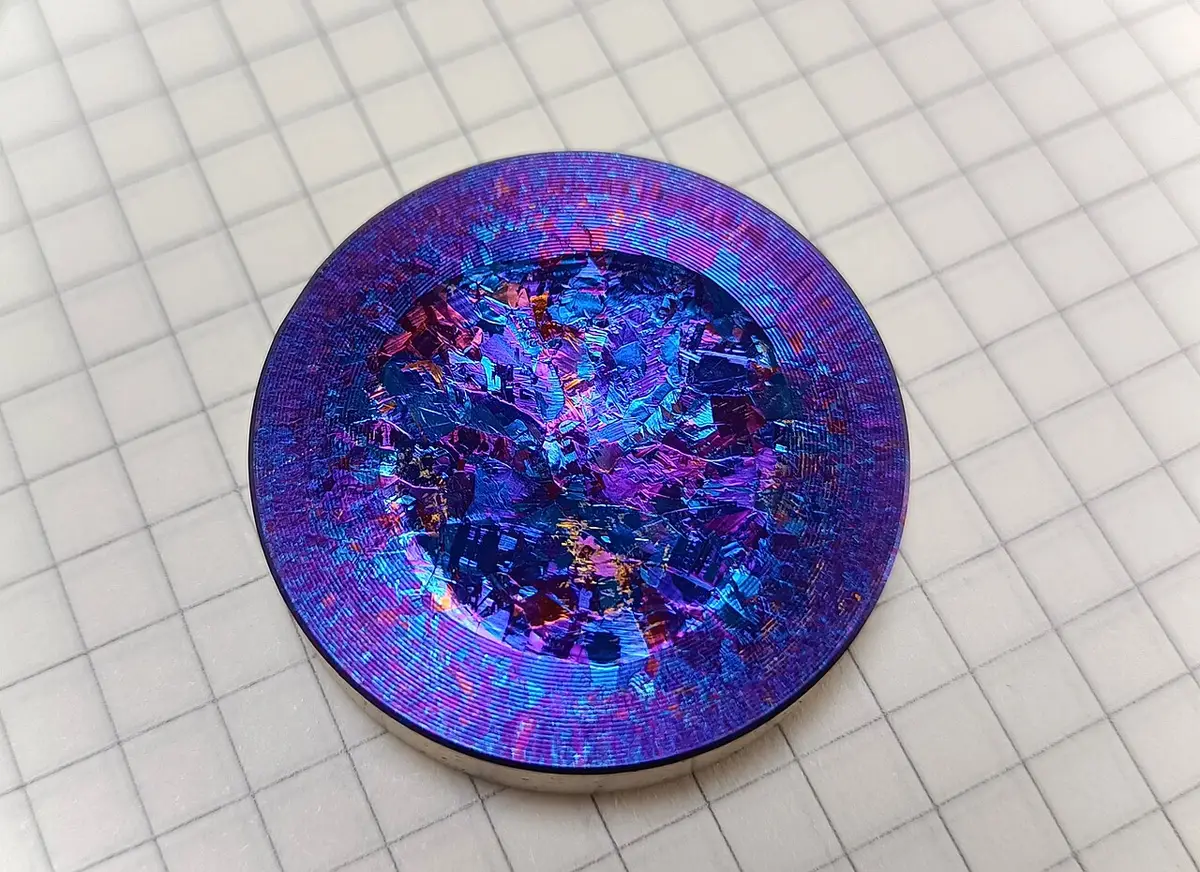
Discoloured titanium after machining means the surface got hot in air and grew a thin oxide film. The colour tells you the film is there and roughly how thick it has become. It does not tell you how deep any damage goes. For a cosmetic part you decide if you can live with it or polish it off. For a fatigue-critical part you treat any tint as a reason to test, and you clear it by removal and a hardness or metallographic check, not by eye.
Why titanium turns straw, purple and blue
The colours are not pigments. Heating titanium in air grows a transparent titanium dioxide layer, and light reflecting from the top of the layer and from the metal beneath recombines, reinforcing some wavelengths and cancelling others. A jewellery reference describes the sequence as the oxide gets thicker: gold or straw, bronze, purple, blue, cyan and green, then grey or silver-white once the film is too thick for coherent interference.
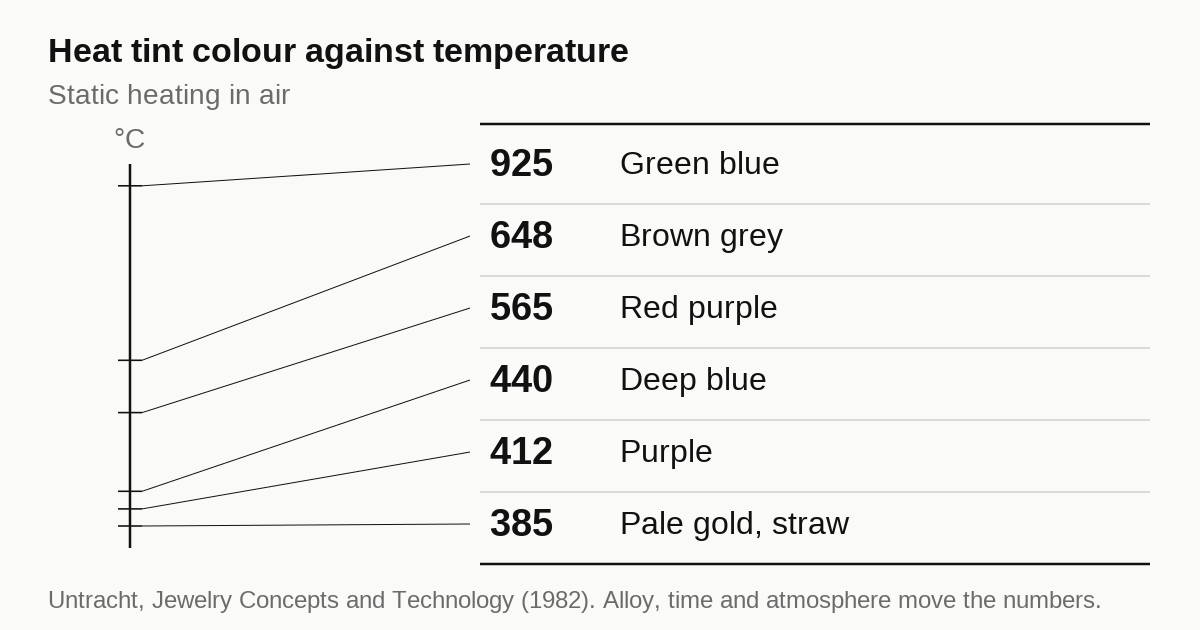
A commonly quoted temperature list gives 385 °C for pale gold, 412 °C for purple, 440 °C for deep blue, 565 °C for red-purple, 648 °C for brown-grey and 925 °C for green-blue. It comes from a jewellery text (Untracht, 1982) cited on a finishing forum, and it describes titanium heated evenly in air. Treat it as a rough guide for two reasons. The jewellery reference itself says the temperatures vary with alloy, surface finish and atmosphere, and that dwell time matters because the film grows only while the metal is hot. A cutting edge heats a spot for a moment under coolant, so the same colour does not mean the same temperature.
Where the heat comes from
The cut. A study of high-speed cutting of Ti-6Al-4V (Materials, 2025) says heat builds in the cut zone as mechanical energy turns to thermal energy, and that the alloy’s poor thermal conductivity keeps it there. Typical Ti-6Al-4V conductivity is 6.7 to 7.5 W/(m K). At high temperature the titanium reacts with oxygen from the air, and the authors report aluminium has a stronger effect on oxide thickness than vanadium. In their tests, cutting at 150 m/min gave a metamorphic layer of about 0.31 µm and cutting at 450 m/min gave about 0.714 µm. Once the oxide gets thick enough, cutting force can make it spall. A worn tool, a dry cut, a missed coolant nozzle and a pause where the tool rubs instead of cutting all raise heat at the surface.
Heat treatment and stress relief in air. A supplier datasheet lists annealing at 1000 to 1200 °F (about 540 to 650 °C) for stress relief and mill anneal at 1300 to 1450 °F (about 700 to 790 °C), both well inside the range where oxide grows. Wikipedia notes that processing at very deep vacuum can minimize or avoid alpha case. Ask where and in what atmosphere any thermal step happens.
Welding and rework. Weld colours follow the shielding and are judged under the weld specification on the drawing. Our welding and alpha case guide covers them. Weld colour rules are for welds and do not carry over to a machined face.
Tint versus alpha case
Alpha case is an oxygen-rich surface layer that forms on titanium exposed to heated air or oxygen. Wikipedia describes it as hard and brittle, forming microcracks that degrade fatigue properties, and says machining or chemical milling is the standard removal method. It is invisible. A tint is the visible sign that the surface passed through oxidising temperatures. A part can be tinted with no measurable alpha case, and a part can carry alpha case with a faint tint.
One titanium machining vendor’s blog (a commercial source, and several of its figures are uncited) states that alpha case forms when titanium is heated above about 600 °C in an oxidising atmosphere. It gives 5 to 25 µm as typical machined depth and 50 to 200 µm for heat-treat induced depth, and says the cut zone can peak at 700 to 900 °C briefly. The same source reports microhardness near 450 HV or higher in alpha case against 320 to 350 HV in the base metal, and typical aerospace depth limits under 10 to 25 µm. Use these as directional only, and read the limit off your own specification.
| What you see | What it suggests | What to do |
|---|---|---|
| Faint straw on a non-visible face | Light heat, thin film | Agree on a tolerated level on the drawing, or pickle |
| Blue or purple on a cut face | Hotter surface | Find the cause, then remove and check |
| Grey or flaky white film | Thick oxide, possible spalling | Treat as nonconforming. Remove and test |
| No colour, but tool was dull or coolant was off | Heat may not show | Test the part if fatigue critical |
| Tint only after a later heat step | Thermal operation in air | Review that process, not the machining |
Need a quote for this part? Get a titanium quote
How to remove it
ASTM B600 is a guide for descaling and cleaning titanium. It covers removal of shop soils, oxides and heat treatment scale. Mechanical methods can remove hot work scale, salt bath conditioning may be needed to remove an oxygen-contaminated layer after chemical milling, and acid etching may be needed for an oxygen-contaminated layer or alpha case. Our pickling and chemical milling guide explains what each step removes and the dimensional effect. Two cautions:
- Remove below the layer. Clearing the colour is not the same as clearing the oxygen-rich layer under it. For a critical part the check afterwards is hardness or a metallographic section.
- Allow for the metal you remove. The vendor blog above reports chemical milling removing 50 to 150 µm per side. That changes a tight dimension, so tell the shop at quote time if you want it on the finished part.
How to prevent it
Prevention is cheaper than removal, and most of it is the shop’s cutting practice. Ask about:
- Tool wear limits. A dull tool rubs and heats the surface. See the tooling and coolant guide.
- Cutting speed. Heat rises with speed. The speeds and feeds guide shows what shops typically run.
- Coolant delivery. The vendor blog says coolant below 70 bar made alpha case depth unpredictable and uses 120 to 200 bar in its example. Ask what pressure the shop uses and whether it reaches the cut.
- Work hardening. Interrupted cuts and dwell raise heat and hardness. See the work hardening guide.
- Deburring heat. Hand grinding and polishing can tint an edge. See the deburring guide.
What to write on the drawing
State the finish requirement as a measurable thing instead of the word “clean”. For example: no visible oxide colour on surfaces A and B, or tint up to light straw permitted on non-visible faces, plus the check required for functional parts, such as microhardness traverse or a section at a stated location. For cosmetic parts, send a boundary sample. We found no universal colour acceptance limit for machined titanium, and the limits that exist in weld specifications are for welds. Send the drawing with those lines through the RFQ form and we reply within 24 business hours with one itemised quote, made by a partner shop that cuts titanium.
Sources
- SkyJems: Heat coloured titanium (encyclopedia) (interference mechanism, colour sequence, caveats)
- finishing.com thread: titanium heat colours (temperature list citing Untracht, 1982)
- Analysis of High-Speed Cutting Surface Layer Formation and Oxide Layer Thickness Prediction of Ti6Al4V, Materials 2025, 18(13):3160
- Alpha case (Wikipedia) and Ti-6Al-4V (Wikipedia)
- ASTM B600: Guide for Descaling and Cleaning Titanium and Titanium Alloy Surfaces (scope)
- Rolled Alloys: 6Al-4V datasheet (anneal and stress relief temperatures)
- Boze Titanium Manufacturing Center blog: alpha case and surface integrity (vendor blog, directional only)
Frequently asked questions
Why does titanium change colour when machined?
Heat grows a thin transparent oxide film on the surface, and light reflecting from the top and bottom of that film interferes to give straw, purple, blue and other colours. Thicker oxide moves the colour along the sequence. The colour shows that the surface got hot in air, not how deep any damage goes.
Is blue titanium after machining a defect?
It can be, depending on the drawing. It is a cosmetic defect on a visible face and a warning on a fatigue-critical part, because heating above about 600 °C in air can form alpha case, a hard brittle oxygen-rich layer. No colour alone proves or rules out alpha case. Hardness testing or a metallographic section does.
How do you remove discolouration from titanium?
ASTM B600 is a guide for descaling and cleaning titanium. Light oxide can be removed mechanically or by pickling, and an oxygen-contaminated layer or alpha case needs acid etching, chemical milling or machining. Remove enough to get below the layer and check the part afterwards.
Can titanium discolouration be prevented during machining?
Largely, by keeping the cut cool: sharp tools, moderate cutting speed and coolant delivered to the cut zone. Ti-6Al-4V conducts heat poorly, so heat stays near the edge. Ask the shop how it controls tool wear and coolant, and record the tint level you accept on the drawing.
Need a quote for this part?
Send the drawing. We send one itemised quote for the finished parts and reply within 24 business hours.
Get a titanium quote