Guides / Grades
How Do You Choose a Titanium Grade for a Machined Part? A Decision Path From Requirement to Drawing Line
Choose a titanium grade by starting from the requirement, not from a grade name. If corrosion is the only reason for titanium, Grade 2 is the usual answer. If the part carries load and weight matters, look at Grade 5, which is Ti-6Al-4V. If the design needs toughness or an implant standard asks for it, Grade 23. If the part is formed, welded or cut from tube, a commercially pure (CP) grade or Grade 9. Above about 400 °C go to a near-alpha alloy such as Ti-6242, and for the strongest thick sections look at beta alloys. This guide is for design engineers and buyers who have to write a grade on a drawing, and it ends with the lines that go on the drawing and the RFQ.
We own no machines, we name no shop and we approve no grade: the drawing owner and the governing standard decide. After you send a drawing we send one itemised quote for the finished parts. Figures are typical specification minimums as printed by distributors and their datasheets. The ASTM and SAE texts are paywalled and we did not read them.
Last reviewed: October 2026. Specification editions and figures were checked that month; confirm the edition on your own drawing before you rely on them.
- Start with the requirement
- Titanium or another metal
- The grades in one table
- Commercially pure or Ti-6Al-4V
- The CP grades 1 to 4
- ELI and damage tolerance
- Tube and the middle grade
- Corrosion grades
- Beta alloys
- High temperature alloys
- Grades for regulated and process industries
- Grades for consumer and performance parts
- Approving a substitution
- What to write on the drawing and the RFQ
Start with the requirement
Most wrong grades come from picking Grade 5 by habit and checking the requirement afterwards. Reverse the order. Write down what the part has to survive: a load, a temperature, a fluid, a forming or welding step, a standard. Each answer narrows the field before any price enters.
| The requirement | Look first at | Why |
|---|---|---|
| Corrosion is the reason, load is mild | Grade 2 | CP grades resist corrosion about equally; Grade 2 is the easiest to cut and buy |
| Hot chloride in a crevice, or reducing acid | Grade 7 or Grade 12 | Palladium, or nickel and molybdenum, keep the surface passive |
| Load and weight both matter | Grade 5 (Ti-6Al-4V) | Minimum tensile 895 MPa against 345 MPa for Grade 2 |
| Toughness, damage tolerance or an implant standard | Grade 23 (Ti-6Al-4V ELI) | Tighter oxygen and iron limits |
| Formed, welded or cut from tube | A CP grade, or Grade 9 | Cold formable and weldable; Grade 9 is made mostly as tube |
| Hot, above about 400 °C for long periods | Near-alpha alloys such as Ti-6242 | Ti-6Al-4V runs out of temperature |
| Highest strength in a thick section | Beta alloys such as Ti-5553 | Deep hardening, with a heat treatment sequence in the quote |
The table is a first filter, not a design check. Minimums come from the Rolled Alloys and Corrosion Materials tables, temperatures from the sources in the high temperature section.
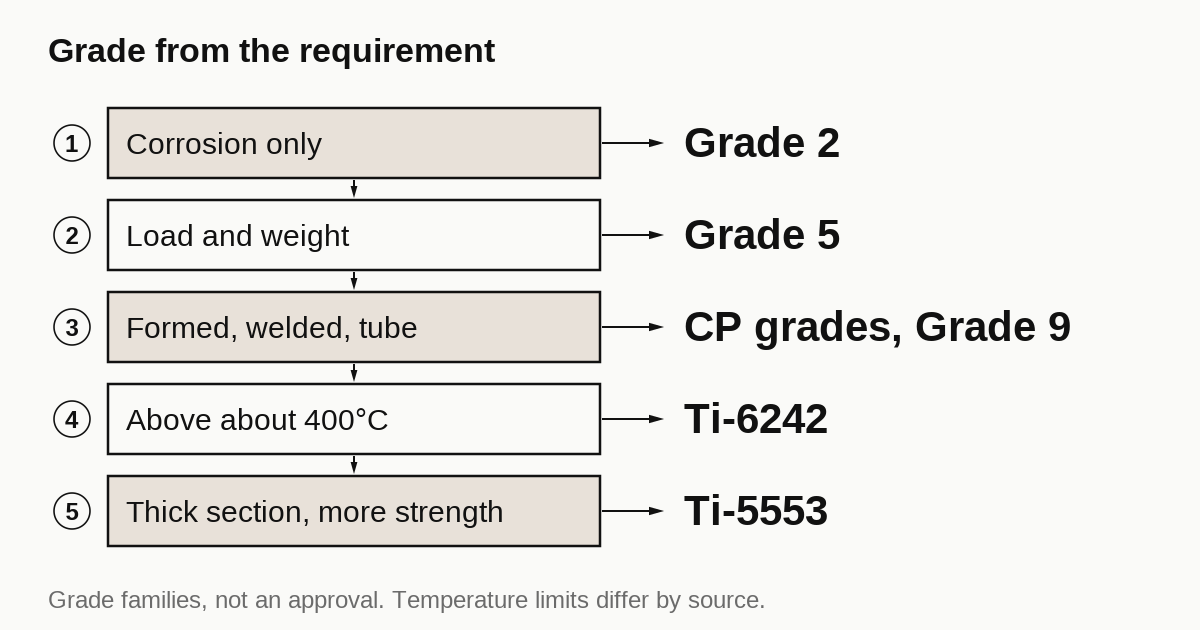
If more than one row applies, the stricter row usually wins, and the grade then has to be available in the form you need. The rest of this guide takes each branch in turn, then covers other metals, industry standards and what to do when a shop proposes a swap.
Read more: the grade reference lists UNS, Werkstoff and JIS numbers for the common grades, with unverified cells marked as such.
Titanium or another metal
Before the grade, check that titanium is the metal. Four neighbours come up often, and each has a guide of its own.
| Alternative | Pick it over titanium when | Number to hold on to |
|---|---|---|
| 6061 or 7075 aluminium | The part is dry, cool and bolted, and cost matters | Aluminium alloys lose strength fast above roughly 150 °C; titanium keeps working to around 400 °C |
| 316L stainless | Stiffness, threads or cost drive the design and no chloride crevice exists | Titanium is about 44 percent lighter; 316L can pit in warm seawater |
| Inconel | Service is hotter than the near-alpha titanium limit | Nickel alloys hold the hottest compressor stages at nearly twice the weight (Leyens, DLR) |
| 4140 or 4340 alloy steel | The part is a tension tie, a wear surface or a dry-environment bracket | Heat treated 4340 at 260 ksi is about 1,790 MPa against 895 MPa minimum for annealed Ti-6Al-4V |
The aluminium, stainless and temperature figures come from our own guides and the sources cited there; the steel figure from aircraftmaterials.com and Rolled Alloys.
The alloy steel case is the least obvious. Per unit of mass, stiffness along a rod is almost identical: about 25.7 for Ti-6Al-4V against 25.5 for steel, in GPa per g/cm3. Tensile strength per kilo is close once the titanium is aged. The advantage appears in a plate or bracket limited by deflection, where titanium reaches the same bending stiffness at roughly 68 percent of the steel mass if the section can thicken. By our calculation, a tension tie sized by strength saves little or nothing. Corrosion is where titanium wins outright, because it needs no coating in seawater.
Read more: titanium vs aluminium, titanium vs stainless steel, titanium vs Inconel and titanium vs alloy steel.
The grades in one table
Eight grades cover almost every machined part. ASTM B348 lists far more, Grades 1 to 41 as annealed bar and billet, and the grades below are the ones our guides treat as stocked or a single mill order. We found no public stock data by grade.
| Grade | Family | Max O | Max Fe | Min tensile | Min yield | Min elongation |
|---|---|---|---|---|---|---|
| 1 | CP | 0.18 | 0.20 | 240 MPa (35 ksi) | 138 MPa (20 ksi) | 24 percent |
| 2 | CP | 0.25 | 0.30 | 345 MPa (50 ksi) | 275 MPa (40 ksi) | 20 percent |
| 3 | CP | 0.35 | 0.30 | 450 MPa (65 ksi) | 380 MPa (55 ksi) | 18 percent |
| 4 | CP | 0.40 | 0.50 | 550 MPa (80 ksi) | 483 MPa (70 ksi) | 15 percent |
| 5 | Alpha-beta | 0.20 | 0.40 | 895 MPa (130 ksi) | 828 MPa (120 ksi) | 10 percent |
| 7 | CP plus Pd | 0.25 | 0.30 | 345 MPa (50 ksi) | 275 MPa (40 ksi) | 20 percent |
| 9 | Near-alpha | 0.15 | 0.25 | 620 MPa (90 ksi) | 483 MPa (70 ksi) | 15 percent |
| 12 | CP plus Mo, Ni | 0.25 | 0.30 | 483 MPa (70 ksi) | 345 MPa (50 ksi) | 18 percent |
| 23 | Alpha-beta ELI | 0.13 | 0.25 | 828 MPa (120 ksi) | 759 MPa (110 ksi) | 10 percent |
Oxygen and iron in weight percent. Source: Rolled Alloys grade table, which lists minimums per ASTM B348. Two cells in that table contradict its own text (Grade 4 oxygen and Grade 5 yield); we used 0.40 for Grade 4 oxygen as Makino’s chemistry table does, and 120 ksi for Grade 5 yield as the Rolled Alloys Ti-6Al-4V datasheet does for annealed plate. The Corrosion Materials CP datasheet gives chemistry for Grade 2 only. FW Metals and Makino (“170 to 310”) list the Grade 1 yield minimum as 170 MPa, and our Grade 4 guide uses “around 170 MPa”; Rolled Alloys and Corrosion Materials print 20 ksi (138 MPa), which is the figure used here. We did not read the ASTM text, so the edition on your drawing governs. A mill certificate for a real heat normally reads above these minimums.
Two things the table cannot show. First, the product form decides the standard: bar and billet fall under ASTM B348, plate and sheet under ASTM B265, and forgings and tube have their own. Second, a grade in the table is not an approval to buy: your drawing may fix a specification above it, as the regulated industries section explains.
Read more: titanium grades chart, the nine grades shops machine in one page, with what each is for.
Commercially pure or Ti-6Al-4V
This is the decision that moves the price more than most geometry choices. Grade 2 has a minimum tensile strength of 345 MPa and a minimum yield of 275 MPa. Grade 5 is specified at 895 and 828. So Grade 2 gives 39 percent of the tensile minimum and 33 percent of the yield minimum, by our arithmetic. Density is nearly the same: about 4.51 g/cm3 for Grade 2 (Corrosion Materials lists 0.163 lb/in3, and our older guides use 4.51) against 4.43 for Grade 5. Makino’s table lists Grade 2 at 4.55; the difference does not change the point, so Grade 5 saves weight only by allowing thinner sections, not by being a lighter metal.
What Grade 5 costs on the machine is well documented. Makino lists the thermal conductivity of Grade 2 at 16.4 W/m K against 6.7 for Ti-6Al-4V, about 2.4 times higher, which sends more heat into the chip. In Makino’s test a 20 mm end mill reached 60 minutes of tool life at 50 m/min in Ti-6Al-4V and at 145 m/min in Grade 2. That is one tool maker’s test on its own cutter, so read it as directional. Our older guides quote a typical production figure of around 80 m/min for Grade 2 and around 50 m/min for Grade 5.
Grade 5 can also be heat treated. The Rolled Alloys datasheet gives typical bar tensile strength of 138 to 155 ksi annealed and 150 to 172 ksi solution treated and aged. The CP grades cannot be strengthened that way.
The rule that follows: use Grade 2 when corrosion is the reason for titanium, when the part welds or forms or when the load case was never checked against Grade 5. Use Grade 5 when the part is structural, when weight is the point or when fatigue life matters in a thin section. A line on the RFQ describing the service lets a shop say when the cheaper grade would do.
Read more: Grade 2 vs Grade 5 titanium, including a decision table by part.
The CP grades 1 to 4
All four CP grades are the same metal with the oxygen limit raised in steps: 0.18, 0.25, 0.35 and 0.40 percent maximum, with iron rising alongside. That is why strength steps up from 240 to 550 MPa minimum tensile while corrosion behaviour stays similar. Corrosion Materials states that corrosion resistance is similar across the four.
- Grade 1 is the most formable and the weakest. Choose it when the part is formed after machining.
- Grade 2 is the default for corrosion service, welds under inert shielding and is the CP grade shops find most easily.
- Grade 3 is specified rarely. If your drawing names it, a specification or pressure code probably asked.
- Grade 4 is the strongest CP grade. It needs no heat treatment cycle, welds and forms within limits and is the CP grade our Grade 4 guide ties to ASTM F67 for implants such as dental parts. Its minimum tensile strength is 61 percent of Grade 5, so it does not replace Grade 5 where the load is high.
To choose within the family, read the yield minimum against the stress and add the designer’s margin. A required yield of 400 MPa, for example, is cleared by Grade 4 (483 MPa) and by none of the lower CP grades. We found no public stock-position data by grade; in our guides Grade 2 is usually on the shelf and Grades 3 and 4 are sometimes a mill order.
Read more: CP titanium grades 1, 2, 3 and 4 compared and Grade 4 titanium against Grade 5.
ELI and damage tolerance
Grade 23 is Grade 5 with the interstitial elements held down: oxygen at 0.13 percent maximum against 0.20 for Grade 5, and iron at 0.25 against 0.40. The cost of tighter limits is a little strength, with a minimum tensile of 828 MPa against 895 in the distributor tables. Our older Grade 23 guide gives about 860 MPa; the site’s Grade 23 reference page ties about 860 MPa to ASTM F136 implant bar and 828 MPa to ASTM B348 bar. This guide uses 828 MPa because the tables we cite are B348, so use the figure in the standard your drawing names. What the tighter limits buy is fracture toughness, ductility and better behaviour at cryogenic temperature.
Grade 23 is specified in three places: surgical implants, where, per our medical parts guide, ASTM F136 and ISO 5832-3 name it; cryogenic service; and subsea or offshore parts where a fracture case has to be made. Outside those, it is usually the wrong call, because you pay for toughness you do not use from a smaller stock pool.
The price gap is not about machining. Cutting data are the same as Grade 5. The cost sits in stock, in the heavier testing behind an implant certificate and in traceability inside the shop, because the heat number has to follow every blank cut from the bar. Grade 5 and Grade 23 bar look identical, so a shop needs segregated storage and a marking routine, not just a certificate.
An ISO 13485 shop is a question you ask when the device file demands it, not something we hold, and not a measure of titanium cutting skill. Ask about the two separately.
Read more: Grade 23 ELI titanium, with the traceability chain step by step.
Tube and the middle grade
Grade 9 is Ti-3Al-2.5V, sometimes called half six four. It is near-alpha, so it behaves more like the CP grades than like Grade 5: it welds readily, cold forms and does not strengthen by heat treatment. Its minimum tensile strength of 620 MPa sits between Grade 2 at 345 and Grade 5 at 895.
Most Grade 9 is made as tube. That sets the market: aircraft hydraulic and fuel lines, bicycle frames and sports tubing. Bar exists, but our Grade 9 guide says many sizes are a mill order, and a machined part in Grade 9 is quoted against whatever stock the shop can find. If nothing forces Grade 9, a shop will usually propose Grade 2 or Grade 5 because they are easier to buy.
Grade 9 is the right choice when a machined end fitting must weld to Grade 9 tube without a dissimilar joint or when stress analysis was run on this alloy. It is the wrong choice when the part needs Grade 5 strength, when it is a solid block or thick plate or when the grade appeared on the drawing by inheritance. Thin wall tube also brings its own machining questions, because clamping pressure ovals the bore and the cut chatters on a thin wall.
Read more: Grade 9 titanium, Ti-3Al-2.5V, including what the RFQ needs about stock form.
Corrosion grades
Grade 2 resists most seawater and oxidising service. It can fail in two situations: crevice corrosion under a gasket, a bolt head or a deposit in hot chloride, and hot reducing acids. Our corrosion guide cites a commonly quoted threshold of brine above roughly 70 °C for Grade 2, though pH and crevice geometry move it.
Grade 7 is Grade 2 with palladium added, up to 0.25 percent per Rolled Alloys, which keeps the surface passive in conditions that break Grade 2 down. Its mechanical properties match Grade 2. Grade 12 adds 0.60 to 0.90 percent nickel and 0.20 to 0.40 percent molybdenum, per Rolled Alloys, and its minimum strength is higher: 483 MPa tensile and 345 yield against 345 and 275 for Grade 2. That sometimes allows a thinner wall.
The practical limit is stock. Both grades are priced above Grade 2, and our corrosion guide says that in most sizes they are a mill order with a minimum heat. A design change sometimes removes the need: a welded joint or a different gasket costs less than a more expensive grade. Ask the process engineer or the plant’s materials group which grade the service needs, and give shops the fluid, pH, temperature and crevice details.
Keep the surface clean on process parts. Iron smeared from steel tooling can seed corrosion later, so ask how the shop keeps steel and titanium apart and whether it pickles afterwards.
Read more: Grade 7 and Grade 12 titanium for corrosion resistant parts.
Need a quote for this part? Get a titanium quote
Beta alloys
Beta alloys such as Ti-5553 and Beta C hold the beta crystal structure at room temperature through alloying with molybdenum, vanadium and chromium. Ageing then precipitates fine alpha particles inside the beta matrix, which gives the strength. Two properties matter to a buyer: they harden deep into thick sections, where Ti-6Al-4V only hardens through a thin one, and aged beta alloys can reach strengths above heat treated Ti-6Al-4V.
ASTM B348 lists Beta C as Grade 19. Ti-5553 has no ASTM grade number, so it is called out by an aerospace or customer specification, and the certificate follows that document. Stock is mainly forgings, with lead times that our beta guide says run to months more often than weeks.
The machining sequence is part of the quote. Cutting most of the stock in the solution treated condition, ageing and then finishing is cheaper in the cut but adds a heat treatment step and a finishing allowance for movement. Cutting aged from the start is simpler but harder on tools. Agree the sequence with the shop before it quotes, and for a first order consider a first article under agreed conditions so both sides have data. Do not let a shop price a beta alloy at Ti-6Al-4V rates.
Read more: Beta titanium machining, Ti-5553 and Beta C.
High temperature alloys
Ti-6Al-4V runs out of temperature earlier than most buyers expect. Leyens (DLR, 2004) gives about 315 °C as the limit for fan blades and disks, and a distributor datasheet from Rolled Alloys gives service through 750 °F, about 400 °C, for the annealed alloy. Above that, drawings move to near-alpha alloys. An ASM Alloy Digest abstract on TIMETAL 6-2-4-2 describes Ti-6242 as for long-term use to 538 °C, and a distributor datasheet says Ti-6246 retains strength to 450 °C. Leyens puts the ceiling for near-alpha alloys at about 540 °C and says oxidation and alpha case set it, not strength. Past that, nickel alloys take the hottest stages at nearly twice the weight.
These alloys are called out by SAE AMS numbers: AMS 4975 covers Ti-6242 bars, wire and rings, AMS 4976 covers its forgings and AMS 4981 covers Ti-6246 bars and forgings, all in the solution and precipitation heat treated condition. We did not read those texts. Expect a smaller stock pool and a quote that states the heat treatment sequence and the alpha case allowance.
Parts for gas turbine engines and aircraft can fall under export control in the country of origin. Classify the part and the drawing first. This is not legal advice, and we do not accept RFQs for controlled defence articles.
Read more: high temperature titanium alloys, Ti-6242, Ti-6246 and where Ti-6Al-4V stops.
Grades for regulated and process industries
Where a standard or a process fixes the grade, your job is to name it exactly, not to choose it.
- Implants. Per our medical parts guide, load-bearing implants usually call Grade 23 under ASTM F136 or ISO 5832-3, and CP Grade 2 or Grade 4 under ASTM F67 appears on dental and some surgical parts. An implant standard is not an industrial one, and no shop should offer to substitute. Instruments are often cut from Grade 5 to ASTM B348. We do not claim any certification, and we make no FDA claim.
- Aerospace. Ti-6Al-4V bar per AMS 4928 (annealed) is a smaller stock pool than Grade 5 to ASTM B348, and the certificate must match. Say “AMS 4928”, not just “Grade 5”. Some aerospace and defence parts are subject to export control; say so at the start. This is not legal advice, and we do not accept RFQs for controlled defence articles.
- Marine. Grade 2 for plate, tube and low load hardware, Grade 5 for fasteners and fittings that carry load, Grade 23 where a flaw tolerance case exists; Grade 7 or Grade 12 in hot crevice-prone service. Crevices under gaskets and in threads are the real limit, and galvanic pairs matter.
- Vacuum and cryogenic. Grade 2 is the grade a 2021 NIST chamber study measured for low outgassing; Grade 23 or Grade 9 are the structural candidates when the part must stay tough when cold. Cleanliness matters more than the grade.
- Semiconductor. CP grades dominate where strength is modest, and Grade 5 appears in small structural sections. If a customer limits specific elements, state the limit on the RFQ and ask for certificate chemistry.
- Electrolyzers. The bipolar plates are the CNC job and commercially pure grades are the likely candidates, with ASTM B265 for plate. The designer sets the grade.
Read more: Ti-6Al-7Nb vs Ti-6Al-4V for medical parts, titanium aerospace parts, titanium medical parts, titanium marine parts, titanium vacuum and cryogenic components, titanium semiconductor parts and titanium electrolyzer parts. The applications reference shows how these sectors compare.
Grades for consumer and performance parts
Consumer and racing parts pick grades for weight, feel and finish, and the grade still goes on the drawing.
- Bikes. Frame tubing is usually Grade 9. Dropouts and brake mounts are Grade 5 or Grade 9; stems and bolts are Grade 5; small hardware is Grade 2 or Grade 5 depending on load. Threads are where the money goes.
- Motorsport. Grade 5 for fasteners, brackets and uprights, billet or forged. Exhaust tube and manifold sections in CP grades or Ti-3Al-2.5V. Beta alloys for springs and clips in some cases. Fatigue is the failure mode.
- Eyewear. Grade 2 or Ti-6Al-4V for hinges and screws, Grade 2 or a beta alloy for bridges and nose pad arms. CP grades carry no added nickel, which is why they are chosen for skin contact.
- Watch cases. Grade 2 is softer at around 150 to 200 HV and Grade 5 is harder at around 300 to 350 HV, per our watch case guide. Grade 5 holds a brushed finish better and costs more to cut.
- Phone and wearable frames. Usually Grade 5, machined from bar or a forged blank. Cosmetic standard on the visible faces drives the quote more than the metal does.
Read more: titanium bike parts, titanium motorsport parts, titanium eyewear parts, titanium watch cases and titanium phone frames.
Approving a substitution
A shop’s quote may offer a different grade, another specification or a different condition. Treat it as a design change and run this checklist before you say yes.
- Is the material line fixed by a customer, a standard or an approved source? If so, the answer is no.
- Compare the strength minimums. Grade 2 for Grade 5 gives 39 percent of the tensile minimum; Grade 4 gives 61; Grade 9 gives 69; Grade 23 gives 93. Any drop needs the designer’s stress check.
- Compare chemistry limits and the specification. Same alloy under a different specification still changes the certificate.
- Name who must approve: the drawing owner and, where the part goes into a customer’s product, that customer. One aerospace supplier document we read says no material substitutions are allowed unless it approves them.
- Choose the paper route: a revised drawing with a new revision letter for a permanent change, a deviation reference for a one-off.
- Ask whether a first article, full or partial, applies. The same document requires one when materials change.
- Check that the certificate, the marking and the packing list name the approved line and its approval reference.
We found no public figure for the cost of a substitution. Ask for stock price, machining hours, certificates and inspection as separate quote lines.
Read more: approving a titanium grade substitution, with a copyable RFQ line and a red flag list.
What to write on the drawing and the RFQ
A complete material note names the alloy, the specification with its revision, the condition and the form. Two examples:
Material: Ti-6Al-4V, ASTM B348 Grade 5, annealed bar.
Material: Grade 2 titanium, ASTM B348, annealed bar. Certificate with heat number.
Then add what lets a shop quote and advise:
- Grade and standard, and the edition if your customer fixes one.
- Form and size: bar diameter, plate thickness or tube size, and whether you supply it.
- Condition: annealed, solution treated and aged, or cold worked.
- Service: load, temperature, fluid and whether the part is welded or formed, so a shop can say when a cheaper grade would do.
- Certificates: EN 10204 type 3.1 with the heat number is the usual request.
- Substitution rule: quote as drawn, list alternatives as separate options, no change without written approval.
If you cannot choose the grade yet, the RFQ form has a “Not sure yet” option. Describe the service in the part description box and let shops advise, then settle the grade yourself before the order. Send the drawing through the RFQ form and we reply within 24 business hours with one itemised quote.
Read more: the specification index covers the standards named on this page in more detail.
Sources
- ASTM B348/B348M-25, scope, grade list and H grades
- Rolled Alloys, titanium grades and relative properties (chemistry limits and minimum properties per ASTM B348)
- Corrosion Materials, titanium Grades 1 to 4 datasheet (CP chemistry, minimums, corrosion similarity)
- Rolled Alloys, 6Al-4V titanium datasheet (service temperature, annealed and aged bar tensile ranges)
- Makino, Machining Titanium Part 3, 2021 (density, thermal conductivity, Grade 2 against Ti-6Al-4V test)
- Leyens, DLR, ICAS 2004 (Ti-6Al-4V and near-alpha temperature limits, alpha case, nickel at nearly twice the weight)
- ASM Alloy Digest, TIMETAL 6-2-4-2 (long-term use to 538 °C)
- SAE AMS 4975P listing and SAE AMS 4981 listing
- aircraftmaterials.com, E4340 (260 ksi hardened condition)
- MatWeb, AISI 4340 steel (density and modulus)
- GKN Aerospace, first article inspection requirements, revision A, 2022 (material substitution approval, partial first article)
Frequently asked questions
How do I choose a titanium grade for a machined part?
Start from the requirement, not the grade name. Corrosion only points to Grade 2. Load with weight pressure points to Grade 5. Toughness or an implant standard points to Grade 23. Formed, welded or tube parts point to a CP grade or Grade 9. Heat above about 400 °C points to a near-alpha alloy. Then check stock and the standard.
Should I use Grade 2 or Grade 5 titanium?
Grade 2 if corrosion is the reason for titanium and the load is mild. Grade 5 if the part carries load and weight matters. The minimum tensile strength is 345 MPa against 895 MPa, so the swap changes what the part can carry. Grade 2 also cuts faster and the bar usually costs less.
When do I need Grade 23 instead of Grade 5?
When an implant standard such as ASTM F136 names it, or when the design needs the toughness that tighter oxygen and iron limits give, as in some cryogenic and subsea parts. On the machine it cuts like Grade 5. The extra cost is in stock, certification and heat number traceability.
What titanium grade is best for seawater?
Grade 2 is the usual answer for plate, tube and low load parts. Grade 5 is common for fasteners and fittings that carry load. Crevices under gaskets and in threads are the real limit, and in hot chloride service Grade 7 or Grade 12 may be needed. The process designer decides.
Is titanium better than alloy steel for strength?
Not always. Heat treated 4340 steel at 260 ksi has about the same tensile strength per kilo as aged Ti-6Al-4V and more than annealed Ti-6Al-4V. Titanium wins on corrosion and on bending stiffness per kilo. For a tension tie sized by strength it saves little or nothing.
Can a shop change the titanium grade I specified?
Not without the written approval of the drawing owner. A shop can propose a cheaper grade or another specification as a priced option, but a change in grade, specification, condition or form is a design decision. The certificate and the shipped parts must match the approved line.
Need a quote for this part?
Send the drawing. We send one itemised quote for the finished parts and reply within 24 business hours.
Get a titanium quote