Guides / Cost
How Do You Reduce the Cost of a Machined Titanium Part? The Levers, in the Order to Pull Them
Reduce titanium machining cost by working down the quote lines in the order they are largest on your drawing: the blank (size and form), the design features that add passes and setups, the tolerances and finish that are tighter than the part needs, the batch size and release rules and the terms around the quote. Material and machine time are the two big lines and both are settled before anyone quotes. This guide is for buyers and designers holding a titanium quote that is too high, and it ends with the changes to put on a revised RFQ.
We own no machines, we name no shop and we do not set the price of the work: after you send a drawing we send one itemised quote for the finished parts. The figures below carry their source and date. Worked examples are arithmetic on stated assumptions and are not prices.
Last reviewed: October 2026. Figures carry the date they were checked; confirm tariffs, surcharges and contract terms with your broker or lawyer before you rely on them.
- The levers in one table
- Where the price comes from
- Size the blank
- Choose the stock form and the lead time
- Change the blank: forging or bar
- Change the design
- Print instead of machine
- Quantity: prototypes, batches and releases
- Market price and how long a quote holds
- What the chips are worth
- Compare quotes line by line
- When a part is rejected
- What to put on the revised RFQ
The levers in one table
We found no public ranking of titanium cost levers by the saving they give, and the order below is our judgement from how a quote is built. Your drawing may reorder it. What does not change is the principle: the cheap changes happen before the quote, on the drawing.
| Lever | What it changes | Who pulls it | When |
|---|---|---|---|
| Grade | Bar price, cutting speed, strength | Design owner | Before the drawing is released; our guide to titanium grade selection covers the decision |
| Blank size and form | Material mass bought, chips made | Buyer and shop | Before the RFQ |
| Forging or bar | Material and roughing time against die cost | Buyer and shop | When the annual quantity is known |
| Design and tolerances | Cycle time, setups, inspection | Designer | Before the RFQ |
| Printing | Waste against surface and fatigue | Designer and shop | When geometry or buy to fly points to it |
| Quantity and releases | Setup share, repeat setups | Buyer | At the RFQ and in the contract |
| Quote terms and timing | Price risk, validity, surcharges | Buyer | At the quote |
| Quality terms | Remake risk, claim period | Buyer | At the PO |
Each row has its own section below, with a link to the post that goes deeper.
Where the price comes from
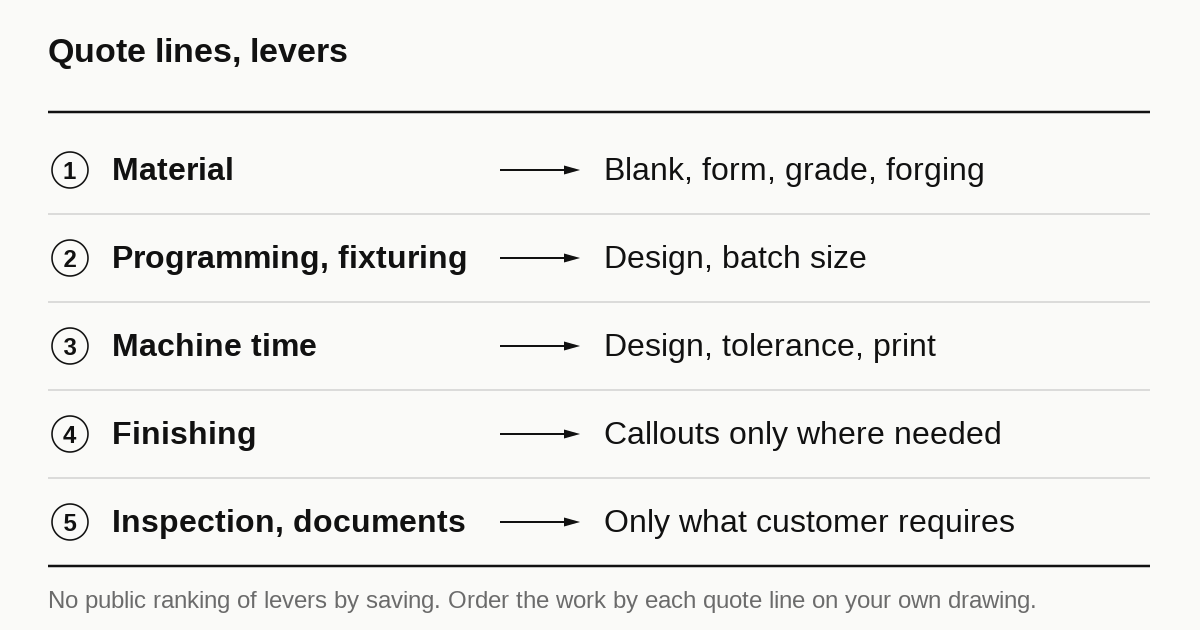
A titanium quote has five lines. The bar costs more per kilogram than aluminium and much of it becomes chips. The machine runs slower because titanium keeps heat in the cutting zone, and our machining cost guide quotes typical carbide surface speeds of around 50 metres per minute for Grade 5 against around 300 and up for aluminium 6061, framed as starting points and not shop promises. Tools wear faster. Thin parts need fixturing. Tolerance, inspection and paperwork add hours.
| Quote line | What drives it | The lever |
|---|---|---|
| Material | Stock size priced, grade, buy to fly | Blank size, form, grade, forging |
| Programming and fixturing | Geometry, number of setups | Design, batch size |
| Machine time per part | Cycle time, cutting data | Design, tolerance, print |
| Outside finishing | Process, lot size | Finish callouts only where needed |
| Inspection and documents | Tolerance count, certificates | Ask for what the customer requires |
When a quote looks high, do not ask for a discount. Ask the shop to split it into the five lines and to state the stock size it priced. Each line has a different fix, which is the point of the table.
Read more: titanium machining cost, where the money goes.
Size the blank
The bar is the first line to check. Bar comes in steps, so a finished diameter that is a little too large for one size jumps to the next. In our worked example, a 48 mm turned part cuts from 50.8 mm (2 inch) hot-worked bar. A 50 mm part may not clean up from the same bar, because that bar can run as small as 50.4 mm and carries an out-of-round allowance of up to 0.58 mm, so it needs 63.5 mm bar, and the mass of bar per length rises 56 percent for a 2 mm change on the drawing.
| Finished diameter | Bar that fits | Smallest actual diameter | Bar mass for a 64 mm slug |
|---|---|---|---|
| 48 mm | 50.8 mm hot-worked | 50.4 mm | about 0.57 kg |
| 50 mm | 63.5 mm hot-worked | 63.5 mm | about 0.90 kg |
Tolerances are from a supplier’s reproduction of the ASTM B348 hot-worked round table, and we did not read the standard itself. Mass is our arithmetic at 4.43 g/cm3, the density this site’s calculator uses for Ti-6Al-4V. A general CNC guide from Protolabs Network says 0.3 to 1.5 mm is removed from each side of a blank, up to 3 mm in total. That is a vendor page, not titanium specific. The buy to fly calculator on this site takes the bounding box and an allowance per face and returns the stock mass and the ratio. Ask the shop which size it priced, and for a quote on the next size up as an option.
Read more: how to size a titanium blank, with six steps, a tolerance table and the offcut question.
Choose the stock form and the lead time
The form you start from decides how much you pay for and how much you throw away. Round bar suits turned parts, plate suits flat and prismatic parts and tube suits hollow cylinders. Our stock forms guide sorts forms into those usually on a distributor’s shelf, those worth asking about early and those that are a mill order, and says that on titanium parts the lead time is frequently the bar and not the machine. We found no public survey of titanium stock lead times, so the ranges in that guide are practice, not statistics: ask the shop for a date and what it assumes.
Three practical moves follow. Say whether the stock form is negotiable, so a shop that has plate can quote plate. Say whether the size is negotiable, so a size on the shelf can replace one on a mill order. Say whether the part repeats, because a shop that knows an annual quantity may buy whole bars. The certificate matters here too: material on the shelf may not carry the certificate your drawing names, so it is not yet your material.
Read more: titanium stock forms and lead time.
Change the blank: forging or bar
A near-net forging pays when most of a machined blank would otherwise become chips and the quantity can carry a die. For a prototype or a few dozen parts, bar is usually the cheaper route in our judgement, and we found no public break-even figure. The arithmetic is in our forging against bar guide: the per-part saving is the mass saved times the bar price plus the roughing time saved, and the break-even quantity is the die and trial cost divided by that saving.
We found no public figure for titanium die cost or break-even quantity. A press operator, FPD Company, told Industrial Machinery Digest in April 2022 that forging can lower unit price by 30 to 50 percent against a part machined from solid, depending on geometry, with the saving coming from less input material. That is one supplier’s claim about its own work and does not say how die cost is treated. Quote from bar first. When the annual quantity is known and the bar buy to fly is poor, ask for a forging route as a priced option and compare die, forging, machining and lead time at your quantity.
Read more: titanium forging vs bar stock.
Change the design
Most of what a part costs is decided on the drawing. Our design for machining guide lists ten decisions: the right stock, open internal corners, wall thickness, tolerances only where needed, hole depth, treatment of titanium on titanium threads, how the part is held, finish only where it matters, certificates decided early and whether the part repeats. Two numbers from a generic CNC cost page, MakerVerse (June 2026, a vendor page that is not titanium specific), show the size of the effect. It says a part needing 2 setups instead of 4 costs roughly 30 to 40 percent less per part. It also puts a tolerance of plus or minus 0.01 mm at 100 to 200 percent above plus or minus 0.05 mm.
| Drawing change | What it removes | How to state it |
|---|---|---|
| Fewer setups | Fixtures, repeated positioning | Ask the shop which features force a second setup |
| General tolerance plus a few called-out features | Finish passes and measurement on every dimension | Name the general class, for example ISO 2768-1, and list the tight features |
| Open internal corners | Small cutters at low feed | Radius on every internal vertical corner |
| Thicker thin walls | Extra passes and fixtures | Wall ratio checked before release |
| Finish only on functional faces | Slow finishing passes | Ra on named faces, rest as machined |
ISO 2768-1 sets general tolerances in four classes for dimensions without individual tolerance indications, according to the EVS catalogue page. We did not read the standard.
Read more: design rules that cut the price of a titanium part.
Print instead of machine
In our judgement machining from bar often costs less than printing, and the surface study below shows why finish matters. Printing wins when a machined blank would waste most of its weight and when the geometry cannot be cut at all, such as internal channels. In between the surface decides. A 2019 study by Kelly and colleagues measured as-built printed Ti-6Al-4V at a surface roughness Ra of 6.00 micrometres, which fell to 1.27 after chemical cleaning and 0.38 after mechanical polishing. All bars were hot isostatic pressed at 920 degrees Celsius and 1,000 bar for 120 minutes. The fatigue runout stress at two million cycles and a stress ratio of 0.1 was 200 MPa as built, 350 MPa chemically cleaned and 450 MPa polished.
So a printed bracket that only carries static load can ship as built, and a printed part under cyclic load needs a finished surface, which is where a cutter or polishing medium cannot always reach. The test bars were small and built in one orientation, so read the figures as a trend. We found no public price survey comparing printing and machining on the same part. A hybrid is possible: printed near net with stock left on the datum faces and then machined. The shop that machines it needs to know the part is a printed blank.
Read more: 3D printed vs machined titanium.
Quantity: prototypes, batches and releases
Setup is paid once per job. Programming, a fixture, a tool trial and the first-article inspection are spread over the batch, while bar, cycle time, tool wear and inspection per part are not. The result is steep at first and flat later. Using one set of assumptions of our own (setup of 16 hours at 85 per hour, 1.5 hours of run time per part and 4 kg of bar at 55 per kg), cost per part is as follows.
| Quantity | Cost per part (illustrative) | Setup share |
|---|---|---|
| 1 | 1,707.50 | 80 percent |
| 10 | 483.50 | 28 percent |
| 100 | 361.10 | 4 percent |
| 1,000 | 348.86 | under 1 percent |
The assumptions are ours and not prices, since we found no public bar price or setup survey. The lesson is where the saving ends. Most of it is gone by 10 pieces, and from 100 to 1,000 the price falls about 3 percent. Beyond that, a shorter cycle, fewer setups or a smaller blank move the price and quantity does not. Release rules matter as much: if 1,000 parts are released as ten lots of 100 and each lot is a new job, the same arithmetic gives 361.10 per part, against 351.92 if a 4 hour re-setup replaces the full one and 348.86 for a single run.
For a prototype, the headline is that five pieces carry a fifth of the fixed block each. The prototype guide gives a worked example and what to ask for in a prototype quote: breaks at 1, 5, 25 and 50, the setup line shown separately and a forecast on the RFQ.
Read more: titanium batch size price breaks and titanium prototype cost.
Need a quote for this part? Get a titanium quote
Market price and how long a quote holds
We found no published price for titanium bar. What we found is a government figure for the raw metal. The US Geological Survey Mineral Commodity Summaries 2026 give the price of imported sponge at 11.10 dollars per kilogram in 2021 and 2022, 12.30 in 2023, 13.30 in 2024 and about 12 in 2025 (estimate), and report 44,000 tonnes of US sponge imports in 2025, a record. Sponge is not bar: melting, forging, rolling, heat treatment and certification each add cost. We found no open index for mill bar prices. As of 31 December 2025 the USGS lists a normal trade relations duty of 15 percent on wrought titanium metal under heading 8108.90.6000 and on unwrought titanium under 8108.20.0000, and none on waste and scrap. Confirm the rate for your part with a customs broker.
A quote carries the risk between its date and the day the bar is bought. Carpenter Technology’s published surcharge page, dated 1 October 2026, says surcharges are generally updated on the first business day of each month and apply at the time of shipment unless stated otherwise at order entry. One manufacturer’s published quote terms, Avalon’s, apply for the period stated and default to 10 days if none is given, with prices renegotiable if material or component costs rise more than 4 percent. Treat that as one example of wording and not a standard. Ask for a calendar expiry date, a hold no longer than the bar supplier’s, a note of which lines can move and the rule for later releases.
Read more: titanium price 2026 and sponge supply and how long a titanium quote should hold.
What the chips are worth
Titanium chips carry value, and by default it belongs to the shop. The USGS reports that the average duty-paid unit value of US titanium scrap imports through July 2025 was about 7.70 dollars per kilogram, against an annual average of 8.50 in 2024. Set against the sponge price in the same sources, that is about 64 percent in each year (our arithmetic). It is the nearest public number, and it is an import value for all titanium scrap, not a recycler’s price for clean turnings from one shop. We found no public price for turnings.
Three consequences follow. A quote prices the bar you consume, not the bar net of what is recovered, and our scrap value guide explains why shops rarely credit scrap per job: the value is uncertain at quote time and the paperwork can exceed what most orders would recover. The question is worth raising only at high buy to fly and high volume, or when you supply the bar: one published set of shop terms says customer-furnished material remains the buyer’s property. And grades should be kept apart in the scrap stream, because a shop that mixes grades in scrap may mix them in stock. The better lever is making fewer chips, which is the blank and design sections above.
Read more: titanium scrap value.
Compare quotes line by line
Two quotes are the same job only when ten lines match: grade and specification, stock size priced, condition, tolerance, finish, inspection, certificate type, quantity breaks, validity and delivery terms. A quote that is silent on a line has not priced it, so ask for it before ranking the totals. Certificate types follow EN 10204:2004 as summarised by Wermac: type 2.2 reports non-specific inspection, type 3.1 reports specific inspection validated by the manufacturer’s independent inspection representative, and type 3.2 adds the buyer’s representative or an official inspector.
Ask for the quote in five lines, ask for alternatives as separately priced options, send every shop the same package and name an Incoterms 2020 rule if the part crosses a border. Our comparison guide has the grid, a red-flag list and the RFQ fields that carry each line.
Read more: how to compare titanium machining quotes line by line.
When a part is rejected
The cheapest part is the one made once. A rejected part is paid for by the party that caused the miss, as the contract defines it. A published example of shop terms asks for written notice of a nonconformance claim within five business days and agrees to repair or replace nonconforming goods, with liability limited to the price of the products. In the United States, UCC section 2-601 lets a buyer reject the whole delivery if goods fail in any respect to conform to the contract, and 2-602 requires rejection within a reasonable time with prompt notice. Other countries apply other law and we did not open any. This is not legal advice.
Using the batch example above, a remake costs about 347.50 per part if the job is still open, of which bar is 220, and 1,707.50 if the job is closed and setup returns. Ask each shop how it handles a nonconforming part and ask for a measured report: one aerospace supplier requirement document, from GKN Aerospace, asks for a ballooned drawing and says coordinate measuring machine data alone is not enough for a positional tolerance.
Read more: titanium part rejected: who pays.
What to put on the revised RFQ
Before you send the drawing out again, go through this list.
- Grade, specification with revision, condition and form, written as drawn.
- The largest finished envelope, and a request for the stock size each shop priced and for the next size up as an option.
- Tolerances: a named general class and a short list of tight features.
- Finish only on the faces that need it, with Ra values.
- Quantity breaks at 1, 10, the first production lot and the annual forecast, and whether the order will be released in lots.
- Whether a forging or a printed blank is acceptable as a priced alternative.
- Certificate type and inspection report, exactly as your customer requires.
- A calendar expiry date for the price, the rule for later releases and an Incoterms 2020 rule.
- Who supplies the bar, the claim period you expect and how a nonconforming part is handled.
- The five-line split of the quote, with setup shown separately from run time.
Send the drawing through the RFQ form and we reply within 24 business hours with one itemised quote. Use the part description box for anything the form has no field for, such as the specification revision, the stock rule and the validity request.
Sources
- USGS Mineral Commodity Summaries 2026, titanium and titanium dioxide
- MakerVerse, how CNC manufacturing costs are calculated, June 2026 (vendor page; generic CNC, directional)
- Industrial Machinery Digest, forging press to reduce titanium part cost, April 2022 (supplier claim, directional)
- Kelly et al., surface topography and porosity in 3D printed Ti-6Al-4V fatigue, Materials Science and Engineering C, 2019
- Carpenter Technology, raw materials surcharge (page dated 1 October 2026)
- Avalon, quote terms, revised 15 April 2024 (example of a manufacturer’s published terms)
- SA Materials, ASTM B348 dimension tolerance table (reproduction; the standard itself was not read)
- Protolabs Network, standard blank sizes for CNC machining (vendor page, not titanium specific)
- GKN Aerospace, AS9102 first article inspection report common mistakes, revision A, March 2022
- Wermac, EN 10204 certificate types (secondary summary; standard not read)
- Cornell Legal Information Institute, UCC article 2: 2-601 and 2-602
- EVS, ISO 2768-1:1989 catalogue page (scope and four classes; standard not read)
Frequently asked questions
How can I reduce the cost of a titanium machined part?
Work from the largest quote lines down: the blank size and stock form, the design features that add setups or passes, the tolerances that need not be tight, the batch size and release rules and the quote terms. Ask the shop to split the quote into lines first, so you can see which line is the problem before you ask for a lower price.
What is the biggest cost driver on a titanium part?
It depends on the part, and we found no public ranking. On a part cut from a large block the bar is the biggest line, because most of it leaves as chips. On a complex part with long cycles it is machine time. On a quantity of one it is setup. The quote split shows which applies.
Is a forging cheaper than machining from bar?
Per part, often, because less titanium is bought and less is removed. In total, only above a quantity that carries the die, and we found no public break-even figure. One press operator reports unit price cuts of 30 to 50 percent against a part machined from solid, which is a supplier claim that depends on geometry.
Does ordering more titanium parts lower the price a lot?
Steeply at first, then little. In our illustrative example the price per part falls 72 percent from 1 to 10 pieces and about 3 percent from 100 to 1,000, because setup is spread thin by then. After that, only material, cycle time and the number of setups move the price.
Can I lower the price by asking for fewer certificates?
Only if your customer does not require them. Each document is real work, so ask for exactly what the contract requires. Dropping a certificate you need, then asking for it after the parts are cut, can mean cutting them again.
Is the titanium market price a good reason to wait?
Not on its own. The US Geological Survey puts imported sponge at about 12 dollars per kilogram for 2025 against 13.30 in 2024, but sponge is not bar. We found no open index for mill bar prices. A quote that holds the bar price for a stated date, with the stock size named, is the practical protection.
Need a quote for this part?
Send the drawing. We send one itemised quote for the finished parts and reply within 24 business hours.
Get a titanium quote