Guides / Finishing
Titanium Burrs: How Shops Break Edges and What to Put on the Drawing
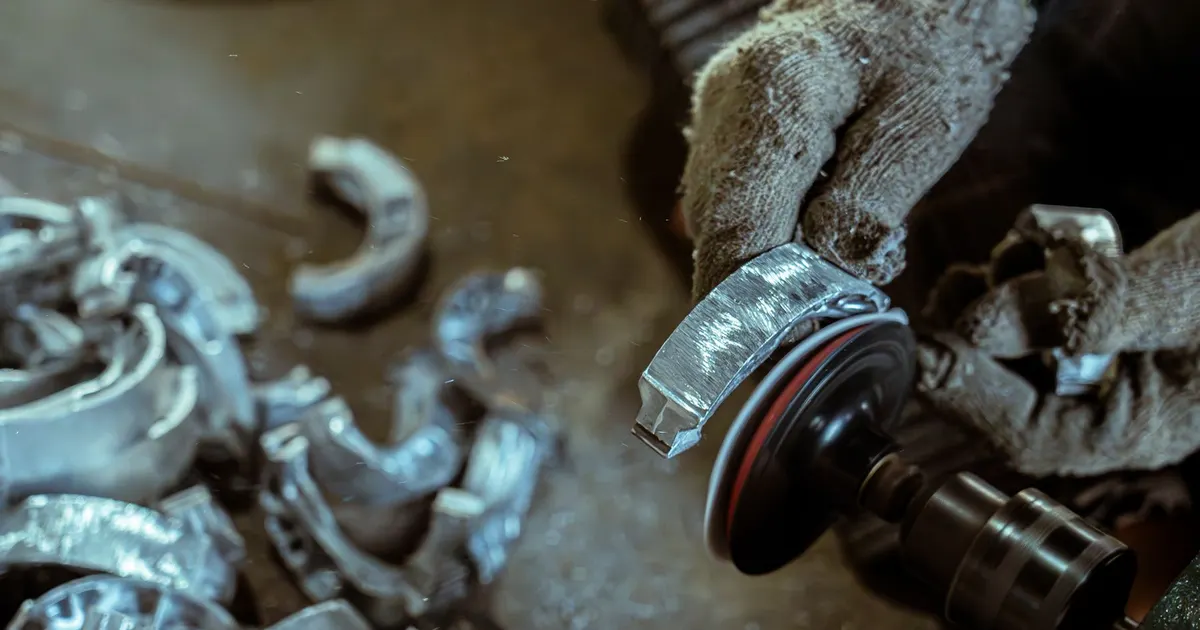
Deburring is the operation nobody puts on a drawing and everybody pays for. A burr is the small ridge or flap of metal left on an edge when a tool leaves the cut. On titanium those ridges are tougher and harder to remove than on aluminium or brass, and the usual shortcuts, such as heat, carry risks of their own. On parts with many edges, the labour of deburring can rival the time on the machine.
This guide covers why titanium burrs form, how edges are broken and finished, and how to describe the result on a drawing so the shop prices it correctly.
Why titanium burrs are a problem
Titanium is ductile. At the end of a cut, the metal at the edge bends and rolls instead of snapping off, which leaves a burr that is thin, strong and firmly attached. These burrs do not fall off in the wash and they can be sharp enough to cut a finger or a seal.
Burr size depends on the cut. A worn tool makes larger burrs. A tool exiting the material at a steep angle makes a bigger exit burr than one that leaves gradually. Cross holes, where a small drill breaks into a larger bore, leave burrs inside the part where nothing can reach them with a file. Shops reduce burr formation with sharp tools, correct feeds and exit strategies, but they do not eliminate it.
Burrs matter for three reasons:
- Function. A burr stops a seal from seating, jams a mating part or breaks off in service.
- Fatigue. A sharp edge concentrates stress and can start a crack. Aerospace and medical parts under cyclic load usually specify a minimum edge radius.
- Safety. Handlers and assemblers cut themselves on titanium burrs.
Edge break sizes
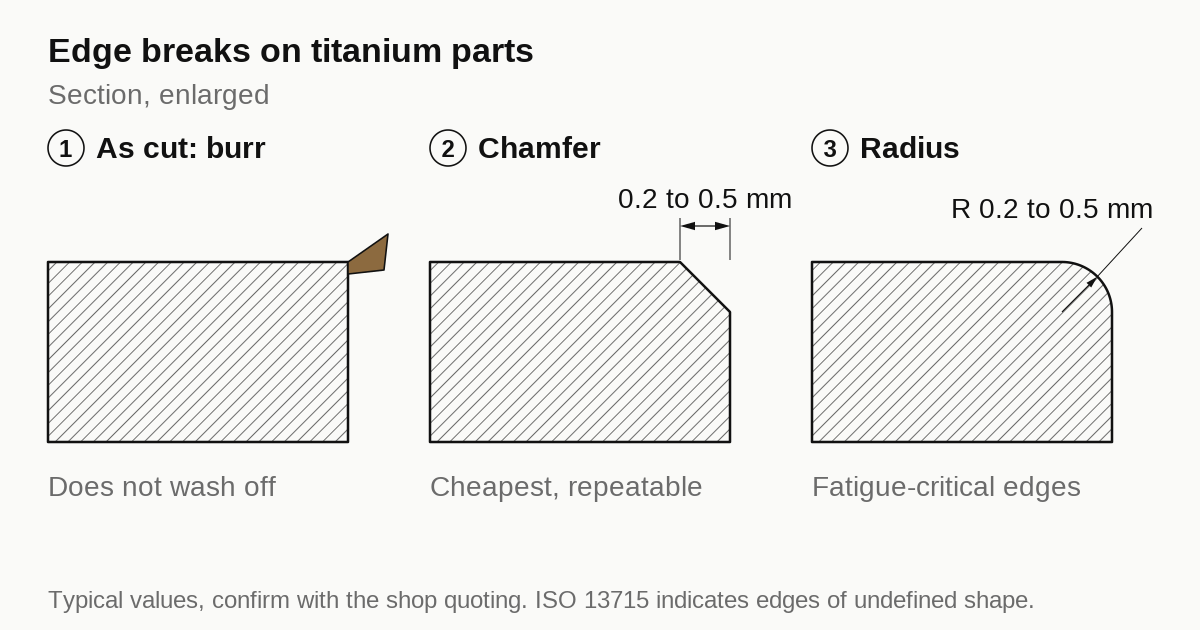
A drawing can leave edges undefined, break them with a general note or give each edge a dimension. The note is usually written with a size or a range. Examples include “break all sharp edges 0.1 to 0.4 mm” or “remove burrs, edge break 0.2 mm maximum”. ISO 13715 is the standard that sets out how to indicate edges of undefined shape on a drawing. Check the version your company uses and refer to it by number.
Typical edge breaks on machined titanium parts fall in a small range. A shop will confirm what it can hold.
| Edge condition | Typical size | Notes |
|---|---|---|
| Burr removed, edge left near sharp | under about 0.1 mm | Hard to hold consistently, so it costs more |
| Light edge break | 0.1 to 0.2 mm | Common on precision parts |
| General edge break | 0.2 to 0.5 mm | Common default on machined parts |
| Defined chamfer | As drawn, often 0.3 to 1 mm at 45 degrees | Cut by the machine, repeatable |
| Defined radius | As drawn | Common on fatigue-critical edges |
A chamfer cut by the machine in the same program as the part is the cheapest and most repeatable edge break. A radius needs a form tool or a ball cutter pass. Hand-blended edges vary from part to part, so drawings that need a tight edge radius should define it and say how it will be checked.
Do not specify an edge break so small that it cannot be measured. A shop can only check it with a magnifier or an edge gauge, and an unclear call causes disputes. Titanium machining tolerances covers how to decide which features deserve a tolerance.
Deburring methods for titanium
| Method | Best for | Watch for |
|---|---|---|
| Machine chamfer or edge-break tool | External and accessible edges, all batch sizes | Needs access, adds a tool change |
| Manual with files, scrapers and carbide burrs | Prototypes, small batches, internal edges | Slow, varies by operator, can damage tolerance edges |
| Abrasive nylon brushes | Light burrs on many surfaces | Rounds edges slightly, mild material removal |
| Vibratory or tumble finishing | Small parts in batches | Parts can knock together, surface changes |
| Abrasive flow machining | Internal passages and cross-hole intersections | Needs custom tooling, higher cost |
| Electrochemical deburring | Hard-to-reach burrs on conductive parts | Setup and tooling needed, outside process |
| Thermal deburring | Not normally used on titanium | Oxygen at heat, and titanium can burn |
Manual deburring needs care in both directions. Too little and burrs remain. Too much and the operator removes metal from a tight tolerance edge or rounds a sealing face. Operators work under magnification on critical parts.
Titanium chips, fines and grinding dust are flammable, and abrasive deburring creates sparks. Shops keep fine titanium swarf and dust away from ignition sources and handle it as the metal fire hazard it is. The shop’s housekeeping and extraction on deburring benches is a reasonable thing to ask about.
Mass finishing changes the surface. Tumbling rounds all edges and can lightly peen the surface, and it can change the surface finish readings. If the part has a defined roughness or cosmetic surface, check the finishing sequence in titanium surface finish. Anodizing after deburring also changes edge appearance, so describe both on the drawing. See titanium anodizing for how colour and dimensional change work.
Need a quote for this part? Get a titanium quote
Cross holes and internal edges
Intersecting holes are the hardest burrs to reach. Where a small cross hole enters a larger bore, the burr forms inside the bore. A shop can reduce it by drilling the cross hole before the final bore pass, by using a deburring tool with a spring-loaded blade that flips out inside the bore or by abrasive flow methods. Drilling titanium explains why hole exits are risky.
The drawing can help by:
- Calling out the cross-hole edge break and its size.
- Keeping cross holes to the minimum number needed.
- Saying whether burrs inside blind or intersecting passages must be removed and how that will be verified, for example by borescope.
Medical and fluid-handling parts often require a verified burr-free internal passage. Ask the shop how it proves it.
Deburring and inspection
Inspection of edges is mostly visual. A shop will check under magnification, often around 10x, for burrs, scratches and the edge break size. For an edge radius a shop may use a profile projector, an optical comparator or a replica compound. Define the method if the requirement is tight, because the method decides the result. For the cleaning and handling that follows deburring on regulated parts, see titanium medical parts.
How deburring appears in a quote
Deburring is labour, and it scales with the number of edges and how hard they are to reach. A shop prices it three ways. It builds it into the machining time when the machine cuts the edge break. It lists a manual deburring time per part. Or it sends the batch for tumbling, with a minimum charge. On a drawing with hundreds of small features the shop can only price the deburring, because it has no way to reduce it. The titanium machining cost guide shows where hours go on a typical quote.
What to put on the drawing and the quote
- State the general edge break as a size and a type: chamfer or radius, and its limit.
- Mark any edge that needs a different treatment: sealing edges, edges under fatigue load and edges that must stay sharp.
- Name cross holes and internal passages that must be burr-free, and how they will be inspected.
- Say what the shop must not do, such as no tumbling or no hand blending near a tolerance edge.
- Ask which methods the shop plans to use and whether any are outside processes.
- Ask whether deburring happens before or after any anodizing or surface treatment.
- Ask how the shop inspects edges and what magnification it uses.
Send the drawing through the RFQ form and shops reply within 24 business hours. For the grades involved, the titanium grades reference lists them.
Frequently asked questions
What edge break should I specify on a titanium part?
Many drawings use a general note that breaks all sharp edges to a small size, commonly 0.1 to 0.5 mm. State the size and whether it is a chamfer or a radius, because a vague note leaves the shop to guess. Fatigue-loaded parts often need a defined radius.
Can titanium be thermally deburred?
Thermal deburring burns burrs off with a burst of hot gas, and titanium reacts with oxygen at heat and can burn. Shops generally avoid it for titanium and use mechanical, abrasive, electrochemical or manual methods. Ask a shop what it uses and whether the drawing restricts any method.
Why is deburring titanium by hand so slow?
Titanium burrs are tough and stringy, they do not snap off like brittle metal burrs, and a hand tool must remove them without cutting into the edge that is under tolerance. Parts with many holes and cross holes multiply the work.
Need a quote for this part?
Send the drawing. We send one itemised quote for the finished parts and reply within 24 business hours.
Get a titanium quote