Guides / Grades
Titanium vs Alloy Steel (4140, 4340): Where Titanium Wins on Weight and Where It Does Not
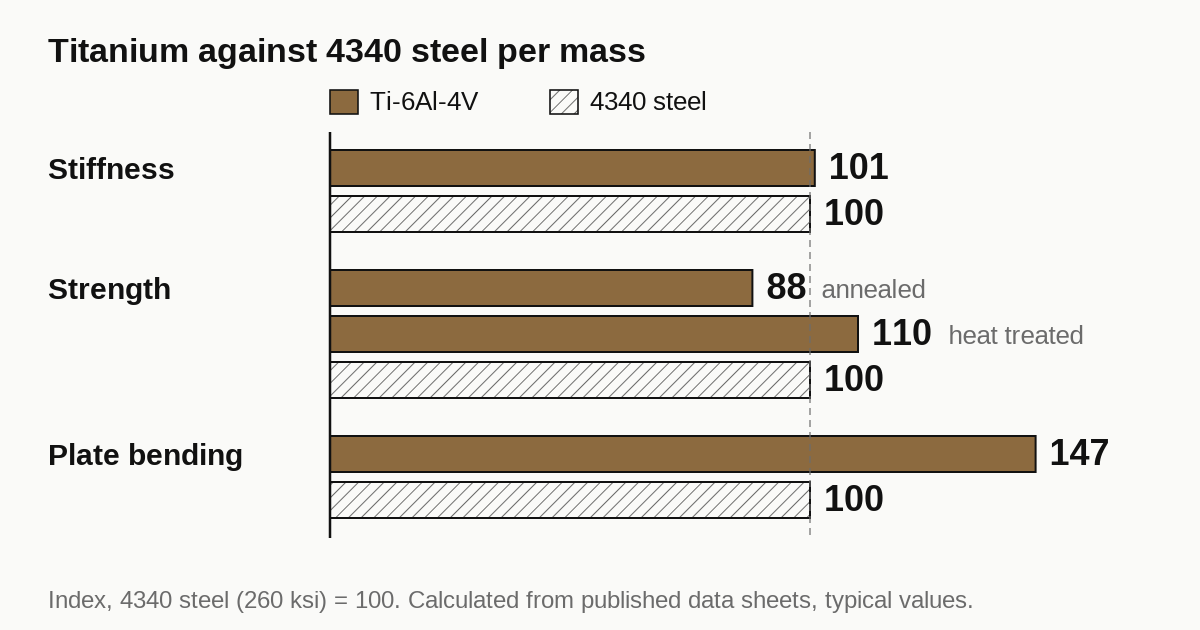
Titanium beats alloy steel on weight only where the part is limited by bending stiffness, and it matches heat treated steel on tensile strength per kilo only when the titanium is heat treated too. Where corrosion matters it wins outright. That is the honest summary of the numbers. For a rod in tension, 4340 at 260 ksi and aged Ti-6Al-4V come out close per unit of mass. For a plate or bracket limited by deflection, titanium is lighter by roughly a third. For anything that sits in salt water, titanium needs no coating. This post is part of our guide to titanium grade selection. It fills the gap between our titanium versus stainless and titanium versus aluminium guides. Figures are typical, and we calculated every ratio from the datasheet values listed under Sources.
The decision by part type
| Part | Pick | Why |
|---|---|---|
| Rod or tie loaded along its length, strength-limited | Alloy steel, unless weight or corrosion pays | Strength per kilo is close; steel machines more easily |
| Rod or strut limited by axial stiffness | Alloy steel | Stiffness per kilo is within 1 percent |
| Bracket, plate or cover limited by deflection | Titanium, if the section can thicken | About 68 percent of the mass for the same bending stiffness |
| Part in seawater, brine or chlorinated water | Titanium | No coating needed |
| Threads, sliding faces, wear surfaces | Alloy steel | Titanium galls, see our stainless guide |
| Part that must not be magnetic | Titanium | Titanium is non-magnetic (our stainless guide); alloy steel is ferromagnetic |
| Part used hot, near 300 °C | Ask both suppliers | The 260 ksi steel condition is tempered near 246 °C; Ti-6Al-4V is published to about 315 to 400 °C |
This table is a first filter, not a design check. The designer’s allowables decide.
Strength to weight
| Property | Ti-6Al-4V annealed | Ti-6Al-4V aged | 4340 hardened and tempered |
|---|---|---|---|
| Density | 4.43 g/cm3 | 4.43 g/cm3 | 7.85 g/cm3 |
| Tensile strength | 895 MPa minimum (B348) | typically 150 to 172 ksi (1,034 to 1,186 MPa) | 260 ksi (1,793 MPa) |
| Tensile strength divided by density | 202 | 233 to 268 | 228 |
| Elastic modulus | about 114 GPa | about 114 GPa | 200 GPa |
The strength, density and modulus figures for steel are for 4340 only; we sourced no 4140 strength figure, and 4140 appears below for machinability and fatigue remarks. The strength to density figures are in MPa per g/cm3, which equals kN m/kg. Sources are under the post; the steel strength is the hardened condition on the aircraftmaterials.com 4340 page and the titanium ranges are typical bar values from the Rolled Alloys Ti-6Al-4V datasheet.
Two readings follow. Annealed Ti-6Al-4V at its minimum is about 12 percent below 4340 at 260 ksi per kilo. Aged titanium is 2 to 17 percent above it. And the steel number needs a heat treatment cycle: that datasheet gives a double temper at 475 °F, with an annealed hardness ceiling of 235 HB for the soft stage. Both metals reach their top strength through heat treatment, so the sequence belongs in the quote either way, as our guide to solution treated and aged titanium explains for the titanium side.
A worked example, with stated assumptions: a tie that must carry a fixed load, sized by strength alone. If steel needs area A at 1,793 MPa, aged titanium at a mid-range 1,110 MPa needs 1.62 A and weighs about 91 percent of the steel tie. Annealed titanium at 895 MPa needs 2.0 A and weighs about 113 percent. So the saving is small or negative.
Stiffness is a different story
Titanium has about 57 percent of steel’s modulus (114 against 200 GPa) and about 56 percent of its density. So stiffness per kilo for a rod in tension or compression is almost identical: 25.7 for Ti-6Al-4V against 25.5 for steel. A titanium strut limited by stiffness weighs what the steel one does.
A plate or bracket limited by bending is different, because stiffness rises with the cube of thickness. At equal bending stiffness, titanium needs about 21 percent more thickness, and the part weighs about 68 percent of the steel one, provided the design allows the thicker section. That is our calculation from the two moduli and densities, using the E^(1/3) over density index. Makino notes that titanium is springy and deflects more than steel for a given force, so check that the extra thickness does not push the part into chatter on the machine or a clearance limit in the assembly.
Fatigue
Both metals can have high fatigue strength. The aircraftmaterials.com page says the fatigue strength of E4340 makes it ideal for highly stressed parts, and Carpenter’s 4140 page lists good wear, impact and fatigue resistance. We found no like-for-like public fatigue figure that compares Ti-6Al-4V and 4340 at matched strength and surface finish, so we give no number. Fatigue depends on the surface and on notches, and both depend on the machining. Ask the designer for the S-N data at the finished surface condition, and read our aluminium comparison for how the same points apply there.
Corrosion and coatings
4140 and 4340 are through hardening alloy steels, not corrosion resistant grades. Outside a dry or oiled setting they need plating, paint or another layer, and that is a step, a cost and a document. Titanium forms a self-repairing oxide film and needs none in seawater. If corrosion is the reason you are considering titanium, our stainless steel comparison covers the chloride case where stainless fails too.
Need a quote for this part? Get a titanium quote
Machining and cost
Engineering ToolBox lists annealed 4140 at 66 percent and annealed 4340 at 57 percent of the free-machining steel benchmark; MatWeb lists 4340 at 50 percent, annealed and cold drawn, based on AISI 1212. A titanium distributor, Performance Titanium, rates Ti-6Al-4V at 22 percent of B1112. The benchmarks are not identical and the Toolbox page itself names 1112 in its text while bolding 1212, so treat the figures as directional. The direction is clear: Ti-6Al-4V is rated at roughly a third to two fifths of the ratings given to annealed 4140 and 4340. Hardened steel is harder to cut than annealed, so these ratings apply to the soft stage.
We found no public price per kilo that compares Ti-6Al-4V bar with 4140 or 4340 bar, so we give none. For a real answer, ask two shops to quote the same drawing in both materials, and ask for these lines separately:
- Stock price and the size priced, plus the mill or stock lead time.
- Machine hours, with the surface speed assumption.
- Heat treatment, outside processing and distortion allowance, for both metals.
- Coating or finishing for the steel; anodize or blast for the titanium.
- Certificates and inspection, which can be heavier on titanium aerospace work.
When titanium is worth it
Pick titanium when the part lives in seawater or chlorides, when it must not be magnetic, when bending stiffness sets the section and weight counts or when the application keeps titanium hot where hardened steel would temper back. Pick alloy steel when the load is tensile, when the part carries threads or wear surfaces or when cost drives the choice and the environment is dry. If you are between the two and also considering Inconel for heat, see titanium versus Inconel.
What to put on the RFQ
Describe the load case in one line: tension, bending or compression, the deflection limit if any, the environment and the temperature. Ask shops to quote both materials as separate options and to show machine hours and heat treatment as separate lines. If you already know the grade, say so. The guide to titanium grade selection sets out how to move from requirement to grade. Send the drawing through the RFQ form and we reply within 24 business hours with one itemised quote.
Sources
- MatWeb, AISI 4340 steel, normalized (density 7.85 g/cm3, modulus 200 GPa, machinability 50 percent; read through a PDF print of the page)
- aircraftmaterials.com, E4340 (260 ksi hardened condition, heat treatment, 235 HB annealed, fatigue remark)
- Engineering ToolBox, machinability of metals (4140 at 66 percent, 4340 at 57 percent)
- Performance Titanium, 6AL-4V (22 percent of B1112)
- Rolled Alloys, 6Al-4V titanium datasheet (density, modulus, annealed and aged bar tensile ranges, service temperature)
- Makino, Machining Titanium Part 3, 2021 (Ti-6Al-4V density 4.43 and modulus 113.8 GPa; springiness)
- Carpenter Technology, 4140 (description, fatigue and wear remark, AMS list)
- Leyens, DLR, ICAS 2004 (Ti-6Al-4V temperature limit about 315 °C)
Frequently asked questions
Is titanium stronger than 4340 steel?
Not at the top end. Heat treated 4340 at the 260 ksi condition has about 1,790 MPa tensile strength, against 895 MPa minimum for annealed Ti-6Al-4V and typically 150 to 172 ksi for aged bar. Per unit of mass, aged titanium comes out close to that steel and annealed titanium below it.
Is titanium stiffer than steel per kilo?
For a rod loaded along its length, no: stiffness divided by density is about 25.7 for Ti-6Al-4V and 25.5 for steel, in GPa per g/cm3. For a plate or beam whose thickness can grow, titanium reaches the same bending stiffness at about 68 percent of the mass, by our calculation.
Which is easier to machine, 4140 or titanium?
4140. Engineering ToolBox lists annealed 4140 at 66 percent and 4340 at 57 percent of the free-machining steel benchmark, and a titanium distributor rates Ti-6Al-4V at 22 percent of B1112. The scales are not identical, so treat them as directional, and note that hardened steel machines harder than annealed.
Does alloy steel need a coating where titanium does not?
Usually. 4140 and 4340 are through hardening alloy steels, not corrosion resistant grades, so a part outside a dry or oiled setting needs plating, paint or another protective layer. Titanium forms its own protective oxide film. The coating adds a step, a cost and a document to the order.
Need a quote for this part?
Send the drawing. We send one itemised quote for the finished parts and reply within 24 business hours.
Get a titanium quote