Guides / Cost
Titanium Forging vs Bar Stock: Where a Near-Net Blank Beats Machining from Solid
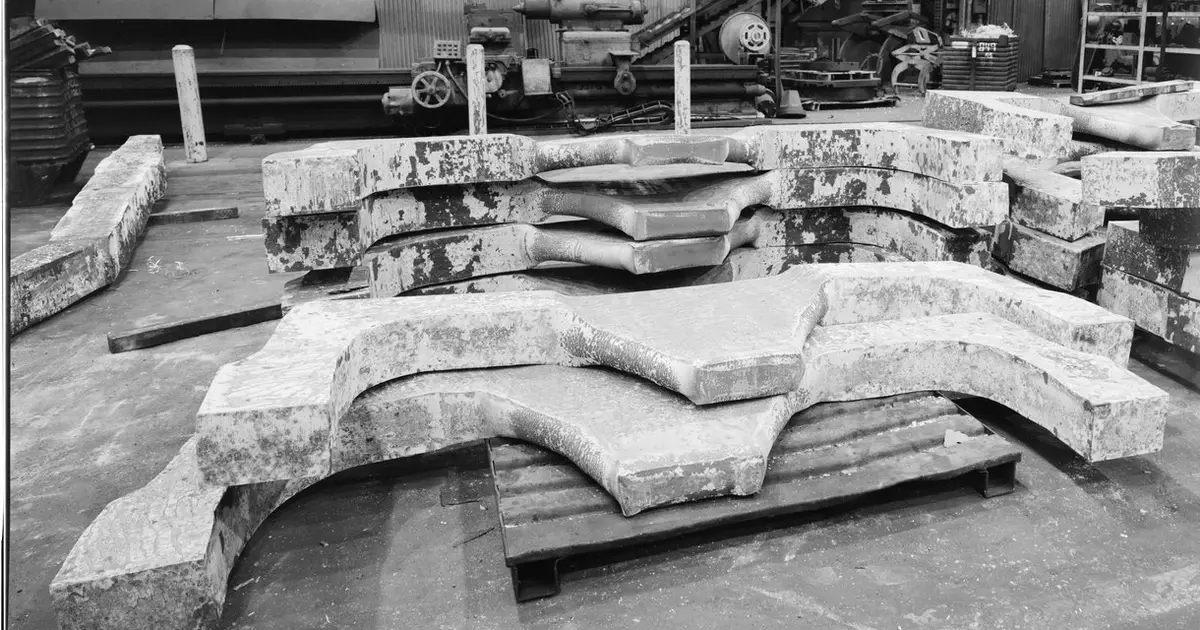
A near-net titanium forging pays when most of a machined blank would otherwise end up as chips and the quantity is high enough to carry a die. For a first article, a prototype or a few dozen parts, machining from bar is almost always cheaper and faster. For a repeating part that weighs a fraction of its bar, a forging can lower the material line a long way, but it adds a die, a forge in the supply chain and a longer path to the first part.
The arithmetic behind the choice
The quantity that matters is buy to fly: the mass of titanium bought divided by the mass of the finished part. Take a part that weighs 1 kg when finished. Cut from solid bar at 8 to 1, the shop buys 8 kg and 7 kg become chips. From a near-net forging at 2.5 to 1, it buys 2.5 kg and 1.5 kg become chips. The example uses round numbers to show the arithmetic. They are not quotes.
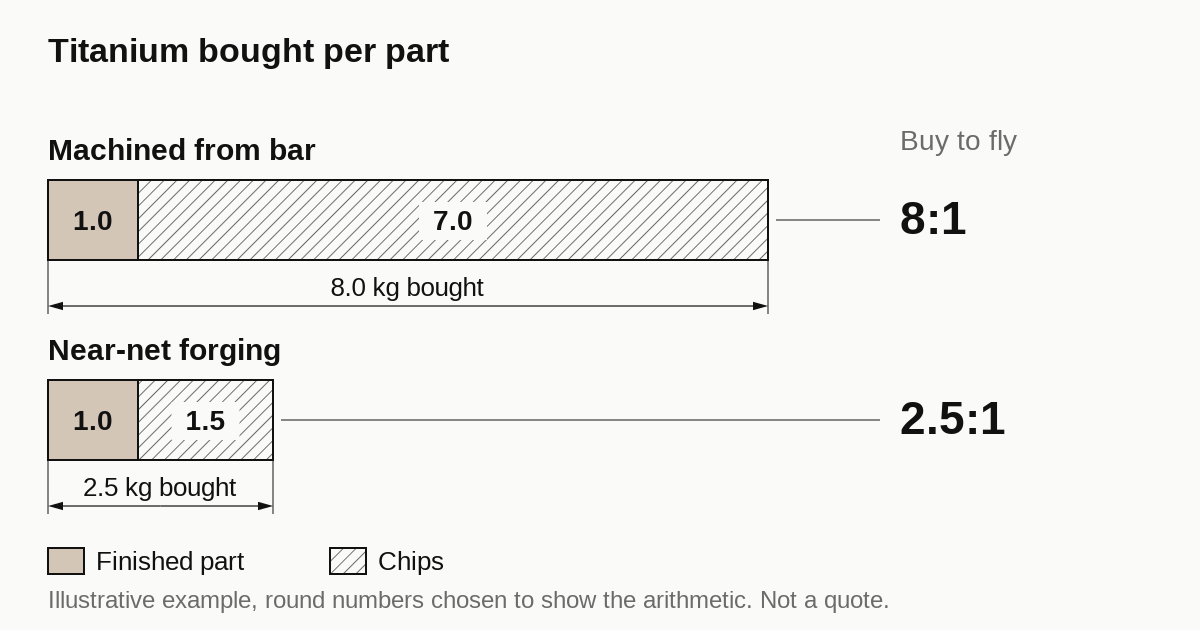
The forging saves 5.5 kg of titanium per part. Whether that is worth anything depends on four more numbers:
| Item | Machined from bar | Near-net forging |
|---|---|---|
| Titanium bought per part | blank mass at the bar buy to fly | blank mass at the forging buy to fly |
| Fixed cost | fixtures, programming | die design, die manufacture, forging trials |
| Machining time per part | long, heavy roughing | shorter, finishing the critical features |
| Lead time to first part | bar from stock, days to weeks | die and first forgings come first, no public figure, ask the forge |
Per-part saving is the mass saved times the bar price, plus the roughing time saved, minus any forging premium. The break-even quantity is the fixed cost of the die and forging trials divided by that saving per part. We found no public figure for titanium die cost or break-even quantity. Anyone giving you a number without your part’s weight and drawing is guessing.
Where the money goes in a forging
Closed-die forging has a high initial cost for die design and manufacture and a low recurring cost per part, so forgings become more economical as volume rises. Conventional closed-die forging also loses material as flash, which can run 20 to 45% of the starting material, and flashless forging avoids that loss at the price of more expensive dies and tighter control of lubrication and workpiece placement. Near-net-shape forging aims to leave little or no final machining and needs very small draft angles, and it is generally used only when it brings a significant cost reduction.
Titanium adds its own wrinkle, because the forging method itself drives cost. A 2008 paper from a forging company and an aircraft maker describes near-net-shape isothermal forging of Ti-6Al-4V as possible but needing costly dies and very long processing times, and proposes forging above the beta transus instead, where flow stress drops and forces and die filling improve. That process was qualified on Airbus A340 roller tracks and then used in series production for the A380 and several forgings for the A400M. The paper opens by noting that titanium alloys are expensive to buy and to machine, which is exactly why near-net forging attracts interest. The point for a buyer is that how the titanium is forged is a cost decision as well as a shape decision.
A press operator that forges titanium reports that it can normally lower unit price by 30 to 50% compared with a part machined from solid, depending on geometry, and attributes the saving to using less input material. That is one supplier’s claim about its own work, and it does not say how die cost is treated. Use it as an indication of the size of the opportunity, not as a forecast for your part.
Where bar wins
Bar is the default for good reasons.
- Small and medium parts. A bar is the right size for most turned and small milled parts. A part whose bar waste is modest never repays a die.
- Low and uncertain quantity. A die is a fixed cost for a part the design may still change. A design change after the die is cut is expensive, while a drawing change on a machined part is a program edit.
- Speed to the first part. Bar from a distributor can ship in days, as the stock forms and lead time guide explains. A forging path needs a die first.
- Tight tolerances. Forging tolerances are looser than machining. A published table for impression-die forgings in general metals gives, for example, about −0.15 mm and +0.46 mm for a 0.45 kg part and about −0.74 mm and +2.21 mm for a 45 kg part. Titanium is a different case, but the lesson holds: a forging leaves stock for every face that has to meet a tolerance.
Where forging wins
- Large parts with a poor buy to fly. Large structural and engine parts are the classic case, where the bar would be many times the finished weight.
- Repeating volume. A part that returns year after year can carry the die.
- Complex shapes. Disks, rings and shaped brackets suit forging, because a bar would have to be turned or milled from a block.
- Grain flow. Forging can orient the grain along the part. The effect depends on the part and the forging design, and the drawing or specification, not the process name, defines what you are entitled to.
In engines, a German Aerospace Center paper notes that for small blade heights it is more cost effective to machine a blisk from an oversized forged disk, while larger blades are attached to the disk by linear friction welding. That is a forged blank machined to final shape.
Need a quote for this part? Get a titanium quote
What to ask before you choose
- What is the buy to fly on bar, and on the forging? Ask the shop and the forge for the blank mass in each case. The buy to fly calculator gives the bar figure for simple shapes.
- What is the die cost, who owns the die and where is it kept? Die ownership varies between forges. Settle who owns it and what happens if you move the part.
- How much stock does the forging leave, and where? The machining allowance on each face sets the remaining cycle time, and the draft on the walls sets how much of the saving survives.
- Which specification and heat treatment apply? SAE AMS 4928 covers Ti-6Al-4V bars, forgings, flash-welded rings and stock for forging, and ASTM B381 is the ASTM specification for titanium forgings, where Ti-6Al-4V is designation F-5. The spec number guide explains how to read them.
- What certificates travel with the forging? The forge’s certificate and the billet’s mill certificate both matter. The mill certificate guide lists what to check.
- What is the lead time to first article and to repeat orders? There is no public figure, so get a date from the forge in writing.
- What does a design change cost after the die is cut?
A sensible way to decide
For a new part, quote it from bar first. That gives you a price and a first article without a die. When the annual quantity is known and the bar buy to fly is poor, ask the shop to quote a forging route too, and compare the full picture: die, forging, machining and lead time, per part, at your quantity. The design-for-machining guide shows drawing changes that cut bar waste without a forging at all, and the machining cost guide shows where the rest of the price comes from.
Send the drawing and your annual quantity with the RFQ form and replies arrive within 24 business hours. If you want both routes priced, say so in the RFQ.
The forging question is one lever among several, set out in our guide to how to reduce titanium machining cost.
Sources
- Forging (Wikipedia): closed-die economics, flash loss, near-net-shape forging, tolerance table
- SAE AMS4928: Titanium Alloy Bars, Wire, Forgings, Rings, and Drawn Shapes, 6Al-4V, Annealed
- Witulski, Terlinde and Knuewer (Otto Fuchs, Airbus), “Low Cost Near Net Shape Forgings from Ti-6-4”, AeroMat 2008
- Leyens (DLR), “Advanced Materials and Coatings for Future Gas Turbine Applications”, ICAS 2004
- Industrial Machinery Digest: a forging press operator’s cost claim (supplier statement, directional)
- ASTM B381 summary, supplier page (designations; read the standard for exact scope)
Frequently asked questions
Is a titanium forging cheaper than machining from bar?
Per part, often yes, because the forging starts near the final shape and wastes less metal. In total, only above a certain quantity, because the die is a fixed cost. One press operator reports unit price cuts of 30 to 50% over a machined-from-solid part, which is a supplier claim that depends on geometry.
How many parts does it take for a forging die to pay off?
There is no public break-even figure for titanium. It depends on the part weight, the buy to fly ratio, the die cost and how much machining the forging still needs. Ask the forge and the shop for a quote at your expected annual quantity and compare it with the bar price.
Does a forged titanium part still need machining?
Yes. Forging tolerances are looser than machined ones, and bores, threads and fitted faces are cut afterwards. A near-net forging leaves less to remove than bar does, but critical features are still machined.
Which specifications cover titanium forgings?
SAE AMS 4928 covers Ti-6Al-4V bars, forgings and rings, and stock for forging. ASTM B381 is the ASTM titanium forging specification, where Ti-6Al-4V carries the designation F-5. Your drawing or customer specification names the one that applies.
Need a quote for this part?
Send the drawing. We send one itemised quote for the finished parts and reply within 24 business hours.
Get a titanium quote