Guides / Sourcing
Which Titanium Specification Goes on Your RFQ
A drawing for a titanium part carries a line such as “Ti-6Al-4V per AMS 4928”. An RFQ written from the same drawing says “Grade 5 titanium”. The shop quotes the second one, buys bar to ASTM B348 and ships a certificate that does not match the first. Nobody lied. The spec number was dropped on the way from drawing to RFQ.
Spec numbers decide which mill can supply the material, what tests it ran and what the certificate proves. This guide explains the ones that turn up most often, how they differ and how to name them on a quote.
Alloy, product form and condition are three separate choices
A specification fixes three things at once.
- The alloy. Ti-6Al-4V, Grade 2, Ti-6Al-4V ELI and so on.
- The product form. Bar, plate, sheet, tube, forging.
- The condition. Annealed, solution treated and aged, cold worked.
“Grade 5” names only the alloy. A spec number adds the form, the condition, the tests and the record keeping. That is why the same alloy can be sold at two prices to two sets of requirements.
The specifications you will meet
| Specification | Issued by | Covers | Typical use |
|---|---|---|---|
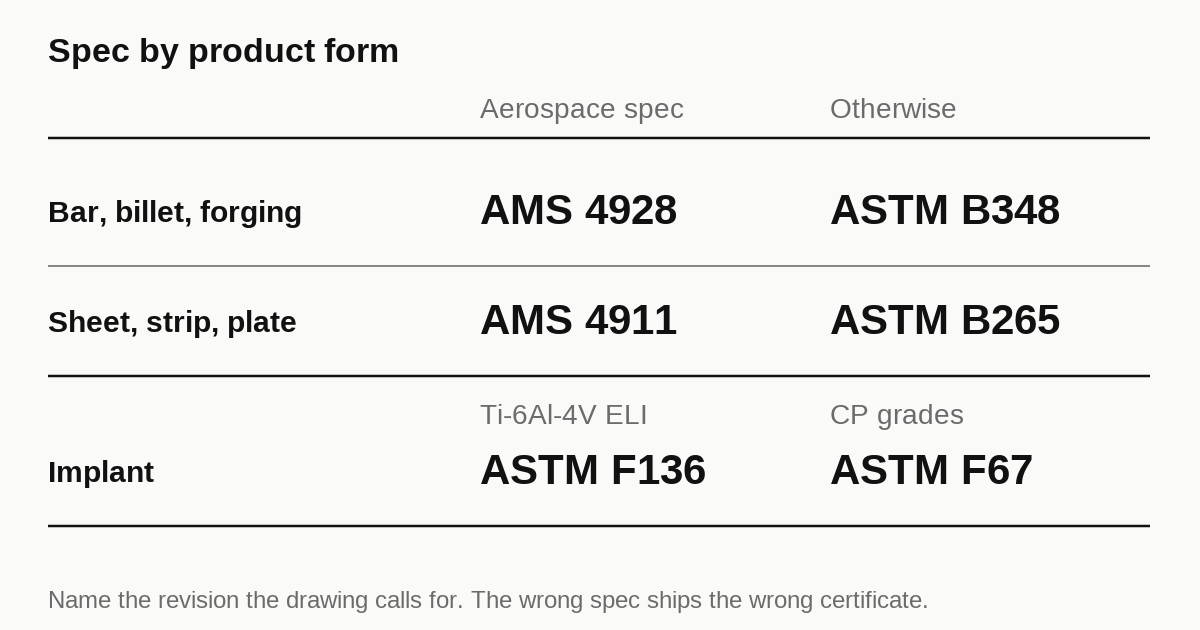
| ASTM B348 | ASTM | Titanium and titanium alloy bars and billets, many grades | General machined parts |
| ASTM B265 | ASTM | Strip, sheet and plate | Flat parts, brackets, covers |
| ASTM B338 | ASTM | Seamless and welded tube | Heat exchangers, fittings |
| ASTM B381 | ASTM | Forgings | Near net shape parts |
| AMS 4928 | SAE | Ti-6Al-4V annealed bars, wire, forgings, rings | Aerospace parts |
| AMS 4911 | SAE | Ti-6Al-4V annealed sheet, strip and plate | Aerospace flat parts |
| ASTM F136 | ASTM | Ti-6Al-4V ELI bar and wire for surgical implants | Implants |
| ASTM F67 | ASTM | CP titanium for surgical implants | Dental and surgical CP parts |
Revisions change. A spec number on a drawing normally comes with a revision letter or date, and the current text of each standard governs. Check the revision, not only the number.
ASTM B348 against AMS 4928
Both cover Ti-6Al-4V bar. They are different documents with different aims.
ASTM B348 is a commercial standard. It lists many grades, sets chemistry limits, mechanical property minimums and testing frequency, and it is the normal call for machined parts. A mill selling to B348 runs material for many customers.
AMS 4928 is an aerospace material specification for one alloy and one condition. It generally asks for more. Chemistry limits are tighter on some elements, microstructure has to meet stated criteria, inspection requirements can include ultrasonic testing of larger sizes, and records are fuller. Material may have to come from sources approved by the aircraft or engine maker.
Typical difference at a glance:
| Item | ASTM B348 Grade 5 | AMS 4928 |
|---|---|---|
| Scope | Many grades and forms of bar | One alloy, annealed |
| Chemistry limits | Standard | Tighter on some elements, check the current revision |
| Microstructure requirements | Few | Defined |
| Ultrasonic inspection | By agreement | Often required above a size, check the revision |
| Usual buyer | General industry | Aerospace and defence |
| Stock pool | Large | Smaller |
Values for individual limits depend on the revision and on bar size, so this guide gives none. Read the specification itself, or ask the shop which revision it will buy to.
Where AMS 4911 and heat treatment specs fit
AMS 4911 covers the same Ti-6Al-4V annealed in sheet, strip and plate. A part machined from plate takes the plate specification, even when the finished part looks the same as one cut from bar. Quote the form you intend to buy.
Annealed is not the only condition. Other AMS specifications cover Ti-6Al-4V in solution treated and aged condition, and the choice of condition shapes the strength and the machining. See solution treated and aged titanium.
Related specifications often appear beside the material spec. AMS 2631 covers ultrasonic inspection of titanium bar, billet and plate. AMS 2801 covers heat treatment of titanium alloy parts. AMS 2249 covers chemical check analysis limits, the allowed gap between certificate chemistry and a check analysis. Check the current revision of each before you name them on a drawing.
How to read a drawing note
A note such as “Ti-6Al-4V, AMS 4928, annealed” breaks into three parts.
- Alloy: Ti-6Al-4V, which is Grade 5.
- Specification: AMS 4928, so bar, wire, forging or ring in the annealed condition.
- Condition: annealed.
The RFQ should copy all three. If the drawing leaves a part blank, ask the drawing owner. A shop that guesses can buy the wrong bar, and the part may need scrapping when the certificate is checked.
Why substitution costs more than it saves
Some quotes arrive with “B348 acceptable” from a buyer who assumes the material is the same. It is the same alloy. It is not the same document, and the certificate has to prove the document on the drawing.
If the drawing owner does approve B348 for a given part, get that approval in writing and attach it to the order. If not, material bought to the wrong specification cannot be used on that part, however good it is.
The mill certificates guide explains what a mill certificate, a certificate of conformity and a test report each prove. The aerospace parts guide covers the wider paperwork chain.
Need a quote for this part? Get a titanium quote
Stock, lead time and quantity
Specification choice moves lead time more than almost anything else on the RFQ.
- Commodity B348 Grade 5 bar is common in many sizes.
- AMS 4928 bar is held by fewer distributors, and some sizes are a mill order.
- Plate to AMS 4911 follows its own supply chain.
Ask the shop for stock lead time and machining lead time separately, as the stock forms and lead time guide explains.
If you want to read the original, the ASTM catalogue entry for B348 describes its scope, and SAE publishes the AMS documents. Both are paid documents. For a plain background on the alloy itself, the Wikipedia article on titanium alloys gives a neutral overview.
Three RFQ lines, rewritten
The same part can be described three ways. Only the third one gives a shop what it needs.
Version one: “Titanium bracket, 100 pieces.” The shop cannot quote. It will ask for the alloy, grade, form and standard, and you lose a day.
Version two: “Grade 5 titanium bracket, 100 pieces.” The shop will quote Ti-6Al-4V and will probably assume ASTM B348 bar. If your drawing names AMS 4928, the quote assumes the wrong material.
Version three: “Ti-6Al-4V bracket to AMS 4928, annealed bar, 100 pieces, certificate of conformity with heat number, mill certificate to EN 10204 type 3.1.” The shop knows the alloy, form, condition, document set and quantity. It can quote and can tell you whether it holds approved stock.
Writing version three takes two minutes and removes most of the back and forth. If you are not sure which spec applies, send the drawing and ask the shop to read the title block back to you. A shop that cuts aerospace titanium will recognise the callouts.
What a certificate should show
The certificate has to prove the specification on the drawing. Look for these items before you accept material.
- The specification number and revision, matching the drawing.
- The heat number, matching the marking on the bar.
- Chemistry results for the elements the specification lists.
- Mechanical test results where the specification requires them.
- The mill’s name and the signature or stamp of the person releasing the heat.
A certificate that cites only “Ti-6Al-4V” with no specification does not prove the document you need.
What to put on the RFQ
- Alloy and grade: for example Ti-6Al-4V, Grade 5.
- Specification and revision: AMS 4928 or ASTM B348, exactly as the drawing writes it.
- Product form: bar, plate, forging or tube, with size.
- Condition: annealed, solution treated and aged, or other.
- Related specs: inspection, heat treatment and chemical check specifications named on the drawing.
- Certificates: mill certificate to EN 10204 type 3.1 or the type your customer requires, and a certificate of conformity naming the heat number.
- Source restrictions: any approved source list your customer imposes.
- Whether a substitute is acceptable: and who approved it.
Send the drawing and the spec lines through the RFQ form and shops that cut titanium will reply within 24 business hours. The grade reference lists the standards next to each grade.
See also: the AMS 4928 specification page and the ASTM B348 titanium bar page.
Frequently asked questions
What is AMS 4928?
AMS 4928 is the SAE aerospace material specification for annealed Ti-6Al-4V bars, wire, forgings and rings. It is stricter than ASTM B348 on several points, so material bought to it comes from a different stock pool than commodity Grade 5 bar.
What is the difference between AMS 4928 and AMS 4911?
They cover the same alloy in different product forms. AMS 4928 is for bars, wire, forgings and rings, and AMS 4911 is for sheet, strip and plate. A machined part cut from plate needs the plate specification, not the bar one.
Can I use ASTM B348 material on a part that calls for AMS 4928?
Not unless the drawing owner approves it. The certificate has to show conformance to the specification on the drawing. B348 material may meet the chemistry and still miss other requirements of AMS 4928, such as inspection and microstructure.
Need a quote for this part?
Send the drawing. We send one itemised quote for the finished parts and reply within 24 business hours.
Get a titanium quote