Guides / Process
Custom Titanium Bolts: What to Specify So the Thread and the Head Survive Service
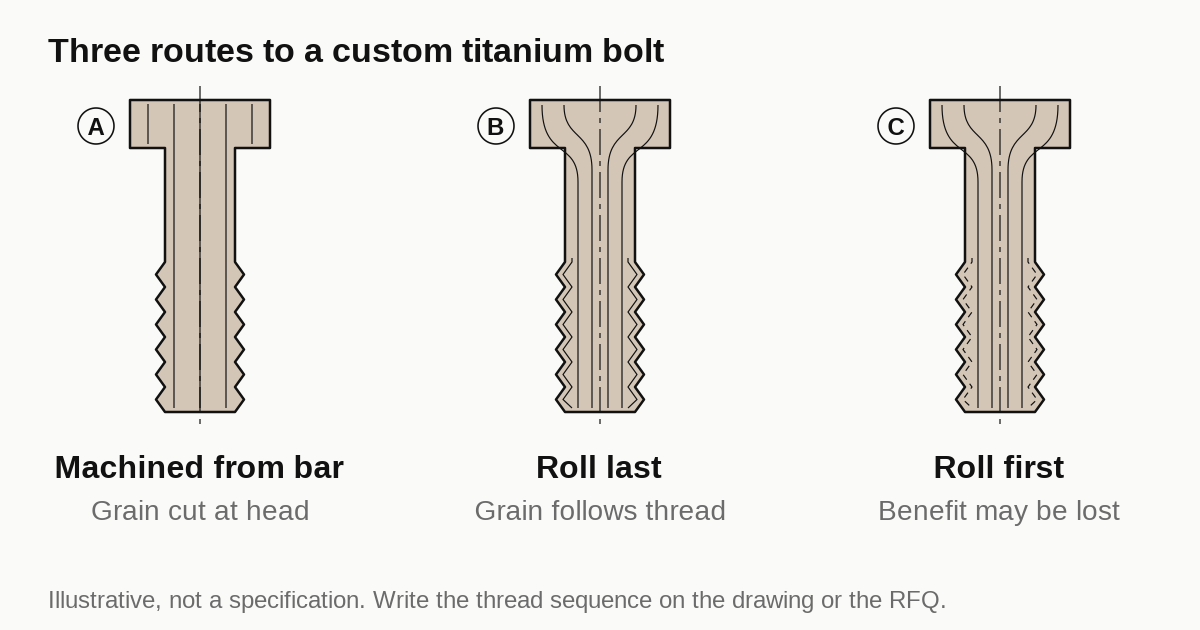
A custom titanium bolt is almost always Ti-6Al-4V, and the price and the fatigue life are set by three choices rather than by the alloy: whether the head is machined from bar or formed on a blank, whether the thread is rolled or cut, and whether the thread is rolled before or after heat treatment. Add a galling plan for assembly and the RFQ is complete. Everything below is general fastener practice, backed by published studies and patents. The sources are listed at the end, and no public specification we could open fixes the thread sequence for titanium, so write it on your drawing.
What a custom titanium bolt usually is
A catalogue titanium bolt follows a standard size and a standard head. A custom one differs in length, grip, head shape, thread class, drilled holes or a special finish. That matters for the route, because short runs and odd shapes lean towards machining while repeat volume leans towards a formed blank.
The grade is rarely in doubt. SAE AS7460 covers aircraft-quality bolts and screws made of 6Al-4V titanium alloy and of 160 ksi (about 1100 MPa) tensile strength at room temperature. SAE lists the older AMS 7461D, upset headed, heat treated and roll threaded Ti-6Al-4V bolts for use up to 600 °F (315 °C), as cancelled. Its title still shows the route aerospace bolts were specified to take. For general service, ASTM F468 covers commercial wrought nonferrous bolts, hex cap screws and studs from 0.250 to 1.500 in. diameter, with nuts under F467. Check the alloy table of the edition you cite before you name it on a drawing. Our spec number guide explains how bar specifications are written.
Pick the strength condition before the bolt shape
Ti-6Al-4V is supplied annealed and can be heat treated for more strength. A supplier datasheet gives the typical room temperature bar tensile strength as 138 to 155 ksi after annealing at 1300 °F and 150 to 172 ksi after solution annealing at 1750 °F and aging at 1000 °F. Two limits matter for bolts:
| Item | Typical value | Source |
|---|---|---|
| Tensile, annealed bar | 138 to 155 ksi (about 950 to 1070 MPa) | Rolled Alloys datasheet |
| Tensile, solution treated and aged bar | 150 to 172 ksi (about 1030 to 1190 MPa) | Rolled Alloys datasheet |
| Section limit for full STA properties | sections over 1 in. may not develop full properties | Rolled Alloys datasheet |
| Density | 4.43 to 4.51 g/cm³ | Wikipedia, Ti-6Al-4V |
| Young’s modulus | 104 to 113 GPa, steel is about 200 GPa | Wikipedia, Ti-6Al-4V and Young’s modulus |
| Annealed service temperature | through 750 °F (about 400 °C) | Rolled Alloys datasheet |
The modulus is the number buyers forget. Titanium is about half as stiff as steel, so a titanium bolt stretches close to twice as much as a steel bolt of the same size under the same load. That changes how preload builds up in the joint, so check the joint and not only the bolt. The size limit is the other trap: a large diameter blank that cannot reach full STA strength through its core is a reason to ask the shop what condition the bolt will really be in. The grade reference and the grade 2 vs grade 5 guide cover the alloy side.
Machined from bar or headed from a blank
Machined from bar. The head and the shank are turned and milled from a bar. A study of aircraft bolt manufacture (on steel, not titanium) says machining is economically advantageous for small quantities and complicated geometries, but that surface defects formed during machining act as preferred sites for fatigue crack initiation, so machined threads often show limited fatigue properties. That caution transfers as a question to ask, not as a titanium test result.
Headed from a blank. For a repeating bolt the head is formed hot. A patent on titanium fastener manufacture describes blanks formed from about 1200 °F (649 °C), usually not below about 800 °F (427 °C), then cleaned in a molten salt bath and acid etched, followed by solution treatment at roughly 1650 to 1775 °F (899 to 968 °C) and aging at roughly 800 to 1050 °F (427 to 566 °C). The same patent calls solution treatment the most problematic step, because titanium reacts at those temperatures and distortion, contamination and hydrogen pickup are risks. It also notes that fasteners can be machined from solution treated bar and then aged, which avoids forging.
Grain flow is the reason people pay for forming. A patent on large titanium bolts says that removing alpha case by machining can strip the upset-forged grain flow that strengthens the head-to-shank transition. If your bolt sees cyclic load, ask the shop how the head is made and whether any machining after heat treatment removes the formed surface. For parts where a die makes sense, our forging vs bar guide covers the economics, and the buy to fly calculator shows how much bar a machined head wastes.
Rolled threads and the sequence question
Rolling forms the thread by displacing metal instead of cutting it. Wikipedia’s summary of the process says rolled threads are stronger than cut threads, with tensile strength gains of 10 to 20% and possibly more in fatigue and wear resistance, and that the blank needs to be about 15 to 20% lighter. It also says rolling needs a ductile material, and that cutting is preferred when quantities are small, the blank is inaccurate or the thread runs up to a shoulder.
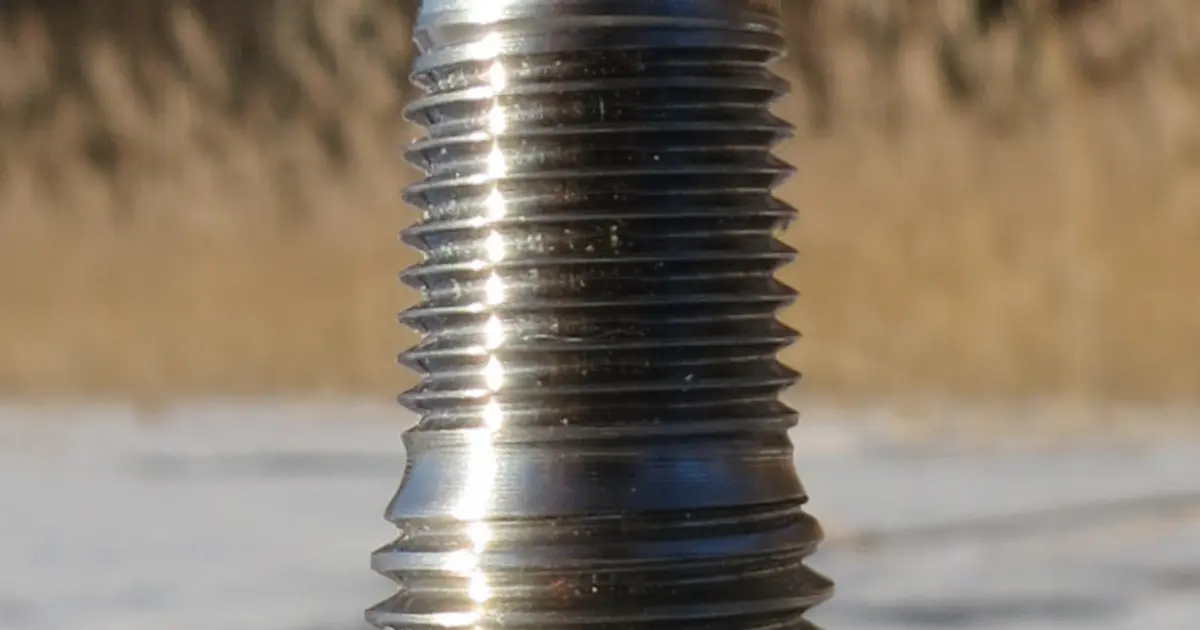
When to roll is the part that varies. The aircraft bolt study mentioned above found, on AISI 4340 steel, that rolling aligns grains and introduces compressive residual stress, and it cites earlier work reporting that fatigue properties are markedly better when threads are rolled after heat treatment rather than before. It adds that manufacturers prefer to make threads before heat treatment to reduce roller and tool wear. That tension is the whole issue: the cheaper sequence is not always the better one for fatigue.
For titanium the evidence is thinner. The same patent describes threading after heat treatment, and reports that standard single-pass rolling produced unacceptable crest and flank laps on large beta processed bolts, which it addresses by rolling a pre-machined wave-form thread. We could not open the text of AS7460 or AMS 7461 to see what they require. So treat the sequence as an open question for your part: put it on the drawing, and ask the shop to confirm in writing which operation comes last. A metallographic section and a microhardness check can show how a thread was made, as the steel study demonstrated, which is a useful incoming inspection if the bolt is critical.
Need a quote for this part? Get a titanium quote
Galling at assembly
Titanium galls. Wikipedia’s galling entry says titanium, like aluminium, has high stacking-fault energy that makes it far more susceptible than copper, bronze or gold, and that in extreme cases a bolt can seize without stripping its threads, breaking the fastener, the tool or both. Mitigations listed there are lubricants, thin-film coatings such as molybdenum disulfide, titanium nitride and diamond-like carbon, surface hardening and a different material for the mating thread. Choose one and write it down: a thread lubricant specification, or a coating on the bolt, or a bronze or steel insert in the nut member. Our guide to threading titanium covers the machining side of the problem, and the coatings comparison covers what a coating does to fatigue.
What to put on the RFQ
- Drawing and standard. Thread form, class, length, grip and the governing specification (for example AS7460 or an F-series edition).
- Material and condition. Alloy, bar specification, annealed or STA, and the section size that sets it.
- Head route. Machined from bar or formed from a blank, and whether you accept a die cost.
- Thread route and sequence. Rolled or cut, and whether before or after the final heat treatment.
- Tests. Tensile and hardness per lot, and anything cyclic loads need, such as a fatigue test or a section for grain flow. Ask what the shop can actually run.
- Certificates. Heat lot traceability from the mill, as the mill certificate guide lists.
- Assembly control. Lubricant or coating, and the mating thread material.
- Quantity and repeat rate. This decides machining or forming more than anything else.
If you send the drawing through our RFQ form, we reply within 24 business hours with one itemised quote. Which shop makes a bolt a given way is the shop’s statement to confirm, not ours.
Sources
- SAE AS7460: Bolts and Screws, Titanium Alloy 6Al-4V, Procurement Specification (aircraft-quality, 160 ksi)
- SAE AMS7461D: Upset Headed, Heat Treated, Roll Threaded (cancelled) (title, 600 °F use)
- ASTM F468-22 scope (nonferrous bolts, 0.250 to 1.500 in.; nuts under F467)
- US8845832B2: Process for manufacture of fasteners from a titanium alloy (conventional forming and heat treatment temperatures)
- US9994947B2: Defect-free threads for large diameter titanium alloy bolts (threading after heat treatment, laps, grain flow)
- Ifergane et al., “The effect of manufacturing processes on the fatigue lifetime of aeronautical bolts”, Engineering Failure Analysis 8 (2001) (AISI 4340 steel, rolled vs machined, sequence)
- Thread rolling (Wikipedia) and Galling (Wikipedia)
- Ti-6Al-4V (Wikipedia) and Young’s modulus (Wikipedia)
- Rolled Alloys: 6Al-4V datasheet (bar tensile ranges, section limit, service temperature)
Frequently asked questions
What grade of titanium is used for custom bolts?
Almost always Ti-6Al-4V (grade 5). The aircraft-quality bolt procurement standard SAE AS7460 covers 6Al-4V bolts and screws of 160 ksi tensile strength at room temperature. Commercially pure grades are softer and are chosen for corrosion rather than strength.
Are rolled threads better than cut threads on titanium bolts?
Rolled threads are generally stronger and more fatigue resistant than cut threads, because rolling aligns the grain and leaves compressive stress at the root. Cutting is cheaper for small quantities or odd geometry. The gain depends on when the thread is rolled relative to heat treatment, so state the sequence on the drawing.
Do titanium bolts gall?
Yes. Titanium is far more susceptible to galling than copper alloys or bronze, and a seized thread can break the bolt or the tool. Lubricant on the thread, a low-friction coating such as TiN or DLC and a different material for the mating part all reduce the risk.
Can you machine a titanium bolt from bar instead of heading it?
You can, and for small quantities and complicated shapes it is often the cheaper route. The trade is that machining cuts through any grain flow and leaves a cut surface, and machined threads often show limited fatigue properties. For cyclic loads ask for a headed blank with rolled threads.
Need a quote for this part?
Send the drawing. We send one itemised quote for the finished parts and reply within 24 business hours.
Get a titanium quote