Guides / Cost
Titanium Machining Lead Time From Purchase Order to Shipment, Step by Step
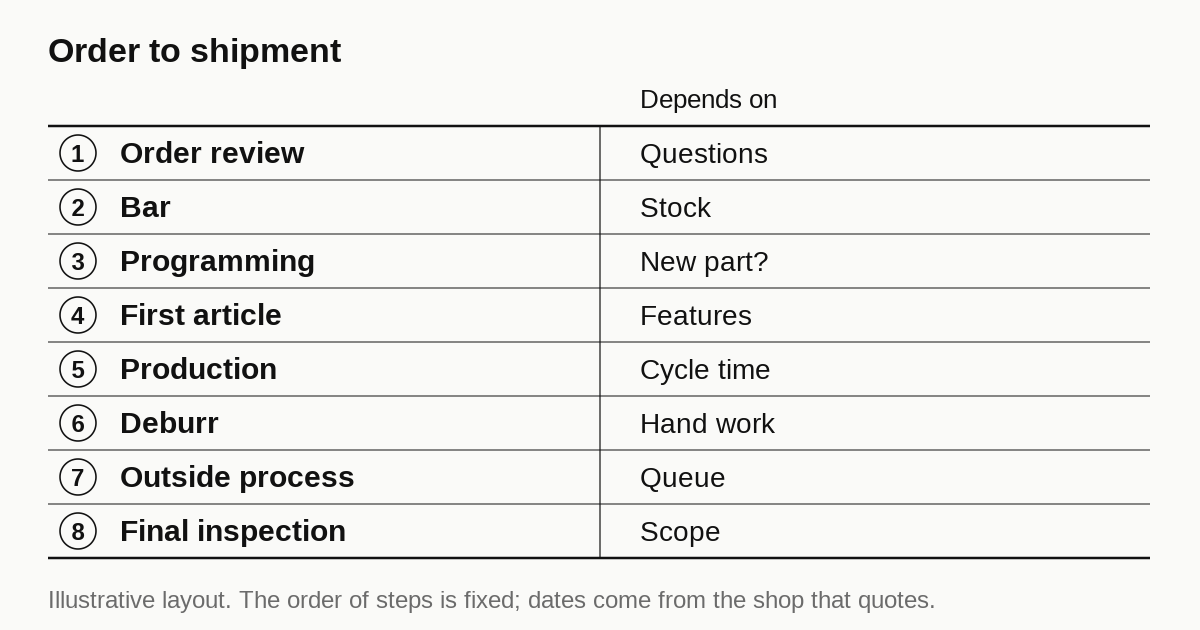
Titanium machining lead time is the sum of eight steps between the purchase order and the shipment, and the bar and the outside processes are usually the longest of them, not the cutting. This post walks the eight steps in order, shows what sets the time of each and lists what to ask a shop to confirm. For the stock side of the story, read our post on bar stock forms and lead time. This one covers everything after you decide to buy.
We own no machines, we name no shop and we do not set dates: the shop that quotes gives its own. We found no public benchmark of titanium CNC lead time by step, so the table below shows what decides each step, not how many days it takes.
The eight steps in order
| Step | What happens | What decides the time |
|---|---|---|
| 1. Order review | The shop checks drawing, specification and certificate line against the quote | Open questions on the drawing |
| 2. Bar | Stock is cut from a shelf, or a mill order is placed | Size, grade, specification and certificate in stock or not |
| 3. Programming and fixtures | Toolpaths and workholding are built and proved | New part or repeat part |
| 4. First article | The first piece is cut and measured against the drawing | Number of features, buyer sign-off |
| 5. Production run | Cycle time per part multiplied by the quantity | Cycle time, available machine hours |
| 6. Deburr and clean | Edges are broken and parts washed | Hand work per part |
| 7. Outside processes | Anodizing, heat treatment or NDT at another site | Queue at the processor, transport each way |
| 8. Final inspection and pack | Measured, certificate pack made, parts packed | Report scope, export paperwork |
Steps 1, 3, 4, 5, 6 and 8 happen inside the shop and can be planned. Steps 2 and 7 depend on another company’s queue, which is why they carry most of the uncertainty.
Step 2: the bar sets the start date
Mill lead times for titanium are not published as a current table. The only dated figure we found is from January 2015, when a titanium distributor’s blog reported that small-diameter products might need 30 weeks or more and larger diameters and plate 14 to 22 weeks. That was a backlog period and is not a forecast, so we show it only as a reminder that a mill order can be measured in months. Distributors shorten the path. Titanium Industries, for example, says it stocks round bar from 0.125 inch to 12 inches in diameter, offers custom cut lengths on request and supplies bar traceable through mill test reports. Its page does not state a lead time.
What matters on your drawing is whether the exact size, grade, specification and certificate type sit on a shelf. A drawing that names a specification the shelf stock does not meet turns a stock job into a mill order, as the stock forms post explains. Our guide to mill certificates shows how the certificate line changes the answer.
Step 4: the first article carries a review clock
When the order calls for first article inspection, production does not run ahead of it. Nikon AM Synergy’s published supplier terms say a supplier may not submit parts from the production run before the buyer accepts the first article, if the order requires that acceptance. GKN Aerospace’s guidance for AS9102 reports lists what triggers a full or partial new first article: a design change affecting fit, form or function, a change in source, process, inspection method, tooling or material, a change in the NC program and a production lapse of two years.
For lead time, that means two things. First, the buyer’s review days belong in the schedule. Second, a repeat order with an unchanged program may skip the step, while a changed program may not. Ask the shop whether your order needs a first article and who has to sign it. Our guide to drawing revision control shows how a revision can reopen it.
Step 7: outside processes are a separate queue
Anodizing, heat treatment and NDT usually happen at another site, with its own schedule and its own transport. One published example from a digital manufacturer, Protolabs, adds 5 business days to a CNC order for anodizing and 3 to 7 business days for a dimensional inspection report, on top of a 3 business day standard CNC lead time. Titanium CNC is not listed on that page, so use the figures as the shape of the problem and not as a titanium quote. A distributor of duplex and nickel alloys states that additional or third-party witness testing can extend its lead time beyond a week, a reminder that witnessed tests add days.
For titanium, each outside step is also a handoff: parts leave with their heat number and come back with a process certificate. The titanium anodizing guide and the post on pickling and chemical milling show which processes are common and what they need from the part.
Need a quote for this part? Get a titanium quote
Where the clock starts and where it stops
Two quotes with the same number of weeks can mean different things. Check each for:
- Start. From the purchase order, from the shop’s order acknowledgement, from the bar arriving or from the first article being approved.
- Stop. Ready to ship at the shop, shipped or delivered to you.
- Freight. The Incoterms rule on the quote. The International Chamber of Commerce describes Incoterms 2020 as eleven rules that clarify the tasks, costs and risks of delivering goods from seller to buyer. The rule you pick decides who books and pays the transport, so it also decides who owns the freight days.
- Partial shipments. Whether a first part of the quantity can leave early.
Our guide to measuring on-time delivery uses the same distinction: a confirmed date is only useful if both sides know what it measures.
What can be shortened and what cannot
| Lever | Effect | Condition |
|---|---|---|
| Accept a bar size that is in stock | Can remove the mill order | Part must fit inside the larger bar and the extra machining must be priced |
| Ship a partial quantity first | Parts reach you earlier | Needs agreement on certificates and invoicing per shipment |
| Release outside processing early | Parts reach the processor sooner | Needs the first article accepted first, if the order requires it |
| Drop a certificate type nobody needs | May unlock shelf stock | Only if the drawing owner agrees in writing |
| Give a forecast | Shop may buy bar before the order | A forecast is not a commitment, so the shop sets its own risk |
Do not shorten the first article, the certificate or a required inspection to save days. Those are the steps a rejected shipment traces back to. Our post on who pays when a titanium part is rejected shows why.
Questions to put to the shop
- Is the bar on the shelf, and does it carry the certificate my drawing names?
- Does the order need a first article, and who signs it?
- Which outside processes are involved, and who runs them?
- When does the lead time start and where does it stop?
- What is the date for each step, and who tells me when one moves?
- Can the quantity ship in parts, and how are certificates issued per shipment?
What to put on the RFQ
State the date you need the parts, whether the bar size and the certificate are negotiable and whether the first article needs your sign-off. Name every outside process. Send the drawing through the RFQ form and we reply within 24 business hours with one itemised quote that states the dates.
Sources
- Performance Titanium, “ATI Surcharge Holds Steady”, 5 January 2015 (dated distributor blog; mill lead times)
- Titanium Industries, titanium round bar: sizes, cut lengths and mill test reports
- Protolabs, lead times (digital manufacturer; titanium CNC not listed; directional)
- Langley Alloys, stock and lead time (duplex, nickel and other alloys; directional)
- Nikon AM Synergy, supplier terms and conditions F020 Rev F (first article and certificates)
- GKN Aerospace, AS9102 first article inspection report common mistakes, revision A, March 2022
- International Chamber of Commerce, Incoterms 2020 rules
Frequently asked questions
How long does titanium machining take from order to shipment?
There is no single public figure. The time is the sum of order review, bar, programming, first article, the run, deburring, outside processes and final inspection. The bar and the outside processes are usually the longest items, not the cutting. Ask the shop for a date per step on your drawing.
Why is titanium lead time longer than aluminium?
Two reasons that are not about cutting speed. Titanium bar in an unusual size, grade or certificate can be a mill order, and titanium parts often go to an outside processor for anodizing or inspection. We found no public study comparing the two metals, so treat the direction as general shop experience.
Does the lead time on a quote include shipping?
Only if the quote says so. Lead time normally ends when the parts are ready to ship, and freight time follows. The Incoterms rule on the quote shows who arranges and pays the transport and where risk passes. Ask the shop to state whether the lead time ends at its door or at yours.
Can a titanium order be shortened after the PO is placed?
Sometimes, by changing what is controllable: ship part of the quantity first, accept a bar size that is in stock or release outside processing earlier. Anything that touches the certificate, the first article or a required inspection should not be shortened without the buyer agreeing in writing.
Need a quote for this part?
Send the drawing. We send one itemised quote for the finished parts and reply within 24 business hours.
Get a titanium quote