Guides / Sourcing
Drawing Revision Control With a Titanium Shop: No More Parts to the Old Rev
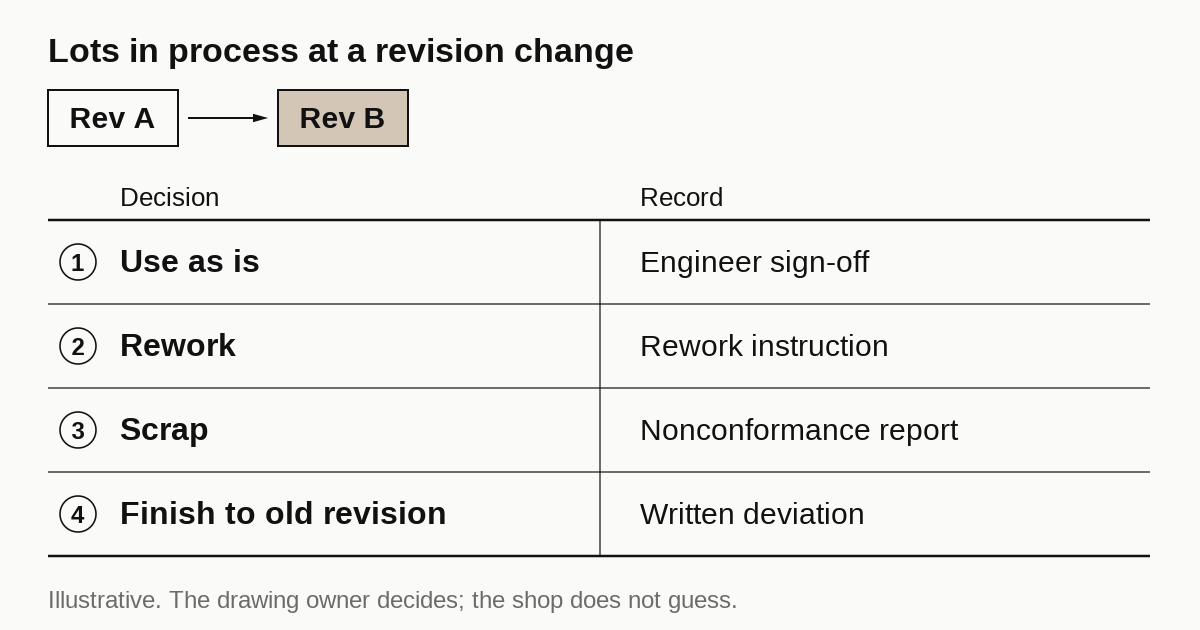
Stop a titanium shop cutting to an old revision by releasing every change as a controlled package: the new drawing with a revision letter, a list of what changed, a decision for every lot already in process and a written confirmation from the shop. Old revisions rarely reach the machine through one big mistake. They arrive through small gaps, such as an attachment to an older email, a saved copy on a programmer’s drive or a traveler printed before the change. In titanium the gap is expensive, because the bar is a large share of the cost of every part.
We own no machines. This is a handoff you can run with any shop, and nothing here is legal advice. For changes that alter the material itself, see our post on approving a titanium grade substitution.
How old revisions reach the machine
Walk the path a drawing takes and you will find the gap in one of these places.
- The quote file. The shop priced revision B, you released C and the programmer still has the quote folder.
- The program. CAM was built from a model of revision B. A drawing change that never reaches the model is never cut.
- The traveler or work order. It was printed with the revision at the time the job was released and not reprinted.
- The inspection plan. The inspection report is balloon-numbered to an old drawing, so the inspector measures the old limit and passes it.
- The outside process. Anodising or heat treatment is released from a purchase order that quotes the old drawing.
ISO 9001:2015 clause 7.5.3, in a trainer’s summary, asks that documented information be available and suitable “where and when it is needed” and describes version control as part of the control of changes. The same trainer notes that a common audit finding is an obsolete document still at the point of work even though the master list is correct. That is the failure here: the right revision exists, and the wrong one is on the bench.
What to send with a revision
ASME Y14.35 is the US standard that sets practices for revising drawings and associated documents, including methods for identifying and recording revisions. We read ASME’s own page, not the standard, so we do not quote its rules. In practice, send these four things with every revision.
- The drawing with the new revision letter and a revision block entry. A rev block is a tabulated list of the revisions of the drawing, as a general engineering drawing reference describes it.
- A change list. One line per change: the feature, the old value, the new value. A cloud on the drawing helps, but a list is faster to check.
- Effectivity. From which order, lot or serial number the change applies. “From now on” is not an effectivity.
- An open WIP decision. What happens to parts already cut, with the choices in the next section.
Add the model if you also send a model. A model-based definition can govern if the drawing and the model disagree, so say which one wins on the PO.
Asking the shop to confirm the revision
Ask for confirmation in writing, in the shop’s own documents, not only in an email thread.
- Order acknowledgement: drawing number and revision.
- Traveler: printed with the revision and signed at release.
- Certificate of conformance or inspection report: shows the revision it was measured against.
- Programs: the program header or setup sheet names the revision.
Ask the shop to withdraw the old drawing from the floor and from shared folders when a new revision arrives, and to tell you when it has done so. A secondary summary of clause 8.5.6, control of changes, lists review, authorisation, communication and documentation updates as the points of that clause. Those are good points for a shop to answer on your change.
Handling parts already in process
Never leave the WIP question open. The shop will either stop and wait, wasting machine time, or keep cutting and hope. Give a decision per lot.
| Decision | When it fits | Record to keep |
|---|---|---|
| Use as is | The change does not touch any feature already cut | Engineer sign-off naming lots and quantities |
| Rework | Cut features can still reach the new limit with material left | Rework instruction and re-inspection on the new revision |
| Scrap | Material cannot be put back and the new limit is out of reach | Nonconformance report with the heat number of the bar |
| Finish to the old revision | You accept the old revision for this lot only | Written deviation naming revision, lot and quantity |
Material cannot be put back, so a change that makes a feature smaller or a wall thinner than what was cut often means scrap for that lot. Ask the shop to tell you the stage of every lot at the date of the change, and use that to decide. Our post on who pays when a titanium part is rejected covers the cost side if the shop cut after the release.
Need a quote for this part? Get a titanium quote
Checking the revision on the inspection report
The inspection report is the last place a wrong revision can hide. Check three things on every report.
- The revision on the report matches the PO.
- The limits on the report match the changed features on your change list.
- The balloon numbers correspond to the drawing sheet you released.
First article inspection is a production validation process for a new or modified production process, as a general reference describes it, and the AS9102 forms list part number accountability, product accountability and characteristic accountability. For a drawing change, a partial or delta first article may be enough: a secondary source says it fits isolated changes, such as drawing changes after a design change, and that Form 1 box 14 records the baseline part number and the reason for the partial inspection. Whether a full or partial inspection is required is set by your customer requirement, so write the trigger on the PO.
A revision handoff checklist
Copy this list and use it for every release.
- New drawing saved with revision letter in the file name and in the title block
- Change list attached, one line per change
- Effectivity stated by order, lot or serial number
- Which governs if the model and drawing disagree
- WIP decision for every lot in process, with a named approver
- Shop confirmation of the new revision on order acknowledgement
- Shop confirmation that the old drawing is withdrawn from the floor and from outside process orders
- Traveler reprinted and program header updated
- First article scope stated: full, partial or none
- Inspection report revision checked on delivery
What to put on the RFQ
State the current revision on the drawing and in the RFQ, say how revision changes will be released and ask each shop how it controls drawings on the floor. A shop that answers with a procedure and a name is a better bet than one that says it is careful. Send the drawing through the RFQ form and we reply within 24 business hours with one itemised quote.
Sources
- ASME, Y14.35 revision of engineering product definition datasets and associated documents (scope page; standard not read)
- Auditor Training Online, explaining ISO 9001 clause 7.5.3 (secondary summary; standard not read)
- The Core Solution, ISO 9001:2015 clause 8.5.6 explained (secondary summary; standard not read)
- Wikipedia, Engineering drawing (revision block, engineering change orders, model-based definition)
- Wikipedia, First article inspection (definition and AS9102 forms)
- InspectionXpert, what is a first article inspection (delta FAI and Form 1 box 14; vendor page; AS9102 not read)
Frequently asked questions
How do I make sure a shop cuts titanium to the latest drawing revision?
Name the revision on the PO, send the changed drawing as a new file with a clear revision letter, and ask the shop to confirm the revision in writing on the order acknowledgement, the traveler and the inspection report. Ask it to remove the old file from the shop floor. One confirmation at the order is not enough when a revision changes mid-job.
What happens to titanium parts already in process when the drawing changes?
Someone with authority over the drawing must decide for each lot: use as is, rework, scrap or finish to the old revision under a written deviation. Do not let the shop decide by default. Material cannot be put back, so a feature cut undersize to the new limit usually means a remake.
Does a drawing revision need a new first article on titanium parts?
Often a partial or delta first article covers only what changed, if your quality requirement allows it. Under AS9102 practice, a delta inspection records the baseline part number and the reason for the partial inspection on Form 1. Your customer requirement decides the trigger, so state it on the PO.
Who owns the revision, the buyer or the shop?
The buyer owns the drawing and the release of a new revision. The shop owns making sure the floor only sees the current one. Both sides need a record: you of what you released and when, the shop of what it received, confirmed and withdrew.
Need a quote for this part?
Send the drawing. We send one itemised quote for the finished parts and reply within 24 business hours.
Get a titanium quote