Guides / Cost
How Batch Size Changes the Price of a Titanium Part: Setup, Price Breaks and Release Quantities
A titanium part gets cheaper per piece as the batch grows because setup is paid once per job, but only until setup is small against the per-part cost. After it, the price moves with material, cycle time and the number of re-setups, not with quantity. This post is part of our guide to how to reduce titanium machining cost. It is the longer-run companion to our post on why five prototypes cost so much each, and it covers quantities from 10 up and what happens when a job is released in lots.
We own no machines, we name no shop and we do not set prices: the shop that quotes sets its own setup hours and rates. The example below is arithmetic on stated assumptions, not a price list.
What is fixed per job and what is fixed per part
A cost-modelling guide from aPriori writes the setup term as: amortised batch setup equals setup time multiplied by the sum of the labour rate and the direct overhead rate, divided by batch size. A generic manufacturing-platform guide, MakerVerse, uses the same shape and says each setup takes 15 to 45 minutes of skilled labour for fixturing, tool loading, zeroing and first-article checks. That figure is for CNC work in general, not titanium, and the same page calls its own batch table illustrative.
| Cost item | Fixed per job or per part | What moves it |
|---|---|---|
| Programming and proving the toolpath | Per job | New geometry, long cutting times at cautious feeds |
| Fixture design and build | Per job | Thin or odd-shaped parts, number of setups |
| Tool trial and first article | Per job | Tolerance count, customer’s inspection rules |
| Bar (stock) | Per part | Blank size, grade, buy to fly |
| Cycle time | Per part | Geometry, cutting data, material |
| Tool wear | Per part | Abrasive titanium, cut length |
| Inspection per part | Per part | Tolerances and sampling plan |
| Outside finishing | Per part, often with a minimum lot charge (we found no public figure) | Process and rack size |
The first three lines are the fixed block that quantity dilutes. The rest set the floor that quantity cannot move. Our machining cost guide explains each of those lines.
The driver table
| Driver | Direction as quantity rises | Magnitude | Who controls it |
|---|---|---|---|
| Setup hours | Per-part share falls | Generic page: 15 to 45 minutes per setup; no public titanium figure | Shop, from your drawing |
| Number of setups | Falls only if the design allows | Generic page: 2 setups instead of 4 cuts per-part price by about 30 to 40 percent | Designer and shop |
| Bar | Per-part cost flat | We found no public bar price; see the blank sizing post | Buyer, through blank size |
| Cycle time | Flat, then falls if the shop optimises it | No public titanium figure | Shop |
| Tolerance | Flat | Generic page: plus or minus 0.01 mm costs 100 to 200 percent more than 0.05 mm | Designer |
| Minimum order for bar or finishing | Steps | We found no public figure | Supplier |
Magnitudes in the third column come from MakerVerse, a manufacturing platform. It is generic CNC, not titanium, so read it as direction only.
A worked example at 1, 10, 100 and 1,000 pieces
Assumptions, all ours and for the arithmetic only:
- Setup of 16 hours: 4 for programming, 8 for the fixture and tool trial, 4 for first article.
- Run time of 1.5 hours per part, with inspection and tool wear folded into the rate.
- A shop rate of 85 per hour and bar of 4 kg per part at 55 per kg. We found no public bar price, so the 55 is a placeholder.
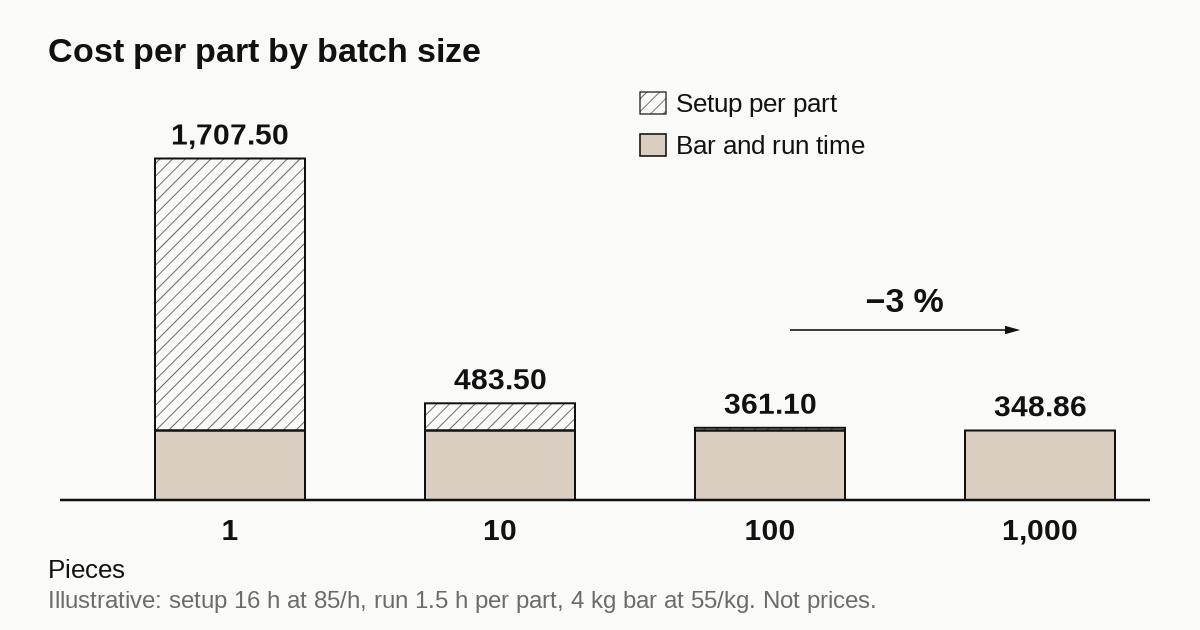
Cost per part is (16 x 85) / quantity + (1.5 x 85) + (4 x 55). The last two terms add up to 347.50.
| Quantity | Setup per part | Cost per part | Setup share | Index (1 piece = 100) |
|---|---|---|---|---|
| 1 | 1,360.00 | 1,707.50 | 80 percent | 100 |
| 10 | 136.00 | 483.50 | 28 percent | 28 |
| 100 | 13.60 | 361.10 | 4 percent | 21 |
| 1,000 | 1.36 | 348.86 | under 1 percent | 20 |
Most of the saving is gone by 10 pieces. From 100 to 1,000 the price falls by about 3 percent. That is the practical meaning of “where the curve flattens”. If you want the price to keep falling after that, quantity is the wrong lever. Shorter cycle time, fewer setups or a smaller blank are the levers, as our design for machining guide explains for the drawing.
Setup is different for different parts
The generic MakerVerse table gives the same shape for a machined part: about 160 at 1 piece, 52 at 10, 40 at 50 and 37 at 100, in euros. The page calls it illustrative and its text and table do not agree at quantity 1, so we use it for the shape only. The point holds either way: a part with a long cycle, such as a deep-pocketed titanium bracket, carries a smaller setup share than a short one, so its curve flattens sooner.
Need a quote for this part? Get a titanium quote
Release quantities and blanket orders
Many buyers place one order for 1,000 and release it in lots. Two things can reprice each release:
- Setup on each release. If the fixture and the program stay with the shop, a repeat run still needs the machine loaded, tools changed and the first piece checked. A change to the NC program can bring back a full or partial first article: one aerospace supplier requirement document, from GKN Aerospace, lists a change in the NC program among the triggers, together with changes in tooling or materials and a lapse in production of two years as defined in AS9102.
- Material price at shipment. A mill that applies its surcharge at the time of shipment can reprice material on each release. Carpenter Technology’s published page says surcharges are generally updated on the first business day of each month and apply at the time of shipment unless stated otherwise at order entry. Our quote validity guide covers how shops word that risk.
Using the same assumptions, suppose the 1,000 parts are released as ten lots of 100. If each lot is a new job with the full 16 hours of setup, the cost per part is 361.10. If the fixture and program stay with the shop and each release needs 4 hours of re-setup, the cost per part is 351.92, against 348.86 for one run of 1,000. The re-setup hours are our assumption. What matters is the gap between 361 and 352: the contract can say which one applies.
A published example of shop terms: one manufacturer’s quote terms apply for the period on the quote, 10 days if none is stated, and let prices be renegotiated if material or component costs rise by more than 4 percent. Treat that as one example of the wording, not a standard.
What to ask for in the quote
- Quantity breaks at 1, 10, the first production lot and the annual quantity, each as a separate line.
- Setup hours and rate shown separately from the run price.
- Which parts of setup are reused on a repeat release: program, fixture, inspection plan.
- How later releases are priced: firm, indexed to the supplier’s invoice or re-quoted before each release.
- The stock size priced, and whether whole bars are bought for the full quantity.
- Whether a first article is repeated on each release or only after a change.
- Minimum lot or minimum charge for outside finishing.
If the part only matters at a quantity of five, our prototype post covers that case. If you are comparing three shops, the quotes only line up when each shows the same breaks and the same release rule.
What to put on the RFQ
State the quantity breaks you want and the annual forecast, and say whether the order will be released in lots. Name the grade and the specification, and say whether you or the shop supplies the bar. For the other levers on a titanium quote, read our guide to how to reduce titanium machining cost. Send the drawing through the RFQ form and we reply within 24 business hours with one itemised quote.
Sources
- aPriori Cost Model Guide, accounting calculations (amortised batch setup formula)
- MakerVerse, how CNC manufacturing costs are calculated, June 2026 (vendor page; illustrative table, generic CNC)
- GKN Aerospace, AS9102 first article inspection report common mistakes, revision A, March 2022
- Carpenter Technology, raw materials surcharge (page dated 1 October 2026)
- Avalon, quote terms, revised 15 April 2024 (example of a manufacturer’s published terms)
Frequently asked questions
At what quantity does a titanium part stop getting cheaper?
There is no fixed quantity. In our illustrative example the price falls 72 percent from 1 to 10 pieces and a further 3 percent from 100 to 1,000, because setup is spread thin by then. After that the per-part price moves only with material, cycle time and the number of re-setups. Ask the shop for breaks on your own drawing.
What is the difference between a batch price break and a blanket order?
A price break is a quote for one job at one quantity. A blanket order is one purchase order released in lots over months. Setup, material price and quote validity then repeat on each release unless the contract says how they are handled, so state the pricing rule for later releases.
Does a new release of the same part need setup again?
Usually some. The program and fixture may be proven, but the machine is reloaded, tools are changed and the first piece is checked. A change to the NC program can bring back a full or partial first article, as one aerospace supplier requirement says. Ask what a repeat release costs.
Is there a public price for titanium setup?
We found no public figure for titanium setup hours or setup charges. A cost-modelling guide gives the formula and a manufacturing platform's generic table shows the shape of the curve. Both are directional. The setup line on a real quote, with hours, is the only number that applies to your part.
Need a quote for this part?
Send the drawing. We send one itemised quote for the finished parts and reply within 24 business hours.
Get a titanium quote