Guides / Finishing
Acid Etching Titanium: Pickling, Chemical Milling and What They Remove
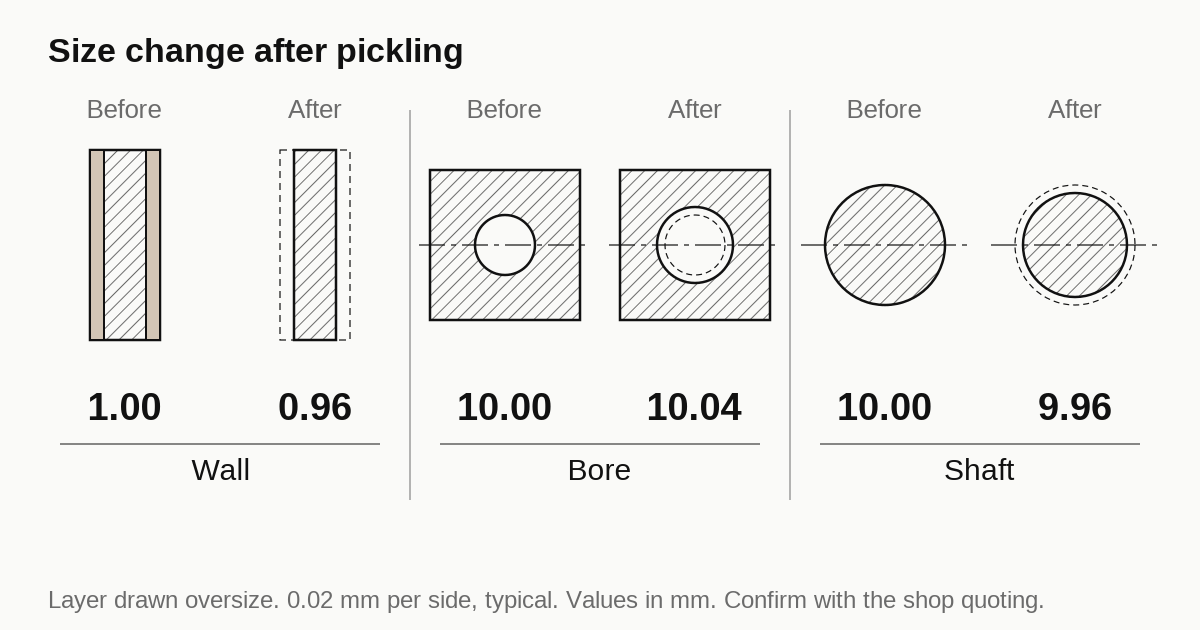
Machined titanium often goes to a tank of acid before it goes to the customer. The acid does a job the machine cannot do: it takes off the thin surface layer that heat, tooling and handling leave behind. That job has a price and a side effect, because the same acid removes metal from every surface it touches. A thin wall can end up thinner than the drawing allows, and a part that went into the tank in tolerance can come out of it outside.
This guide explains what pickling and chemical milling do, how much they remove, what risks come with them and how to write the requirement so the shop quotes it once.
Why titanium needs surface treatment after machining
Titanium reacts with oxygen and nitrogen when it is hot. Hot forming, heat treatment in air and some welding leave alpha case, a hard brittle surface layer that cracks under load. Machining can leave smeared metal, tool material picked up on the surface and iron from steel fixtures or tools. Fingerprints and coolant residue add organic contamination.
The treatments below remove these layers instead of leaving them in place. Titanium welding and alpha case explains how alpha case forms and why it has to come off physically. Where the part was only machined from clean bar and never heated in air, alpha case is not the issue, but smeared metal and contamination still can be, especially before inspection or anodizing.
What pickling is
Pickling is an acid dip. The usual bath is nitric acid with a smaller amount of hydrofluoric acid in water, with the nitric acid kept well above the hydrofluoric acid. That balance matters, because the hydrofluoric acid attacks the titanium and the nitric acid limits how much hydrogen the metal absorbs while it does.
What it removes:
- Oxide scale left after heat treatment or hot working.
- Alpha case, to the depth the process takes off.
- Smeared or burnished metal left by tools.
- Embedded iron and other contamination from tooling and fixtures.
Pickling is an outside process for most machine shops. It involves hydrofluoric acid, which is a serious hazard, so the work goes to a specialist processor with the tanks, handling and waste treatment for it. The processor adds days to the lead time and a minimum charge to the quote.
How much metal comes off
Pickling removes a thin layer from every wetted surface. The amount depends on bath strength, temperature and time, and processors control it by timing and sometimes by measuring a witness coupon. A drawing or process specification may state how much to remove.
Alpha case depth varies a great deal. After forging or heat treatment in air it can run from tens of micrometres to a few tenths of a millimetre, depending on temperature and time. Removing all of it can take more than a standard light etch, and a part with deep alpha case may need machining allowance for that reason.
The arithmetic that matters to a buyer is removal per side against feature size.
| Feature | Removal per side | Effect on size |
|---|---|---|
| 1 mm wall | 0.02 mm | Wall 0.96 mm, a 4 percent loss |
| 3 mm wall | 0.02 mm | Wall 2.96 mm, a 1.3 percent loss |
| 10 mm bore | 0.02 mm | Bore 10.04 mm, larger |
| 10 mm shaft | 0.02 mm | Shaft 9.96 mm, smaller |
| 25 mm bar thickness | 0.05 mm | Thickness 24.90 mm |
The figures are examples to show how the arithmetic works, not promised values. A processor will confirm the removal for its bath.
The consequence is that dimensions must be machined with the etch in mind. A shop leaves a small allowance on surfaces that will be pickled, so the part reaches size after the bath instead of before it. For thin walls, the allowance matters more, which links directly to thin wall titanium parts. The titanium machining tolerances guide covers how tolerance interacts with finishing steps.
What chemical milling is
Chemical milling uses the same chemistry for a different goal. The surface is coated with a masking layer, called a maskant. The maskant is cut away where metal should come off, and the part is immersed in the etchant. The acid removes metal only where it is exposed, and the depth is controlled by the time in the bath.
It is used to take weight out of large parts, to thin selected areas of a plate or skin, to cut shallow pockets across a wide area and to make shapes that would be slow or distorting to mill. Because no cutting force acts on the part and no heat builds at an edge, it suits thin, large parts that would bend under a cutter.
Its limits are real. The etch removes metal sideways under the edge of the maskant as well as downward, so pocket edges slope rather than stand vertical. Depth control is typically within a tolerance wider than milling holds, and surface finish on the etched area differs from a machined one. Masking, scribing and stripping the maskant are manual steps and drive the cost. It is a specialist process, again outside most machine shops.
Need a quote for this part? Get a titanium quote
Hydrogen control
Titanium absorbs hydrogen readily, and absorbed hydrogen makes it brittle. Etching in an acid bath is a recognised route for hydrogen pickup, so processors manage it in three ways:
- Controlling the acid ratio and temperature of the bath.
- Limiting the time in the bath and the removal.
- Measuring hydrogen content on test coupons or parts, and baking in a vacuum or inert atmosphere to drive it out where the specification requires it.
Which of these applies depends on the part’s specification. Aerospace and medical drawings often cite a process spec for etching and a hydrogen limit. Look for the callout and give it to the shop. Where a spec is not named, ask the processor which standard it works to. No number is given here, because the limit varies by specification and alloy.
Pickling before other steps
Pickling usually sits in the middle of a finishing sequence. Typical positions:
| Step | Why pickling comes before or after it |
|---|---|
| After machining, before inspection by penetrant | Removes smeared metal that can hide surface cracks |
| After stress relief or heat treatment | Removes scale and alpha case formed in the furnace |
| Before anodizing | Gives a clean, uniform surface so colour is even |
| After welding | Removes heat tint and oxide near the weld |
| Before shipping on medical parts | Part of cleaning and passivation routines |
For colour work, an uneven surface shows up as uneven colour, which is explained in titanium anodizing. For roughness changes after etching, see titanium surface finish. Ask the processor what surface roughness the part will have after the bath.
What goes wrong
- Part below tolerance after the bath. The shop did not leave allowance for removal, or the processor removed more than assumed.
- Uneven etch. Contamination or oil left on the part before the bath, or a part racked so acid pooled in a pocket.
- Hydrogen over the limit. Bath out of balance, or removal longer than specified, with no bake step planned.
- Staining and dark spots. Acid trapped in blind holes and crevices after rinsing.
- Mixed material in the tank. A steel part or fixture in the same bath contaminates titanium surfaces.
Good processors rinse thoroughly, use dedicated titanium racks and keep records of the bath for each batch.
What to ask on the quote
- Is pickling or chemical milling required, and by which specification?
- How much material is removed per side, and how is it measured?
- Has the shop left machining allowance for the removal?
- Who performs the process, and how many days does it add to the lead time?
- How is hydrogen controlled, tested or baked out?
- Does the processor use racks and baths dedicated to titanium?
- What does the sequence look like with inspection and anodizing, and where does the etch fit?
Add the finishing requirement and its specification to the drawing and send it on the RFQ form. Shops reply within 24 business hours. Where grade affects how the part reacts to etching, the titanium grades reference lists the common grades.
See also: ASTM B600, the guide to descaling and cleaning titanium.
Frequently asked questions
What does pickling do to titanium?
Pickling dips the part in an acid bath, usually nitric acid with a smaller amount of hydrofluoric acid, to remove oxide scale, alpha case, smeared metal and surface contamination. It removes a thin layer of titanium from every wetted surface, so thin features change size.
What is the difference between pickling and chemical milling?
Pickling cleans the whole surface and removes a small, even layer. Chemical milling uses a masking layer so the etchant removes metal only from selected areas, to a controlled depth, for example to reduce weight on a pocketed skin or plate. Both use acid, and both need hydrogen control.
Can pickling cause hydrogen embrittlement in titanium?
It can if the bath is badly controlled. Titanium absorbs hydrogen during etching, so processors keep the acid balance within limits and many specifications require hydrogen testing or a vacuum bake afterward. Check the drawing for a process specification and ask the processor how it controls hydrogen.
Need a quote for this part?
Send the drawing. We send one itemised quote for the finished parts and reply within 24 business hours.
Get a titanium quote