Guides / Grades
Titanium vs Inconel: Which Alloy for a Part That Runs Hot
Pick titanium when the part runs below roughly 315 to 400 °C and weight matters. Pick Inconel 718 when the part sees higher temperature, up to about 650 °C. Between those limits sits a middle option: near-alpha titanium such as Ti-6242, good to about 540 °C. The choice is almost always made by temperature first and by cost second, because titanium runs out of room before it runs out of money.
Temperature decides it
The upper service temperature is the first filter, and it is not one number for all titanium.
| Alloy | Typical upper service temperature | Source |
|---|---|---|
| Ti-6Al-4V | about 315 °C | DLR paper, ICAS 2004 |
| Ti-6Al-4V, annealed | through about 400 °C (750 °F) | Rolled Alloys |
| Ti-6242 (near-alpha) | about 540 °C (538 °C, 1000 °F, long term) | DLR paper, ASM Alloy Digest |
| Inconel 718 | up to about 650 °C (1200 °F) | Elgiloy, Combined Metals datasheet |
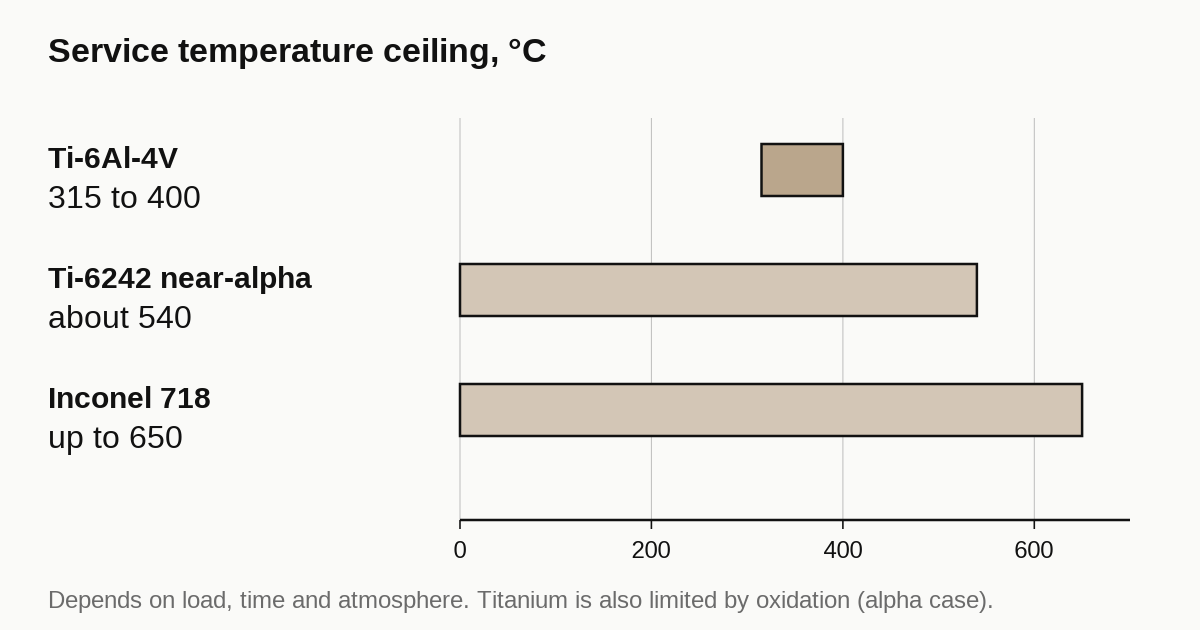
The spread for Ti-6Al-4V comes from what each source means by a limit. The German Aerospace Center paper, which is the more conservative of the two, explains why the titanium ceiling is where it is. The ceiling for near-alpha alloys is not set by strength or creep resistance. It is set by oxidation. Over long periods at temperature, titanium forms an oxygen-enriched brittle layer called alpha case, which sharply reduces ductility and fatigue strength. That is why the hottest compressor stages in an engine are made from nickel superalloys, which the paper says weigh nearly twice as much. Our guide to welding and alpha case explains the layer and how it is removed.
Inconel 718 is the other side. Aged half-inch bar tested at 1200 °F (649 °C) shows a 0.2% yield strength of 149 ksi (1027 MPa), a tensile strength of 168 ksi (1158 MPa) and 19% elongation, according to a supplier datasheet. For comparison, well-processed Ti-6Al-4V has a yield of 880 to 920 MPa at room temperature. In other words, hot Inconel 718 carries more stress than room-temperature Ti-6Al-4V.
Melting point is not the limit for either. Ti-6Al-4V melts at about 1650 °C and Inconel 718 between about 1260 and 1336 °C. Parts fail from creep, strength loss and oxidation long before they reach those temperatures. These figures are typical, not design values: always take design values from the specification and the part’s own load and life.
Weight is titanium’s reason to exist
Ti-6Al-4V ELI has a density of 4.42 g/cm³. Inconel 718 is 8.19 g/cm³. That is a factor of about 1.85. A 100 cm³ blank weighs about 442 g in titanium and 819 g in Inconel 718.
| Property | Ti-6Al-4V | Inconel 718 |
|---|---|---|
| Density | 4.42 g/cm³ (ELI) | 8.19 g/cm³ |
| Thermal conductivity at 20 °C | 6.6 W/m·K (ELI) | 11.4 W/m·K |
| Yield strength | 880 to 920 MPa at room temperature | about 1027 MPa at 649 °C (aged bar) |
| Typical upper service temperature | about 315 to 400 °C | up to about 650 °C |
If the part has to be light and stays below the titanium ceiling, titanium is the natural choice. If the part is hot, weight comparison stops mattering, because titanium cannot do the job. In engines this plays out as titanium in the cooler front stages and nickel alloys in the hot rear stages.
Cost: the same order of raw material, a very different blank
We found no open source that gives like-for-like bar prices for Inconel 718 and titanium. Mill product prices are contract prices. What the public data does show is raw input:
- Imported titanium sponge landed at about $12 per kg in 2025 (USGS estimate), down from $13.30 in 2024.
- Nickel averaged about $15,000 per tonne on the London Metal Exchange in 2025 (USGS estimate), about $15 per kg, down from about $16,812 per tonne in 2024.
- Inconel 718 is 50 to 55% nickel by composition, with 17 to 21% chromium and 4.75 to 5.5% niobium plus tantalum.
So nickel and titanium raw materials are in the same range per kilogram, and the alloy and conversion costs on top differ by grade and mill. The more concrete difference is mass. A bar of Inconel 718 has about 1.85 times the mass per unit volume, so the same blank weighs nearly twice as much and is bought by the kilogram. The titanium price guide covers what the sponge figures mean for a titanium quote.
Need a quote for this part? Get a titanium quote
Machining: both are slow
Neither alloy is easy. Titanium keeps heat at the cutting edge, as the speeds and feeds guide shows: Ti-6Al-4V conducts heat at about 7 W/m·K, and tool suppliers publish carbide milling starting speeds around 30 to 60 m/min. Inconel 718 has higher thermal conductivity than titanium, but it work hardens rapidly, and age-hardened Inconel 718 is typically cut with aggressive but slow passes using a hard tool to limit the number of passes. The work hardening guide covers the same effect in titanium.
We did not find an open tool-supplier table for Inconel 718 to quote, so we give no speed number for it. A shop that cuts both can tell you which one costs more cycle time on your geometry, and the answer depends on the part, the condition of the bar and the tooling.
Two practical points apply to both:
- Condition matters. The Inconel guidance above refers to age-hardened 718, and bar supplied in another condition will cut differently, so state the condition on the RFQ. Titanium in the annealed or solution-treated and aged state also cuts differently, as the STA guide explains.
- Heat treatment after machining. If aging follows machining, ask where distortion is expected and who allows for it.
How to choose
- Start with the maximum temperature and the duration at temperature. A brief excursion is different from continuous service.
- Check the atmosphere. Titanium in hot air forms alpha case, and the German Aerospace Center paper calls its oxidation resistance moderate compared with nickel superalloys.
- Check weight. If weight is not critical, the cheaper and easier path may be a different alloy altogether, such as stainless steel.
- Consider the middle option. Near-alpha titanium such as Ti-6242 reaches about 540 °C, and is a lighter answer than nickel where the temperature allows. The grades chart shows what is commonly machined.
- Ask the shop about the grade you pick. Cutting titanium well does not prove a shop cuts nickel alloys well, and the reverse is also true.
Send the drawing with the RFQ form and state the temperature, load and atmosphere. Replies arrive within 24 business hours, and shops tell you what they have run in each alloy.
If titanium is still in the running, our guide to titanium grade selection covers the high temperature alloys and the other grades.
Sources
- Leyens (DLR), “Advanced Materials and Coatings for Future Gas Turbine Applications”, ICAS 2004 (temperature limits, alpha case, nickel at nearly twice the weight)
- ASM Alloy Digest: TIMETAL 6-2-4-2 (long-term use to 538 °C)
- USGS Mineral Commodity Summaries 2026: Titanium and Nickel (sponge price, LME nickel price)
- Inconel (Wikipedia): melting range, work hardening, machining and Ti-6Al-4V (Wikipedia): strength, density, thermal conductivity
- United Performance Metals: Ti-6Al-4V ELI datasheet (density, thermal conductivity, melting point)
- Combined Metals (Elgiloy): Inconel 718 datasheet (density, thermal conductivity, composition, 650 °C limit)
- High Temp Metals: Inconel 718 data (aged bar at 1200 °F)
- Rolled Alloys: 6Al-4V titanium (annealed, service through 750 °F)
Frequently asked questions
What is the maximum service temperature of titanium?
For Ti-6Al-4V sources give about 315 °C (a German aerospace research paper) or through 750 °F, about 400 °C (a supplier page for annealed material). Near-alpha alloys such as Ti-6242 are rated to about 540 °C. Above that, oxidation and loss of ductility become the limit.
Is Inconel stronger than titanium?
At room temperature Ti-6Al-4V has a typical yield strength of 880 to 920 MPa. Aged Inconel 718 bar still shows a yield strength of about 1027 MPa at 649 °C. Per unit weight titanium wins at moderate temperatures, because Inconel 718 is about 1.85 times denser.
Which is harder to machine, titanium or Inconel?
Both are difficult. Inconel work hardens rapidly and age-hardened Inconel 718 is cut with slow, aggressive passes using hard tooling. Titanium conducts heat poorly, which keeps heat at the cutting edge. Ask the shop for its cutting data on your grade instead of assuming one is easier.
Is Inconel more expensive than titanium?
No open source gives a like-for-like bar price. Raw inputs are the same order of magnitude: about $12 per kg for imported titanium sponge and about $15 per kg for nickel in 2025. Inconel 718 bar has about twice the mass per unit volume, so a blank of the same size weighs nearly twice as much.
Need a quote for this part?
Send the drawing. We send one itemised quote for the finished parts and reply within 24 business hours.
Get a titanium quote