Guides / Process
When a Titanium Part Needs Five Axes: Impellers, Blisks and Deep Pockets
A deep pocket in titanium is a tool-length problem. The cutter has to reach the bottom, and the longer it sticks out, the more it bends, chatters and wears. In aluminium a shop can accept some of that. In titanium, with high cutting forces and heat at the edge, a long thin tool does not cut well, and a part with deep features can go from routine to expensive. Five-axis machines solve part of the problem by moving the tool to the part instead of the other way round. They also open geometry that three-axis machines cannot cut at all, such as impeller blades with undercut surfaces.
This guide explains where five axes help on titanium, where they do not and what a shop will ask for before quoting.
Why tool length drives titanium cost
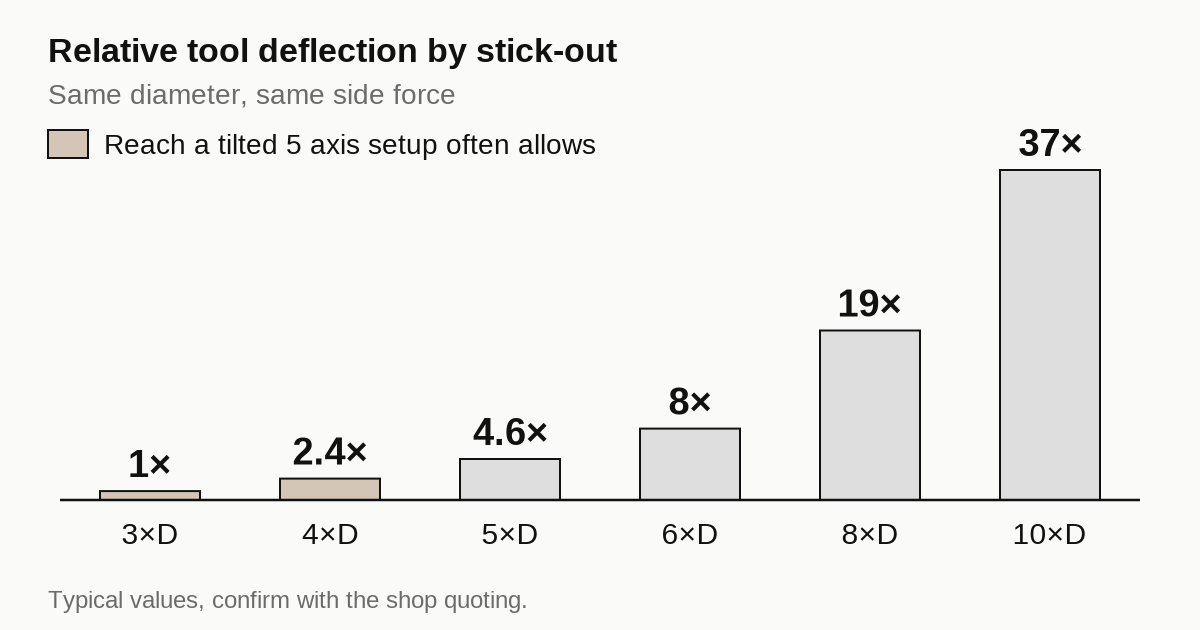
A cutter sticking out of its holder behaves like a cantilever beam. Its deflection under a given side force rises with the cube of the stick-out length and falls with the fourth power of the diameter. Doubling the stick-out multiplies deflection by about eight times. Halving the diameter at the same length multiplies it by sixteen.
Titanium makes this worse in three ways. Cutting forces are high for the strength of the tool. Thermal conductivity is low, so a rubbing tool heats quickly. And the surface skin work hardens when the tool deflects and rubs instead of cutting, a behaviour explained in titanium work hardening.
Shops therefore reduce tool length wherever they can. They step deep pockets in several depths with progressively longer tools, they use necked tools that reach in without rubbing and they tilt the part so the cutter approaches at an angle that needs less reach.
What five axes change
A five-axis machine has three linear axes plus two rotary axes, built as a tilting table (trunnion), a swivelling head or a mix. The rotary axes allow two different ways of working.
3+2 positioning. The machine tilts and locks the part, then cuts as a three-axis machine in the new orientation. One setup reaches the top, sides and angled faces, and the shop can bring short tools into pockets from the best angle. Most prismatic titanium parts that benefit from five axes need only this.
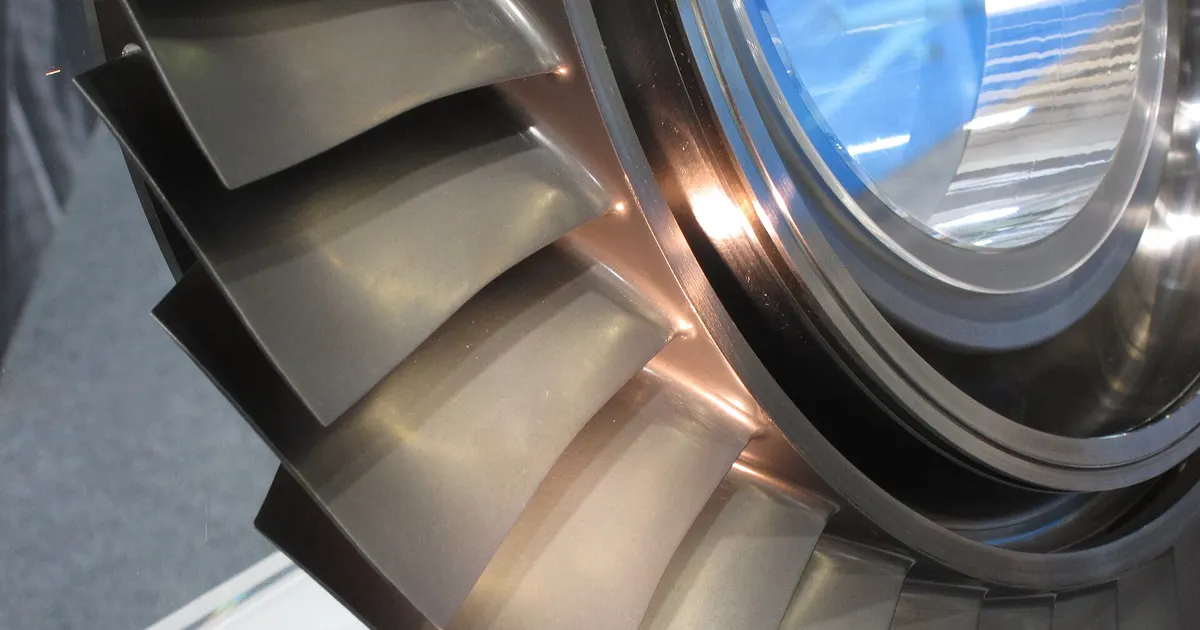
Simultaneous five-axis. The tilt axes move while the tool cuts. This is required for curved, continuously varying surfaces such as impeller blades, blisks and complex turbine geometry, and it is useful for contour finishing on freeform shapes. The programme is more complex and every move has to be checked for collisions.
| Approach | Setups | Tool reach | Typical use |
|---|---|---|---|
| 3-axis with several setups | Many | Long tools for deep features | Simple prismatic parts |
| 3-axis with indexer (4th axis) | Fewer | Better access around a cylinder | Round parts with features around the axis |
| 3+2 five-axis | One or two | Short tools from tilted angles | Housings, brackets, manifolds with angled features |
| Simultaneous five-axis | One | Short tools following the surface | Impellers, blisks, blades and freeform surfaces |
Impellers and blisks in titanium
Impellers, compressor wheels and blisks (a blade and disk made as one piece) use titanium for its strength-to-weight ratio, and Ti-6Al-4V is a common choice. They are among the hardest titanium parts to cut because the blades are thin, curved and close together, so a shop works through a sequence of steps:
- Roughing removes bulk metal between the blades with a stiff cutter, leaving an even allowance.
- Semi-finishing brings the blade and hub surfaces closer to size with a uniform stock left.
- Finishing the blade surfaces with a tapered or barrel-shaped tool, in several passes from hub to tip.
- Hub and fillet finishing, where the blade meets the base, with a smaller tool.
- Inspection, normally on a coordinate measuring machine or optical scanner with a blade profile report.
Blade deflection during cutting is the main problem. A thin blade flexes away from the tool and springs back, which is covered in thin wall titanium parts. Shops control it with a pattern that cuts both sides of the blade evenly, light finishing passes and sometimes support material left until the last step.
Cutter shapes matter here. Barrel (circle-segment) tools have a large radius on their side, which allows a large step-over and a good finish with fewer passes, and they work well on the long, gently curved faces of a blade.
Need a quote for this part? Get a titanium quote
Deep pockets and angled features
Not every five-axis part is an impeller. The more common case is a housing or manifold with deep pockets, angled bores and faces at several orientations. Five axes help in these ways:
- Shorter tools. Tilting the part lets the tool approach a deep corner from a direction that reduces overhang.
- Fewer setups. Each setup is a chance to introduce positional error and adds handling time. Machining all faces in one clamping keeps feature positions tied to one datum, which helps positional tolerances. See titanium machining tolerances.
- Constant engagement. The tool can keep a steady contact angle on curved floors and walls instead of burying itself in a corner.
- Better surface. Tilting the tool away from its tip, where cutting speed drops to zero, improves finish on curved faces.
A shop quoting a five-axis part often asks for the 3D model as well as the drawing, because collision checks and toolpath planning start from the model. Send both when you have them. Five axes do not remove the need for good design. Corner radii, wall thicknesses and pocket depth-to-width ratios still set the price. The design for machining guide lists the drawing choices with the largest effect.
What five axes add to the cost
| Cost item | Why it is there |
|---|---|
| Machine hourly rate | Five-axis machines cost more to buy and run |
| Programming | CAM time for toolpaths, collision checks and simulation |
| Fixturing | A smaller number of more rigid fixtures, designed for tilted access |
| Probing | Probing cycles to align the part and check stock before finishing |
| Inspection | Surface and profile checks on freeform geometry |
On balance, five axes tend to pay back on parts that would otherwise need three or more setups, a long reach or hand finishing of angled surfaces. On a flat plate part with shallow pockets they add cost with little benefit. A fair quote lets you compare. See titanium machining cost for where a titanium quote spends its hours.
Material and workholding points
Titanium bar, plate and forgings all feed five-axis work. Forgings near the final shape save the most machining time on impellers and complex housings but need a tooling cost and lead time of their own. Bar and plate cost less up front and leave more swarf.
Workholding in five-axis work has to be rigid and compact. Large clamps get in the way of the tilted tool, so shops use dovetail or zero-point systems, custom fixtures or a sacrificial stock section to hold the part from below.
What to ask on the quote
- Does the shop run 3+2 or simultaneous five-axis, and which does your part need?
- How many setups does the plan use, and which datum controls the critical features?
- What is the longest tool reach the plan needs, and how does the shop manage tool deflection?
- How does the shop check for collisions before the first cut?
- What inspection method covers the freeform or blade surfaces?
- Can the shop quote a three-axis alternative for comparison?
- What is the plan for residual stress or blade deflection on thin features?
Send the 3D model and drawing with the RFQ form and replies arrive within 24 business hours. If you have not chosen the grade yet, the titanium grades reference shows what each one machines like.
Frequently asked questions
Why use 5 axis machining for titanium?
Tilting the part or the spindle lets a shorter, stiffer cutter reach into deep features, keeps the cutting engagement steadier and finishes several faces in one setup. In titanium, where cutting forces are high and tool deflection ruins surface and accuracy, shorter tools matter.
What is the difference between 3+2 and simultaneous 5 axis machining?
In 3+2 machining the machine tilts and locks the part, then cuts as a normal three axis machine. In simultaneous five axis the tilt axes move during the cut, which is needed for curved surfaces such as impeller blades. Many prismatic titanium parts need only 3+2.
Does 5 axis machining cost more than 3 axis?
Machine hourly rates are usually higher, and programming time and simulation add to the quote. It often pays back by removing setups, fixtures and hand finishing. A shop will quote both routes for a part where either would work.
Need a quote for this part?
Send the drawing. We send one itemised quote for the finished parts and reply within 24 business hours.
Get a titanium quote