Guides / Grades
Approving a Titanium Grade Substitution: What to Ask Before You Say Yes
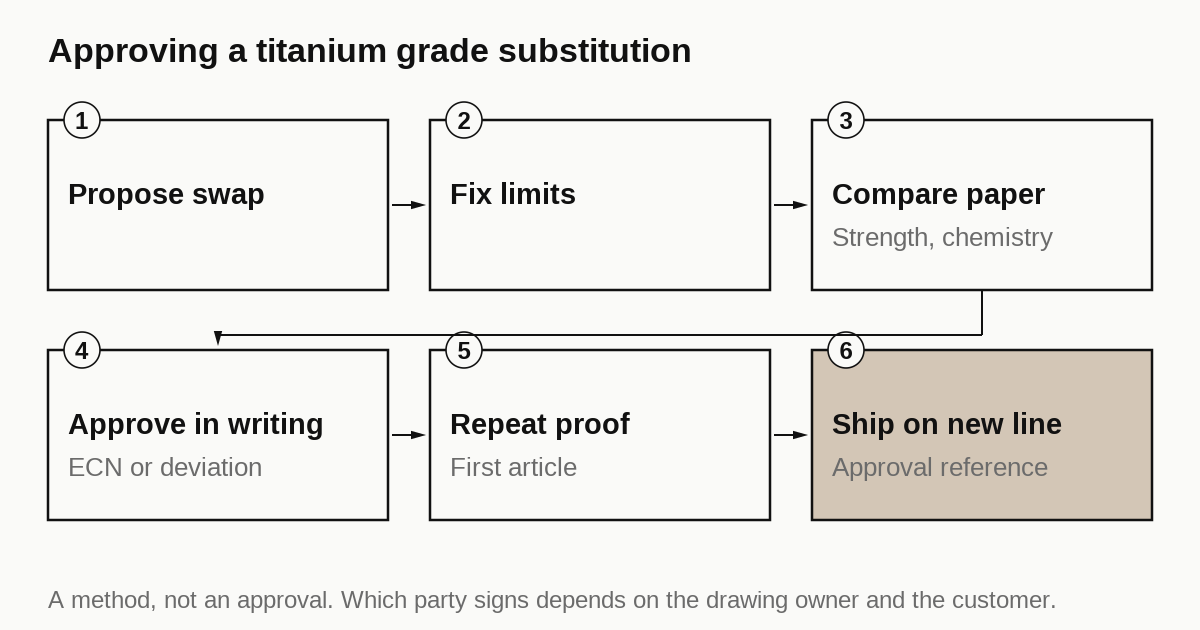
A titanium grade substitution is any change to the material line on the drawing: the grade, the specification, the condition or the product form. The rule is short. The shop proposes; the drawing owner decides in writing; the paper follows: a revised drawing or a deviation reference, then a certificate that names the approved material. This post is part of our guide to titanium grade selection. It is written for the buyer who has just read “we can offer Grade 2 instead” in a quote and has to decide what happens next.
We own no machines, we name no shop and we approve no substitutions. The approval belongs to you and your customer. Figures are specification minimums as printed by distributors. We did not read the ASTM or SAE texts, which are paywalled.
What counts as a substitution
| Swap a shop may offer | What actually changes | What to check |
|---|---|---|
| Grade 2 for Grade 5 | Strength: 39 percent of the tensile minimum, 33 percent of the yield minimum | Design owner re-checks the load case |
| Grade 4 for Grade 5 | 61 percent of tensile, 58 percent of yield | Same, and ask about fatigue and temperature |
| Grade 9 for Grade 5 | 69 percent of tensile, 58 percent of yield | Same, and confirm bar is stocked |
| Grade 5 for Grade 23 | Oxygen limit rises from 0.13 to 0.20 percent and iron from 0.25 to 0.40; toughness differs | Not allowed where an implant or toughness requirement names Grade 23 |
| B348 Grade 5 for AMS 4928 | Same alloy, different specification and certificate | Written approval; the certificate must still match the drawing |
| Annealed for solution treated and aged | Condition: bar tensile typically 138 to 155 ksi annealed against 150 to 172 ksi aged | Which condition the drawing fixes |
| Plate or forging for bar | Product form and the standard behind it | Whether the drawing fixes the form |
| An “equivalent” alloy such as Ti-6Al-7Nb | A different alloy | Never without the device or design owner |
Grade minimums (tensile MPa and yield MPa): Grade 2 345 and 275, Grade 4 550 and 483, Grade 5 895 and 828, Grade 9 620 and 483, Grade 23 828 and 759, from the Rolled Alloys grade table. Percentages are our arithmetic. Chemistry limits for Grades 5 and 23 are from the same table. Grade 23 is shown at the 828 MPa B348 value; the site’s reference page ties about 860 MPa to ASTM F136 implant bar, which is why older pages show a higher figure. Condition ranges are typical bar values from the Rolled Alloys Ti-6Al-4V datasheet.
The AMS 4928 row needs a caveat. Two Rolled Alloys pages differ on iron for Ti-6Al-4V: its ASTM B348 table lists 0.40 percent maximum, while its 6Al-4V datasheet, which lists AMS and ASTM numbers together without tying any figure to one of them, lists 0.30 percent (and hydrogen at 0.0125 percent maximum). Neither names AMS 4928 and we could not read the AMS text, so we do not claim which limits it sets. What the SAE listing does say is the scope: bar, wire, forgings, flash welded rings and drawn shapes in the annealed condition, in a document separate from B348. Our AMS 4928 and B348 guide shows how a dropped specification number becomes a wrong certificate.
Stage 1: before the RFQ, decide what is fixed
- List the fixed lines of the material note. Grade, specification and revision, condition, product form, approved source. Why: a shop can only quote what it can buy, and every line you leave open is a line it may fill with the cheapest stock. Good looks like: “Ti-6Al-4V per AMS 4928, annealed, bar” with the revision letter.
- Name the drawing owner. Why: someone must be able to say yes or no. Good looks like a named person or function, not “engineering”.
- Write one line on the service. Load, temperature, fluid, whether the part is welded or formed. Why: a shop that knows the service can say whether a cheaper grade is plausible, and you can judge its answer.
- Say who supplies the material. If you supply bar, the shop cannot swap it, and the certificate you hold becomes the proof. Why: it removes one variable from the comparison.
Stage 2: put the substitution rule on the RFQ
- Quote as drawn. Ask every shop to price the material exactly as written. Why: quotes you compare must be like for like.
- Ask for alternatives as separate options. Each option shows the grade or specification, the price difference and the lead time difference. Why: it keeps a swap visible instead of buried in a total.
- Say that no change is accepted without written approval. The RFQ form has no field for this, so use the part description box. Why: the rule travels with the RFQ to every shop it reaches. Our form fields are part description, grade, quantity, tolerance, needed by, certificates, preferred region and drawing. The grade list includes “Not sure yet” if you want shops to advise.
A line you can copy into the part description:
Material as drawn: Ti-6Al-4V, ASTM B348 Grade 5, annealed bar. Quote as drawn. List any alternative grade, specification or condition as a separate option. No substitution is accepted without written approval from the drawing owner.
Stage 3: when a quote proposes a swap
- Check whether the line is fixed. If the drawing or the customer fixes it, the answer is no and the quote is not comparable. Why: a quote that changes a fixed line cannot be set beside one that does not.
- Compare the strength minimums. Use the table above. Any drop in minimum yield or tensile strength needs the designer’s stress check, not a purchasing decision. Why: the minimums are the margin the design was built on.
- Compare chemistry and the specification. Same alloy under a different specification still changes the certificate. Ask the shop which specification and revision it would buy to. Why: the certificate proves only the document it names.
- Ask whose approval is needed. Where the part serves a customer’s product, assume that customer’s. One aerospace supplier requirement document from GKN Aerospace (revision A, 2022) says material certifications must be copies of the original mill certifications and that no material substitutions are allowed unless GKN approves them. Other customers write other rules, so read yours. Why: an approval from the wrong party does not protect the shipment.
- Choose the paper route. A permanent change is a revised drawing with a new revision letter and a note such as “material changed from Grade 5 to Grade 9 per approval reference”. A one-off change is a deviation or concession with a reference number. Why: the part number’s history must show which material it was made from.
Need a quote for this part? Get a titanium quote
Stage 4: before shipment
- Match the certificate to the approved line. It must show the grade, the specification and revision, the heat number and the approval reference. Why: receiving inspection will compare it with the drawing, and a gap there is the expensive place to find one. Our mill certificate guide lists what each document proves.
- Ask whether a first article applies. The GKN document says a full or partial first article is required for affected characteristics when materials change, when the design changes form, fit or function and in several other cases, including a two-year lapse in production as defined in AS9102. We could not open AS9102 itself. If your customer asks for first articles, a material change normally brings one, so settle it before the first part ships. Why: a missing first article found after shipment holds the whole lot.
- Check the heat number on the parts. The marking, the certificate and the packing list should agree. Why: a mismatch is how a wrong bar reaches the customer unnoticed.
Cost and lead time
We found no public figure for what a substitution costs, and it varies. The lines that move are stock price, machining time (the grade changes cutting speed), certificates, inspection and any repeated first article. Lead time moves with stock: a grade the shop holds ships faster than one on a mill order. Ask for these as separate lines in the quote.
Red flags
- “Or equivalent” with no named standard.
- A cheaper grade offered before anyone asked about the load case.
- A swap proposed after the shop has already bought material.
- A certificate that names a different grade or specification from the order.
- No heat number on the certificate or the parts.
- Reluctance to quote as drawn.
What to put on the RFQ
State the fixed lines, the service note and the substitution rule from Stage 2, and name the grade you want even if you are open to advice. If the grade is not yet decided, the guide to titanium grade selection walks the decision from requirement to drawing line, and our Grade 23 guide covers the case where tighter chemistry is the point. Send the drawing through the RFQ form and we reply within 24 business hours with one itemised quote.
Sources
- Rolled Alloys, titanium grades and relative properties (chemistry limits and minimum properties per ASTM B348)
- Rolled Alloys, 6Al-4V titanium datasheet (annealed and aged bar tensile ranges, AMS listing, chemistry)
- ASTM B348/B348M-25, scope and grade list
- SAE AMS 4928W listing, scope; AMS 4928X noted as newer
- GKN Aerospace, AS9102 first article inspection report common mistakes, revision A, March 2022 (supplier requirement: material substitution approval, partial first article triggers)
Frequently asked questions
Can a shop substitute Grade 2 for Grade 5 titanium?
Only with written approval from the drawing owner. Grade 2 has a minimum tensile strength of 345 MPa against 895 MPa for Grade 5, so the swap changes what the part can carry. A shop can propose it as a priced option, but it is a design decision, not a purchasing one.
Is ASTM B348 an acceptable substitute for AMS 4928?
Not unless the drawing owner approves it in writing. Both cover Ti-6Al-4V bar, but AMS 4928 is a different document, issued by SAE for aerospace use. The certificate has to name the specification the drawing names, and a B348 certificate does not prove AMS 4928.
Who approves a titanium material substitution?
The owner of the drawing and, where the part goes into a customer's product, usually that customer too. One aerospace supplier document we read says no material substitutions are allowed unless it approves them. Shops and suppliers such as this site do not approve substitutions.
Does a material change need a new first article inspection?
Often. One aerospace supplier requirement says a full or partial first article is needed when materials, process, source or tooling change. Whether yours is required depends on your customer's rules and the standard they cite, so ask before the first part ships.
Need a quote for this part?
Send the drawing. We send one itemised quote for the finished parts and reply within 24 business hours.
Get a titanium quote