Guides / Sourcing
Export Controls on Titanium Parts: How EAR and ITAR Apply to the Drawing You Send
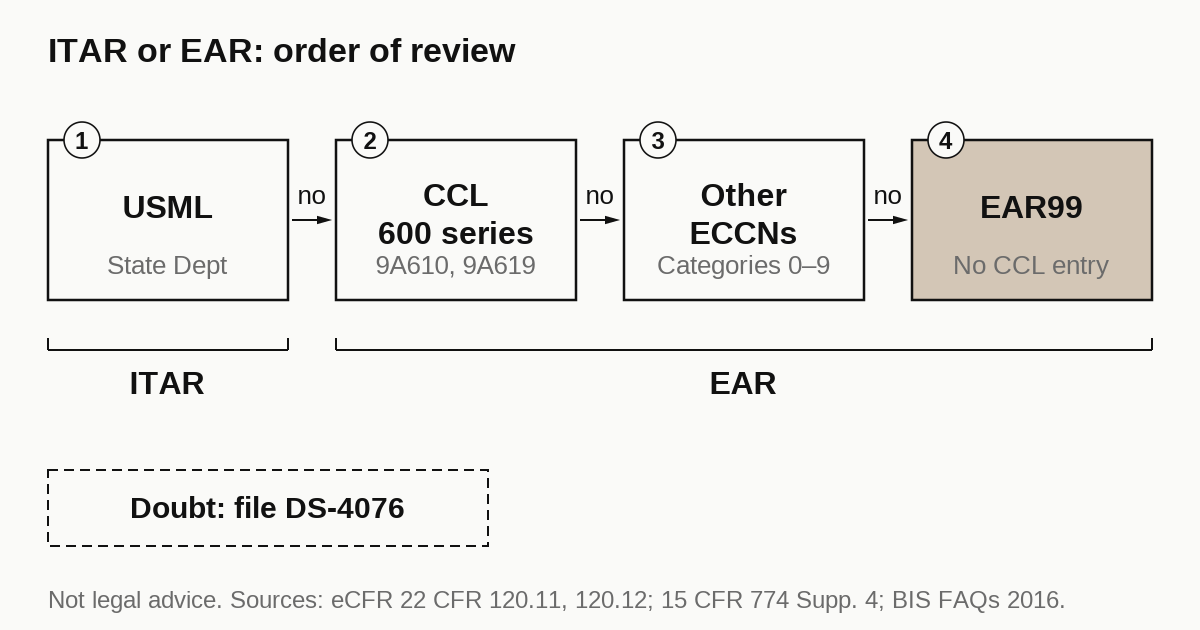
For titanium parts, export control attaches mainly to the item, its drawing and its end use, not to the grade name. A drawing for a part that goes on a military aircraft is technical data, and handing it to a shop in another country can be an export that needs approval first. So the sequence for a buyer is: classify the part, mark the drawing with the result, then decide who may receive it. This guide covers the US rules, because they are the ones most RFQs for aerospace and defence titanium meet. Other countries have their own, and your compliance contact has to check them.
We are not a law firm. Rules change, so confirm anything here with your export compliance officer or counsel. The regulation text below was read on the eCFR and BIS pages listed under Sources in October 2026.
Two rulebooks and who runs them
| ITAR | EAR | |
|---|---|---|
| Agency | State Department, Directorate of Defense Trade Controls (DDTC) | Commerce Department, Bureau of Industry and Security (BIS) |
| Covers | Defense articles on the US Munitions List (USML) | Everything else subject to the EAR, from dual-use items to former munitions |
| List | USML, 22 CFR 121.1 | Commerce Control List (CCL), 15 CFR Part 774 |
| Unlisted items | Not applicable | EAR99 |
The EAR itself says that items exclusively controlled by the State Department under ITAR are not subject to the EAR. That is why the order of review begins with the USML: an item is either under one rulebook or the other, and you find out by working through the steps.
What counts as the drawing
Under ITAR, technical data is information needed to design, build, operate, repair, test, maintain or modify defense articles, and the definition names “blueprints, drawings, photographs, plans, instructions, or documentation” (22 CFR 120.33). The same section excludes public domain information, general engineering principles taught in schools and colleges, and basic marketing information.
A defense article under 22 CFR 120.31 is not only the finished product. The definition includes technical data and also “forgings, castings, and similar unfinished products” that can be identified as defense articles by their properties, composition, geometry or function. For titanium buyers that is the point to remember: a near-net forging or casting made for a controlled part can itself be controlled before any machining. Our forging versus bar guide explains why buyers choose forged blanks, and for a controlled part the blank carries the same classification as the rest.
On the EAR side, “export” includes physical or electronic shipment out of the US and also releasing technology or source code to a foreign person inside the US, which counts as an export to that person’s most recent country of citizenship or permanent residency (15 CFR 734.13). So the drawing does not have to cross a border to be an export.
What exporting the drawing needs
For ITAR technical data, 22 CFR 125.2(a) requires a DSP-5 licence to export unclassified technical data unless the export is exempt. If a foreign company will manufacture a defense article, 22 CFR 124.1 requires prior written approval from DDTC for manufacturing licence agreements, technical assistance agreements and similar arrangements. Registration is a separate step: under 22 CFR 122.1 anyone in the US in the business of manufacturing defense articles must register with DDTC, and “a manufacturer who does not engage in exporting must nevertheless register.” That is a question for any US shop you consider for a controlled job.
For EAR items the answer depends on the classification. Each ECCN has a licence requirements section, and 15 CFR 738.2 describes how entries are built: ten categories numbered 0 to 9, five product groups A to E (A equipment, B test and production equipment, C materials, D software, E technology), and an ECCN such as 3A001 where the first digit is the category and the letter the group. Read the licence requirements of the specific ECCN, together with the destination and end user, before you send anything.
How to classify a titanium part
The State Department’s order of review (22 CFR 120.11) starts with the general characteristics of the article to find the USML category, then matches the specific characteristics to an entry. If an entry uses “specially designed”, the exclusions in 22 CFR 120.41 are checked, and an item that fits more than one entry goes under an enumerated entry rather than a catch-all. A defense article stays controlled when built into an item that is not on the USML, unless the regulations say otherwise.
If the item is not on the USML and no other agency has exclusive jurisdiction, it is subject to the EAR and BIS’s order of review applies (Supplement No. 4 to Part 774). BIS’s FAQ describes it in steps:
- Pick the CCL category (0 to 9), then the product group (A to E).
- Check the “600 series” ECCNs first, for an entry that does not depend on “specially designed”. If the item is described there, you stop.
- If not, review the rest of the category from the 000 series upward. The first entry that enumerates or describes the item is the classification.
- If nothing on the whole CCL fits, the item is EAR99.
The “600 series” are ECCNs in the xY6zz format. BIS says items controlled there were previously on the USML or are on the Wassenaar Arrangement munitions list. The BIS 600 series table lists, for example, 9A610 for military aircraft items from USML Category VIII and 9A619 for gas turbine engines from Category XIX. BIS also gives a worked example: parts for the C-130 and L-100 aircraft that are not enumerated or described on the USML are controlled under ECCN 9A610.x, unless a release in the “specially designed” definition applies. That shows how an ordinary machined titanium bracket can land in a 600 series entry because of which aircraft it fits, with no change to the material.
BIS also states plainly that you remain liable for violations that follow from an incorrect classification, even if you used its order of review or its decision tool. So record how you classified the part and who signed it off.
If doubt remains after the order of review, 22 CFR 120.12 provides a commodity jurisdiction determination, requested on form DS-4076. DDTC gives a preliminary response within 10 working days of a complete request, and if there is no final determination after 45 days the applicant may ask in writing for expedited processing. Registration with DDTC is not required to file.
Need a quote for this part? Get a titanium quote
What to state before the drawing circulates
A buyer who classifies early avoids the worst outcome, which is a drawing already sitting in several inboxes when someone asks the question. Put these on the RFQ, ahead of the attachment:
- Classification result: ITAR (USML category), EAR with the ECCN, EAR99, or “not yet classified”.
- Who classified it and when, with the drawing revision the classification refers to.
- Allowed places of manufacture, by country, if the classification limits them.
- Who may see the drawing, including whether foreign persons in the shop may.
- Drawing marking: a classification note in the title block or border.
- Material and stock: whether the mill product also carries a requirement, such as origin. Pair this with the paperwork in our mill certificate guide.
- Flow-down: whether the shop must pass the same terms to its own suppliers, for example heat treaters and inspectors.
If you cannot give item 1, say so. A shop that is told “unclassified, to be confirmed” can decide whether to quote at all.
What this means for our RFQ form
Our aerospace guide states that we do not accept RFQs for controlled defence articles. If your drawing is ITAR controlled, do not send it through the form. We hold no ITAR registration, and nothing on this site claims one. For EAR items, state the ECCN or EAR99 in the notes field; the reply with one itemised quote comes within 24 business hours. How a shop handles controlled data is a question for the shop, and you should ask it for its written procedure, as set out in our supplier checklist.
Start the RFQ at the RFQ form once classification is clear.
See also: the guide to buying titanium parts for the US market.
Sources
- 22 CFR 120.11 Order of review and 22 CFR 120.12 Commodity jurisdiction determination requests
- 22 CFR Part 120 definitions, including 120.31 defense article and 120.33 technical data
- 22 CFR 122.1 registration, 22 CFR 124.1 agreements and 22 CFR 125.2 technical data
- 15 CFR 734.3 items subject to the EAR and 15 CFR 734.13 export (same part), 15 CFR 738.2 CCL structure
- BIS, Commerce Control List Order of Review FAQs (updated October 2016)
- BIS, 600 Series Items FAQs (updated December 2016)
Frequently asked questions
Is titanium bar export controlled?
The answer depends on the item and its classification, not on the grade name. A drawing for a military aircraft part can be controlled even when the material is ordinary Ti-6Al-4V. Classify the finished part and its technical data first. Product group C of the Commerce Control List covers materials, so check it too if you buy a specialised alloy.
What is the difference between ITAR and EAR?
ITAR is run by the State Department and covers defense articles on the US Munitions List. The EAR is run by the Commerce Department and covers other items, including dual-use goods and former munitions items in the 600 series. Under the order of review you check the USML first, then the Commerce Control List.
Does sending a drawing to a foreign shop count as an export?
Yes, it can. Under ITAR, drawings are named as technical data, and exporting unclassified technical data needs a licence unless an exemption applies. Under the EAR, releasing technology to a foreign person is an export, including inside the US. Classify the drawing before it leaves your control.
How do I find out if my part is ITAR or EAR?
Follow the order of review: start with the US Munitions List entry, then the Commerce Control List 600 series, other ECCNs and EAR99. If doubt remains, a commodity jurisdiction request on form DS-4076 asks DDTC to decide, and registration is not required to file. This guide is not legal advice.
Need a quote for this part?
Send the drawing. We send one itemised quote for the finished parts and reply within 24 business hours.
Get a titanium quote