Guides / Process
Cutting Titanium by Spark Erosion: Wire EDM, Sinker EDM and the Recast Layer
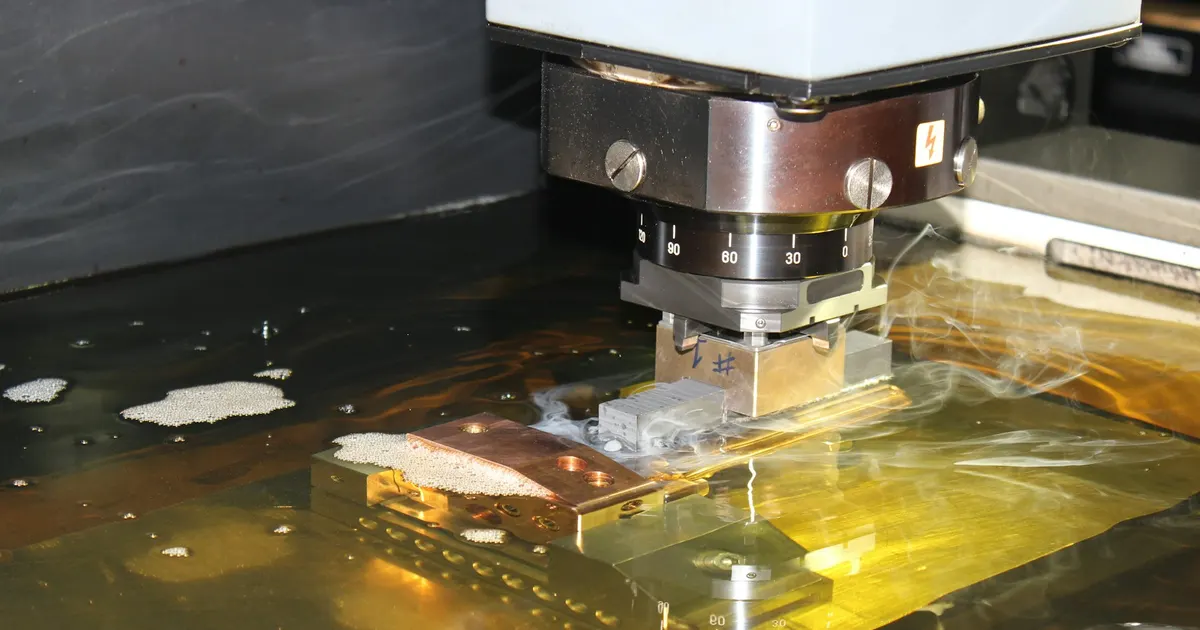
Some titanium features cannot be milled economically. A sharp internal corner has the radius of the cutter that made it. A very thin rib bends away from the tool. A slot in a hardened or heat treated section wears out cutter after cutter. For these jobs shops turn to electrical discharge machining, which removes metal with sparks instead of a cutting edge. The process works on titanium, but it leaves a surface condition that matters on aerospace, medical and fatigue-loaded parts, and that is where quotes and drawings often disagree.
How EDM removes titanium
EDM only works on electrically conductive material, and titanium is conductive. A series of controlled sparks passes between a tool electrode and the part, immersed in a dielectric fluid. Each spark melts and vaporises a tiny volume of metal, and the fluid flushes the debris away. No cutting force acts on the part, so thin and delicate features keep their shape while they are cut.
Two forms are common.
Wire EDM uses a thin travelling wire, often brass or coated brass, as the electrode. It cuts a profile through the thickness of the part like a very fine saw, in a bath or flushing stream of deionised water. It needs a start hole for any internal cutout, which a shop drills or burns first.
Sinker EDM (also called ram or die-sink EDM) plunges a shaped electrode, usually graphite or copper, into the part in an oil dielectric. It produces blind cavities, deep narrow slots and shaped pockets that a wire cannot reach because the feature does not go all the way through.
Where EDM beats milling in titanium
- Sharp internal corners. A wire cuts a very small corner radius. A milled corner carries at least the radius of the cutter, and deep pockets need large cutters. Design for machining explains why corner radius drives price.
- Thin features that deflect. With no cutting force, thin walls and fins hold their shape. For milled thin walls see thin wall titanium parts.
- Heat treated or hard sections. EDM is indifferent to hardness, which helps on aged or solution treated material.
- Profiles from plate without clamping force. A wire cuts parts out of plate with no cutting load, although residual stress in the plate can still move a part once it is free.
- Removing broken taps and tools. A shop can burn out a broken tap or drill, which is one reason EDM shows up on thread-related repairs.
- Small batches of complex profiles. No custom cutter is needed, only a program.
EDM is slower than milling for removing bulk metal, so shops mill first and use EDM only on the features that need it.
The recast layer and heat affected zone
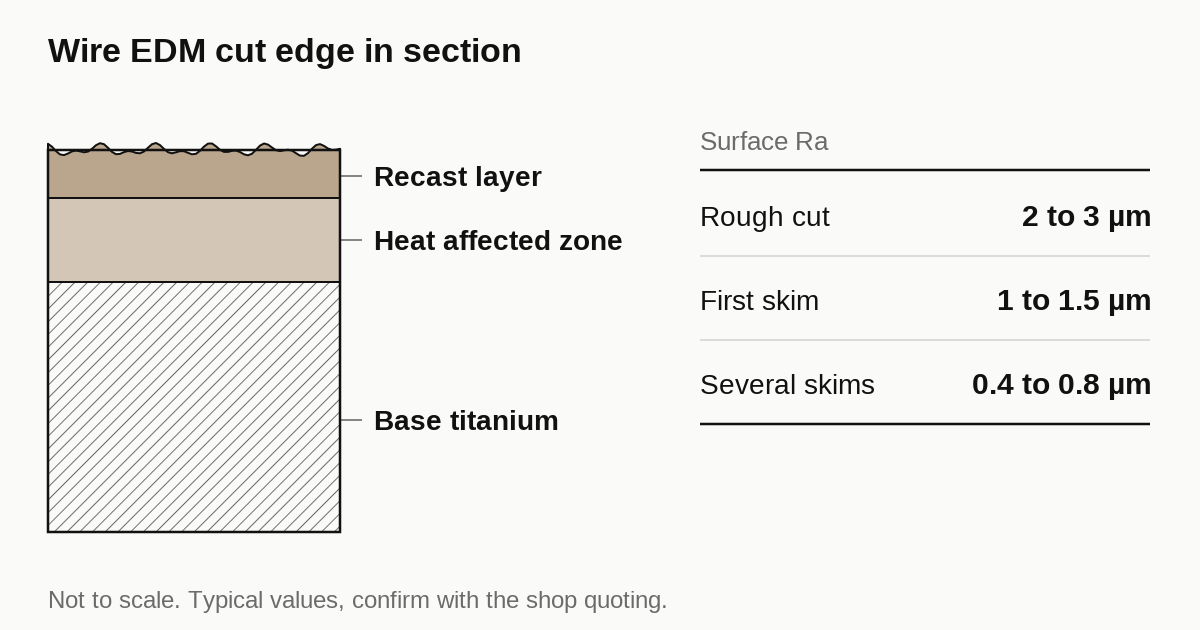
The sparks leave a mark on the surface. The thin film of titanium melted by each spark does not all leave with the debris. Some resolidifies as a layer on the cut surface, called the recast layer or white layer because of how it etches under a microscope. Beneath it sits a heat affected zone where the metal’s structure has changed without melting. Below that is unaffected base metal.
The recast layer is typically thin, in the range of a few micrometres to a few tens of micrometres depending on the energy of the cut. It is harder and more brittle than the base metal and can carry microcracks. Fatigue life, which depends strongly on surface condition, can suffer, so aerospace and medical drawings often limit it.
Shops reduce it with skim cuts. A first rough cut at high energy is followed by one or more finishing passes at lower energy that trim away the damaged layer and leave a thinner one. Each skim adds time and cost.
| EDM stage | Typical surface (Ra) | Typical recast layer | Use |
|---|---|---|---|
| Rough cut | around 2 to 3 µm | thickest | Blanks, non-critical profiles |
| First skim | around 1 to 1.5 µm | thinner | General parts |
| Multiple skims | around 0.4 to 0.8 µm | thinnest | Tight tolerance, fatigue-sensitive parts |
These are typical values. A shop will confirm what its machine and wire achieve on your grade and thickness. The surface comparison with milled and ground finishes appears in titanium surface finish.
Need a quote for this part? Get a titanium quote
Hydrogen pickup and alpha case
Titanium absorbs hydrogen readily, and hydrogen embrittles it. Wire EDM in a water-based dielectric is a recognised source of surface hydrogen pickup, and some specifications address it by limiting hydrogen content or by requiring removal of a surface layer or a vacuum bake afterward. Whether your part needs this depends on its specification, so look for it on the drawing. If a drawing refers to a process spec for EDM, ask the shop which spec it follows and whether it has run it on titanium before.
Oxygen and nitrogen are the neighbouring concern. They form alpha case when titanium is heated in air, and while EDM happens under fluid rather than in air, many shops treat the whole question of surface contamination together. See titanium welding and alpha case for what alpha case is and how it comes off.
Common post-EDM routes, depending on the drawing:
- Light mechanical removal by polishing or abrasive blasting of the recast layer.
- A chemical etch that removes a controlled thickness from the surface.
- Machining a finish pass where the geometry allows.
- Inspection, such as a cross-section of a sample, to show the layer depth.
Tolerance and finish on EDM cuts
Wire EDM can hold tighter tolerances than most milling on small profiles, and shops commonly quote in the range of ±0.005 mm to ±0.013 mm on skim-cut features. Part thickness, wire condition, thermal drift and flushing all affect what a shop can hold. Thick parts (above about 50 mm) are harder, because the wire deflects and flushing is poor deep in the cut.
Sinker EDM tolerance depends on electrode wear, so shops use several electrodes on deep or precise cavities. Expect longer lead time because electrodes have to be made.
Tolerance in general, including how to choose which dimensions to call out, is in titanium machining tolerances.
What EDM adds to a quote
| Item | Why it costs |
|---|---|
| Wire cutting time | Slow bulk removal, charged by cut length or time |
| Skim passes | Each pass is another trip around the profile |
| Start holes | Drilling, or burning a start hole in thick material |
| Electrodes (sinker) | Made, measured and replaced as they wear |
| Post-EDM treatment | Etch, bake or inspection as specified |
Shops quote wire EDM by cut length or by time, so a drawing with long profiles in thick plate costs far more than the same profile in thin sheet. The same logic applies to sinker work, where electrode count and burn time set the price. EDM on a titanium part is rarely the whole job. It usually fits between milling and finishing operations, so the shop’s routing decides when the part leaves the milling machine and when it returns.
What to ask on the quote
- Which features does the shop plan to cut by EDM, and which by milling?
- Wire or sinker EDM, and in what dielectric?
- How many skim cuts does the quote include?
- Does the drawing limit recast layer depth or hydrogen content, and has the shop met that before?
- What post-EDM treatment is included: etch, polish or none?
- What tolerance and surface roughness does the shop expect on the EDM surfaces?
- How does it inspect them?
Mark the EDM features on the drawing, describe any recast or hydrogen requirement and attach everything to the RFQ form. Shops reply within 24 business hours. For the grades most often cut this way, see the titanium grades reference.
Frequently asked questions
Can you wire EDM titanium?
Yes. Titanium conducts electricity, so wire EDM cuts it without cutting force. It is used for profiles, thin sections, sharp internal corners and features that would deflect under a milling cutter. Cutting rate is slower than milling for bulk removal.
Does EDM leave a recast layer on titanium?
Yes. Each spark melts a thin film of metal that resolidifies on the cut surface as a recast layer, with a heat affected zone beneath it. Its depth depends on the settings, and skim cuts make it thinner. Fatigue-critical parts often have a drawing note that limits or removes it.
Is hydrogen pickup a concern with EDM on titanium?
It can be. Titanium absorbs hydrogen readily, and cutting in a water-based dielectric is a recognised source. Ask whether the drawing or a process specification limits hydrogen content or requires a removal step, and whether the shop follows it.
Need a quote for this part?
Send the drawing. We send one itemised quote for the finished parts and reply within 24 business hours.
Get a titanium quote