Guides / Industries
Titanium in Racing: Machined Parts, Fasteners and Exhaust Components
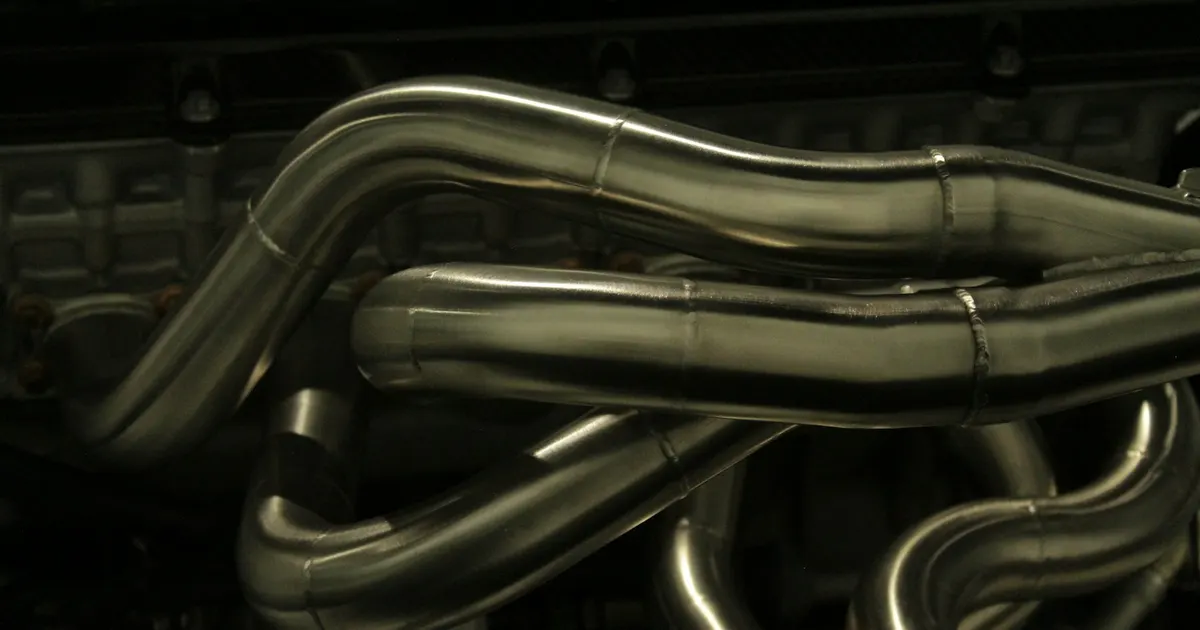
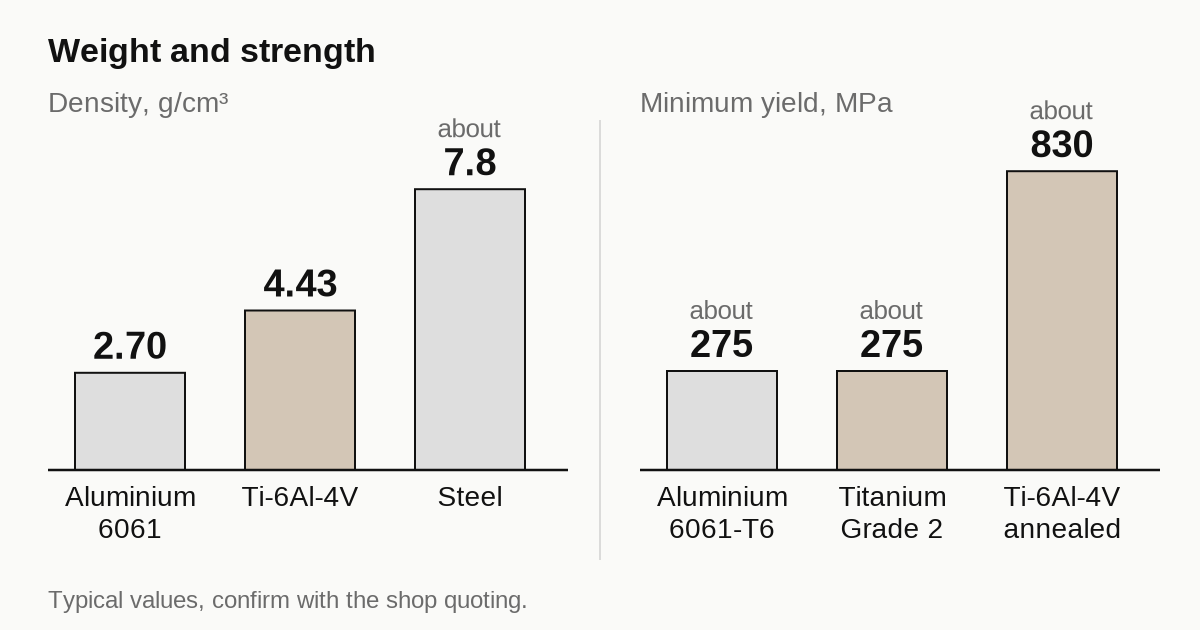
Racing buyers ask for titanium to save weight, and they are usually right to. Ti-6Al-4V has a density around 4.4 g/cm3 against about 7.8 for steel, and it holds strength at temperatures where aluminium gives up. The cost is a part that takes longer to cut and a supply chain that expects a clear drawing.
This guide covers where titanium pays off on a race car or bike, which grade belongs where and what the quote needs to say.
Where titanium earns its cost
Weight matters most where it moves. Parts that spin, reciprocate or sit unsprung give the largest return for each gram removed.
| Part | Typical material | Reason |
|---|---|---|
| Wheel studs, bolts, suspension fasteners | Ti-6Al-4V (Grade 5) | Strength at low weight, unsprung or rotating mass |
| Brackets, mounts, pedal box parts | Ti-6Al-4V (Grade 5) | Stiffness and strength in a small section |
| Uprights and hub parts | Ti-6Al-4V (Grade 5), billet or forging | Where regulations and budget allow |
| Engine parts such as connecting rods, valves and retainers | Ti-6Al-4V and other specialist alloys | Reciprocating mass |
| Exhaust tube and manifold sections | Commercially pure grades or Ti-3Al-2.5V | Formable, weldable, tolerates heat |
| Spring parts and clips | Beta alloys in some cases | Elastic range, shop and designer decide |
The grade reference lists each designation. If you are comparing against aluminium for a bracket, titanium vs aluminum covers where each wins, and against steel, see titanium vs stainless steel.
Strength and stiffness, put in numbers
Annealed Ti-6Al-4V has a typical minimum yield strength around 830 MPa. Aluminium 6061 in T6 is around 275 MPa. Titanium is also less stiff than steel, with a modulus of roughly 114 GPa against about 200 GPa, so a titanium part swapped one-for-one for a steel part will deflect more. Designers adjust the section. A machine shop does not, so the drawing has to carry the final geometry.
Billet or forging
Race parts are often cut from billet because quantities are small and the design changes. A billet part machined from bar has uniform properties but a grain direction that follows the bar, and a high buy-to-fly ratio on complex shapes. A forged blank has better grain flow and less waste for repeat parts, but tooling costs money and takes weeks.
For one-offs and runs below a few dozen, billet is usually what a shop will quote. For a repeat part, ask the shop about a forged or near-net blank and titanium stock forms and lead time covers the sourcing side. Our buy to fly calculator gives the stock weight from the geometry.
Fatigue is the failure mode
Race parts see rapid, repeated and sometimes extreme loads, and titanium fatigue life depends heavily on surface condition. Four things matter on the drawing.
- Radii in internal corners. A sharp corner concentrates stress. State the minimum radius.
- Surface finish on loaded faces. Tool marks across a loaded section can start a crack. Call out Ra on those faces, see titanium surface finish.
- Clean cutting. A dull tool leaves a smeared, work-hardened surface layer. A good shop changes tools on a schedule. See titanium work hardening.
- Post-process treatments. Some race parts are shot peened or polished in critical areas. These are separate processes with their own specifications. Name the one you want rather than writing “improve fatigue”.
A shop cannot validate your load case. Design validation and testing stay with the team that owns the part. The shop supplies to the drawing and the inspection plan.
Condition and heat treatment
Ti-6Al-4V is commonly bought annealed, and some race parts are specified solution treated and aged for higher strength. The condition changes cutting behaviour and the order of operations, because a shop usually rough machines, heat treats and then finishes to size so that distortion from the treatment is cut away. If your drawing calls a heat treated condition, name the specification and say whether the treatment is done before or after machining. A treatment in a vacuum furnace avoids the oxygen-rich surface layer that forms in air, which is why a shop will ask about it. If you only write “heat treated”, expect questions before the quote.
Hot-formed or forged blanks arrive with a surface layer that must be machined off. The drawing’s stock allowance and the shop’s blank size need to agree, or the finished part is undersize.
Need a quote for this part? Get a titanium quote
Fasteners and threads
Titanium bolts are a cheap way to save weight, but threads gall without lubricant. Use an assembly lubricant or anti-seize rated for titanium and set torque values from the fastener supplier, because a titanium bolt does not take the same torque as a steel one of the same size. Rolled threads are stronger in fatigue than cut threads, and for a critical fastener that difference matters. For machined threads, ask whether the shop thread mills. Drilling titanium covers the hole side.
If the part is a critical fastener rather than a custom machined bolt, buy it from a fastener manufacturer who tests it. A machined bolt is a custom part, and the buyer owns its qualification.
Exhaust components
Titanium exhaust parts are formed and welded more often than machined. Machined items include flanges, collectors, clamps, v-band rings, mounting brackets and valve actuator housings. Three things apply.
- Welding needs inert gas shielding. Inside and outside the weld, or oxygen embrittles the joint. See titanium welding and alpha case.
- Heat colours the surface. Titanium exhaust turns blue, purple and straw with use. That is a thin oxide film, and it is cosmetic.
- Thin wall distorts. Machined thin flanges and thin walls need stress-relief steps in the process. Titanium thin-wall parts explains why.
Regulations and traceability
Many series restrict titanium in some components, or require specific approvals for safety-critical parts. Rules vary by series and by year, so confirm against the current technical regulations before you order. Parts that go into a safety-critical position usually need the material certificate tied to a heat. Titanium mill certificates explains what to ask for, and titanium machining tolerances covers what is realistic to specify.
Prototype runs and revisions
Race programmes change a part many times in a season. A few habits keep a titanium order from drifting.
- Revision on the drawing. Put the revision letter on the drawing and the RFQ. A shop that machines revision B while you ordered revision C costs a week and the material.
- First off before the batch. For a run of more than a handful, ask for one part inspected and approved before the rest are cut. It adds a day and prevents a scrapped batch.
- Order material early. Bar for one-off parts is often available from stock, but a specific specification or a large section can take weeks. See titanium stock forms and lead time.
- Keep spares of the blank. If the design is likely to change, ask the shop to cut one extra part from the same heat for later comparison.
Lead time is quoted by each shop, so ask for it in writing alongside the price.
What to put on the RFQ
Part: upright bracket, drawing and STEP attached. Material: Ti-6Al-4V, ASTM B348 bar, annealed. Forged blank acceptable if available. Certificate: EN 10204 3.1, heat number recorded against each part. Critical faces: Ra 0.8 on the faces marked A, all internal radii 1.0 mm minimum. Finish: bead blast, no anodize, edges broken 0.3 mm. Inspection: first off dimensional report, dimensions marked with a diamond. Quantity: 8 now, repeat orders possible. Needed by: date.
Shops typically confirm tolerances, finish and lead time in their quote. Send the drawing through the RFQ form and we reply within 24 business hours with one itemised quote, made by a partner shop that cuts titanium.
For the grade decision in general, read titanium grade selection.
Frequently asked questions
Why is titanium used for racing parts?
Because it gives high strength at about 56 percent of the density of steel, keeps that strength at exhaust and engine temperatures and resists fatigue well. It is usually chosen where a lighter part saves weight in a rotating, reciprocating or unsprung position.
Which titanium grade is used for race fasteners and brackets?
Ti-6Al-4V (Grade 5) is the usual grade for machined brackets, fasteners and engine parts. Commercially pure grades and Ti-3Al-2.5V appear in exhaust systems and tubing, where formability and welding matter more than peak strength.
Do racing series restrict titanium?
Some do, in specific parts such as fasteners, valves or suspension. Rules differ by series and change by year, so check the current technical regulations before ordering.
Need a quote for this part?
Send the drawing. We send one itemised quote for the finished parts and reply within 24 business hours.
Get a titanium quote