Guides / Industries
Titanium Watch Cases and Consumer Parts: Plan the Finish Before the Cut
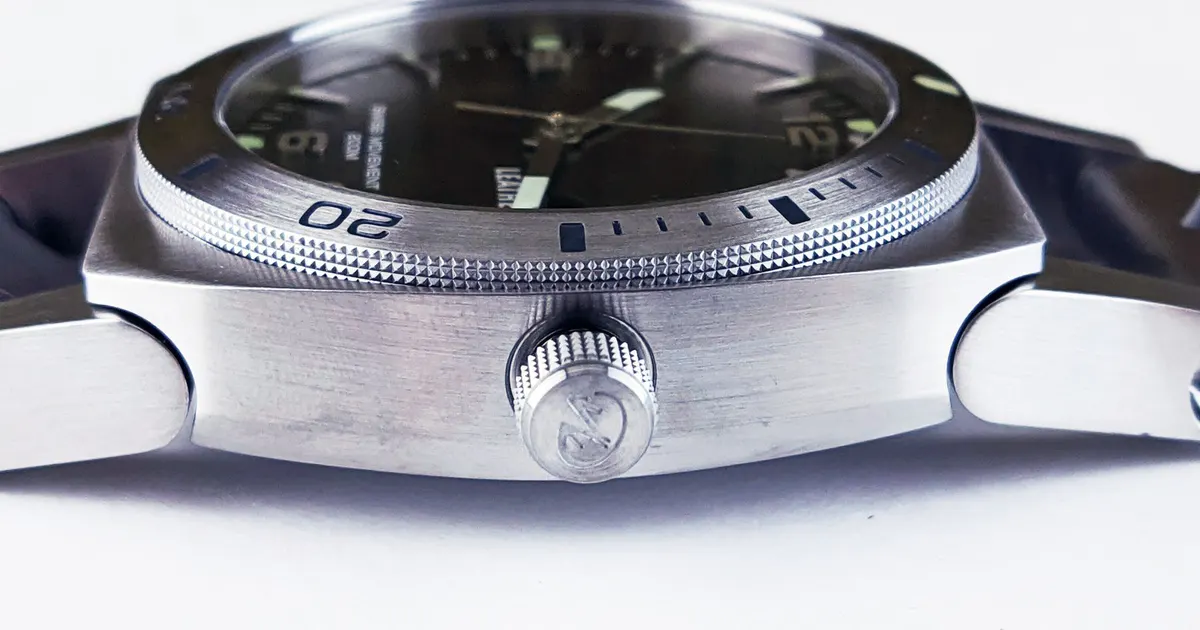
A watch case is judged by hand and by eye. A shop can hold every dimension on the drawing and still ship a part the customer rejects, because the brushed flat has a visible tool line or a polished bevel shows a ripple. That is why this guide starts with the finish and works back to the cut.
The same applies to other visible consumer parts in titanium: pen bodies, torch housings, phone frames, camera rings, jewellery components and bracelet links. Appearance sets the sequence.
Why titanium for a case
- Weight. At roughly 4.4 to 4.5 g/cm3, titanium is about 40 percent lighter than 316L stainless steel for the same volume.
- Skin contact. Commercially pure grades carry no added nickel, which suits wearers with nickel allergy.
- Corrosion. Sweat, salt water and soap do not attack titanium in normal use.
- Feel. Titanium conducts heat poorly, so it warms to the wrist quickly.
The drawback is scratch resistance. Commercially pure titanium is soft compared with hardened steel or ceramic, and visible wear is a frequent complaint about titanium watches.
Grades and hardness
| Grade | Typical hardness | Behaviour |
|---|---|---|
| Grade 2 (CP) | Around 150 to 200 HV | Softer, easier to cut, scratches readily |
| Grade 5 (Ti-6Al-4V) | Around 300 to 350 HV | Harder, holds edges and brushed finish better, costs more to cut |
| 316L stainless, for comparison | Around 150 to 200 HV | Polishes faster, heavier |
Values are typical and vary with product form and condition, so a shop or supplier confirms them. The grade reference lists designations, and Grade 2 vs Grade 5 titanium compares them for general use.
Hardening is a separate decision. Cases are often given a surface treatment, such as a thin hard coating applied by a specialist coater, to improve scratch resistance. A coating is only as good as the surface beneath it, so finish and coating are specified together. Talk to the coater before you finalise the surface condition.
The sequence
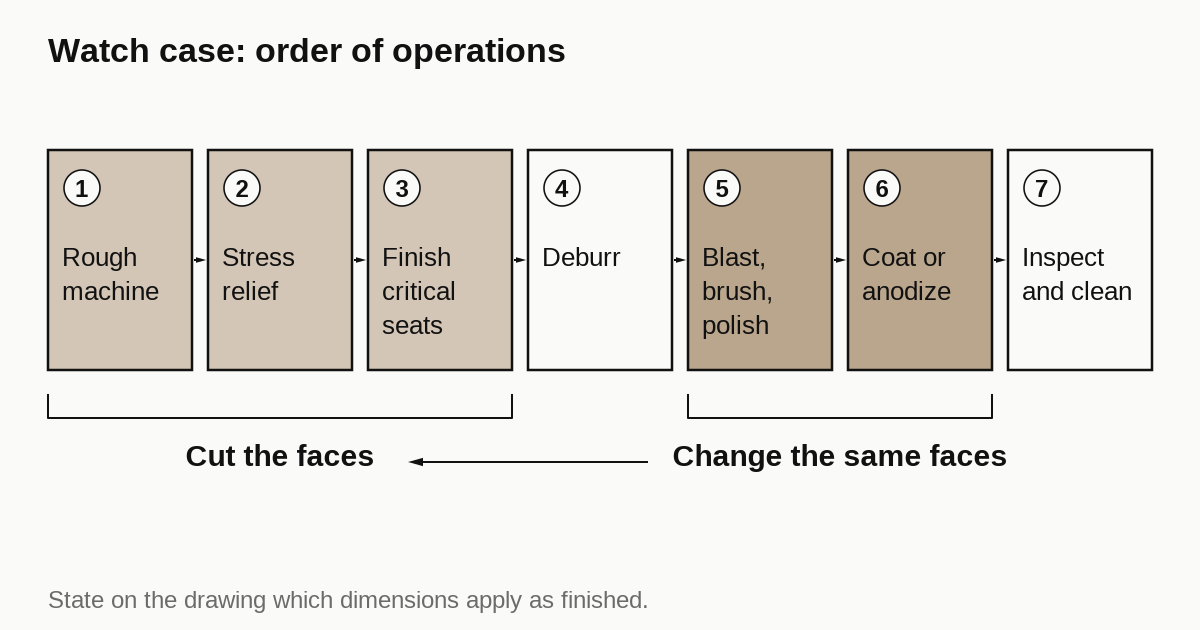
For a watch case the order of operations is:
- Rough machining from bar or forged blank, leaving finish allowance.
- Stress relief if the case is thin walled, to limit distortion. See titanium thin-wall parts.
- Finish machining of critical seats and threads.
- Deburring.
- Surface finishing: blast, brush, polish or a combination.
- Coating or anodizing, if specified.
- Final inspection and cleaning.
The point of listing it is that steps 5 and 6 remove or add material on faces that steps 1 to 3 just machined. A shop that does not know the finish plan will machine to the final size and then watch the finisher cut into it.
Finish allowance and where tolerances apply
Every finishing step changes the part:
- Blasting peens the surface and removes a few microns.
- Brushing removes a thin layer and leaves directional lines that the design usually specifies.
- Polishing removes more material and rounds edges unless the polisher masks them.
State on the drawing which dimensions apply as finished. The crystal seat, the case back thread, the gasket groove and the lug hole spacing are the usual critical features. Tolerances on those are typically in the range of hundredths of a millimetre, and a shop will tell you what it can hold. Titanium machining tolerances explains the cost of tighter values.
A practical approach used by many shops: machine critical seats to final size after the main finishing steps are complete, or protect them during finishing. Ask the shop which it prefers.
Surface finish on titanium
Titanium does not polish like steel. It takes longer to reach a bright finish, the surface smears if the tool or abrasive is wrong, and a mirror finish shows every small surface defect. A brushed or bead blasted finish is more forgiving, which is why many titanium cases use it, often combined with a polished bevel for contrast. See titanium surface finish for the Ra values shops quote, and titanium anodizing if colour is part of the design.
Appearance requirements need to be physical, not verbal. A sample case, or a golden sample approved by the brand, is the only reliable reference for “brushed” or “satin”. Add a written rule for what counts as a visible defect, such as tool marks, pits and scratches measured at a stated viewing distance.
Need a quote for this part? Get a titanium quote
Threads, seals and water resistance
A screw-down case back needs a thread, a sealing face and a gasket groove.
- Galling. Titanium on titanium threads can seize when screwed down dry. Some designs pair a titanium case with a different material for the case back, and others specify a lubricant. Decide this before ordering.
- Gasket groove. The width, depth and finish of the groove decide whether the gasket seals. Machine marks across the groove can leak.
- Water resistance rating. The watch brand sets the claim and tests the finished watch against ISO 22810 or its own standard. A machine shop supplies the case to the drawing and does not certify the rating.
Traceability and certificates
For a consumer part, ask for the material certificate to match the grade on the drawing. An EN 10204 3.1 certificate with chemistry is normal. If the brand states “nickel-free” or “hypoallergenic” on packaging, it needs the material evidence behind that claim. Titanium mill certificates explains what the certificate shows.
What drives price
| Factor | Effect |
|---|---|
| Setups and 5-axis work on lugs and bezels | Largest machine-time driver |
| Visible faces | Hand finishing time and scrap |
| Mirror polish | Slow, highly operator dependent |
| Coating | Adds a process and a rejection risk |
| Quantity | Cost per piece falls at hundreds, and the quote shows the set-up share |
Titanium machining cost covers how these combine.
Bar, forging or near-net blank
A case is usually cut from bar for prototypes and low volumes. At higher volumes a forged or near-net blank saves material and machining time, but the forging tooling costs money and takes weeks, and the surface layer left by hot working has to be machined away. Ask the shop where the break-even sits for your quantity. Our buy to fly calculator shows how much of the bar becomes swarf for a given shape.
Prototype first
Watch cases are rarely right on the first article. Order a small prototype run in the same grade and finish route as production, because a case finished by hand in a prototype shop can look different from one finished in a batch process. Compare the two against your approved sample, write down the differences and adjust the finish allowance before you commit to a production quantity.
Handling and packaging finished parts
A finished case is easily marked. Specify individual packaging, for example a separate pocket or bag for each case, with no part touching another, and say whether gloves are required for final handling. Cleaning before coating or final inspection removes oils and polishing compound, and a part with leftover compound can fail a coating process. Say who cleans the part, and to what standard, before it leaves the shop.
What to put on the RFQ
Part: case middle, 40 mm, drawing and STEP attached. Material: Grade 5 titanium, ASTM B348 bar, annealed. Certificate: EN 10204 3.1. Critical dimensions: crystal seat, gasket groove and case back thread apply after finishing. Finish: brushed flats, bead blasted sides, polished bevel. Approved sample will be shipped. Coating: hard coating by our coater, their surface requirement attached. Threads: case back thread as drawn, lubricant specified by us. Quantity: 50 prototype, 500 per year. Needed by: date.
Shops typically confirm tolerances, finish and lead time in their quote. Send the drawing through the RFQ form and we reply within 24 business hours with one itemised quote, made by a partner shop that cuts titanium.
For the grade decision behind a case drawing, see titanium grade selection.
Frequently asked questions
Is titanium a good material for a watch case?
It is light, corrosion resistant, free of nickel in the commercially pure grades and comfortable against skin. Its weaknesses are a surface that scratches more easily than hardened steel and a finishing process that is slower than on stainless steel.
Which titanium grade is used for watch cases?
Grade 2 commercially pure titanium and Grade 5 (Ti-6Al-4V) are both used. Grade 5 is harder and keeps a brushed finish longer, and Grade 2 is softer and easier to cut and form. Hardening or coating the finished case is common for either.
Why does finish affect machining tolerances on a watch case?
Brushing, blasting and polishing remove material from surfaces that may include the crystal seat and the gasket groove. The drawing has to say whether a tolerance applies before or after finishing, and the shop plans a finish allowance on that basis.
Need a quote for this part?
Send the drawing. We send one itemised quote for the finished parts and reply within 24 business hours.
Get a titanium quote