Guides / Industries
Machining Titanium Eyewear Parts: Hinges, Screws and Frame Components
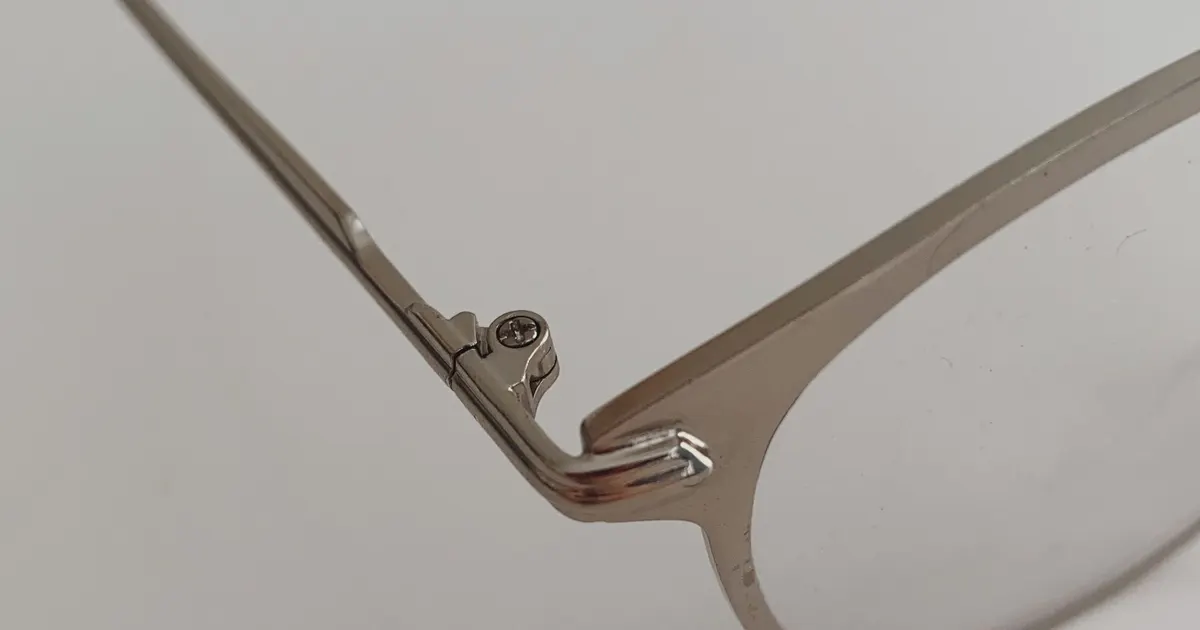
An eyewear part is small, visible and worn against skin. Hinge barrels, screws, bridge pieces and end pieces weigh a few grams or less, yet each has a fit, a finish and a thread that the wearer notices. Small size makes titanium harder, not easier. Tools are tiny and fragile, chips jam in small bores and a burr you could ignore on a bracket is a defect on a frame.
This guide explains the materials, the features that drive cost and what a quote request needs to say.
Which parts are machined
Not every part of a titanium frame is machined. Wire, strip and sheet are formed and stamped, and joined by welding. The machined parts are the small solid ones.
| Part | Typical material | Typical process | Critical feature |
|---|---|---|---|
| Hinge barrel and hinge block | Grade 2 or Ti-6Al-4V | Swiss-type turning, micro milling | Fit between barrel and pin, thread for the screw |
| Screws | Ti-6Al-4V or Grade 2 | Turning, thread rolling or milling | Thread class, head slot, tip |
| Bridge and end pieces | Grade 2 or beta alloy | Milling from bar or sheet | Weld surface, outline, thickness |
| Nose pad arms and pad boxes | Grade 2 or beta alloy | Milling, forming | Spring behaviour, slot width |
| Rimless mounts and lens screws | Grade 2 or Ti-6Al-4V | Turning, drilling | Hole position, bore, seat |
The grade reference shows the designations. For a part that needs strength in a tiny section, such as a screw, Ti-6Al-4V is normal. For parts that will be bent or welded into a frame, commercially pure grades are easier to form. See Grade 2 vs Grade 5 titanium for the tradeoff.
Beta titanium alloys are used where a frame must flex and spring back. These are sold under trade names, and their properties depend on the supplier. Ask your material supplier for the specification rather than assuming a standard.
How small parts are made
Small cylindrical parts such as screws and hinge pins are usually made on a Swiss-type lathe, which feeds bar through a guide bush close to the cut. That keeps a slender part rigid. Prismatic parts such as hinge blocks and end pieces are milled, often on a small machine with micro tools.
Three limits matter.
Bar quality. Swiss turning needs bar with good straightness and a controlled diameter, usually ground bar in small diameters. Bar that is oversized or bent causes vibration and poor finish. Ask the shop which bar it buys and see titanium stock forms and lead time.
Tool size. A drill under 1 mm in titanium can break at the first sign of chip packing. Shops use peck cycles, through-tool coolant where available and conservative feeds. That means a longer cycle time than the part’s size suggests. Drilling titanium covers why.
Chips. Titanium chips are long and stringy. On a small part a chip wrapped around the tool or the bar stops the machine. Chip breaking in the program and high pressure coolant help, and titanium tooling and coolant covers the options.
Threads at small sizes
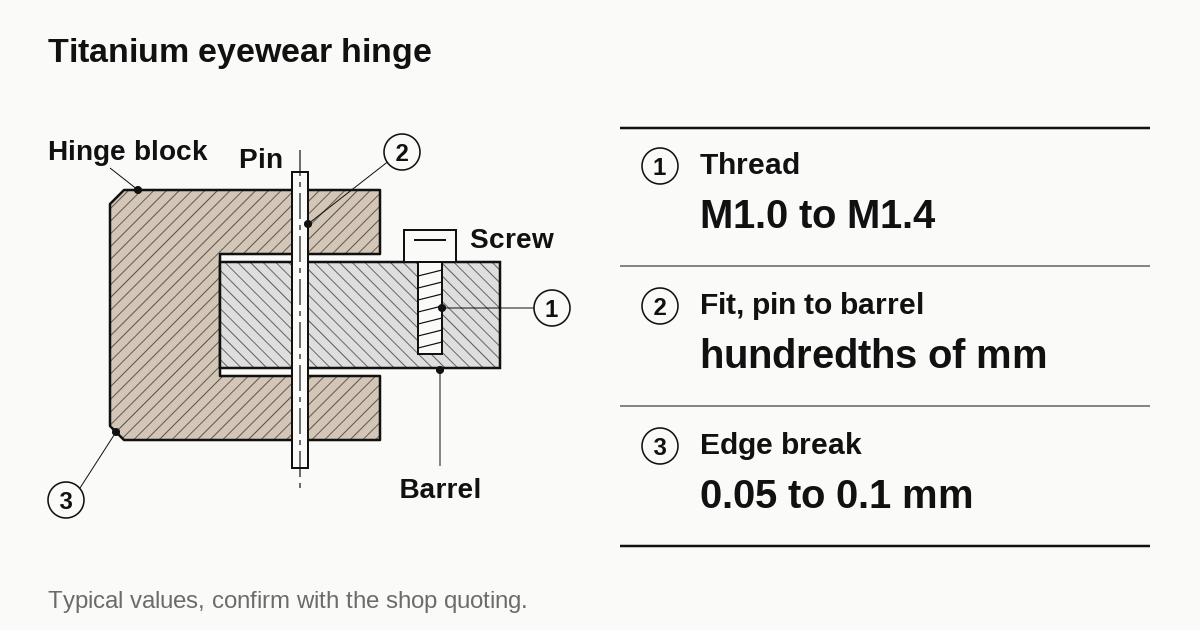
Eyewear screws are commonly in the range of M1.0 to M1.4, and the hinge or lens-mount threads they run in are even more delicate. At that size a thread is a few tenths of a millimetre deep.
- Rolled threads are stronger and have a better surface than cut threads, and shops often roll screw threads. Tooling is specific to the diameter and pitch.
- Cut or milled threads are normal in blocks and housings. A tap this small breaks easily in titanium.
- Galling applies here as everywhere, but you cannot add much lubricant to an eyewear screw. Some assemblers use a thread-locking or sealing compound instead. Say what you intend.
- Gauge and class. Write the thread standard and tolerance class on the drawing. Small thread gauges are specialised, and a shop will tell you what it holds.
Tolerances, fits and burrs
Hinge fits are tight because a loose hinge wobbles. A pin to barrel fit is typically held in the range of hundredths of a millimetre, and a shop confirms what it can hold. Our article on titanium machining tolerances explains why tighter values cost more.
Burrs are the other limit. On a part worn against the face, a burr is a complaint. Say what edge condition you want:
- Break edges to a stated radius or chamfer, for example 0.05 to 0.1 mm.
- No burrs detectable at a stated magnification, if that is your inspection standard.
- Specify whether tumbling or electropolishing is acceptable, because both remove a few microns of material. Plan the tolerance around that.
Thin features, such as pad arms and sheet bridges, distort during cutting. Titanium thin-wall parts explains the cause.
Need a quote for this part? Get a titanium quote
Skin contact and nickel
Eyewear touches skin for hours a day, so nickel release matters. Commercially pure titanium contains no added nickel, which is a main reason it is chosen for frames. Some alloys and coatings are different, so ask the material supplier for the certificate and state your requirement. In the EU, nickel release from items in prolonged skin contact is restricted under REACH. The standard for spectacle frames is ISO 12870, which includes requirements and tests. Check the current standards that apply to your market. A machine shop does not certify a finished frame. The brand owner does, and the shop supplies parts to the drawing and the certificate.
Finishing: where eyewear parts differ
A frame’s colour and feel come from finishing, so ask for the finish at quote stage.
- Tumbling or vibratory finishing removes burrs and gives a uniform satin surface.
- Polishing gives a bright surface, but titanium polishes slowly and shows its limits compared with steel.
- Anodizing gives colour from a thin oxide film, where thickness sets the hue. Colour depends on the surface beneath it. See titanium anodizing and titanium surface finish.
- PVD coatings give gold, rose or black finishes. These are applied by specialist coaters.
Joining frame parts is usually done by laser or resistance welding, both under shielding where required, and titanium welding and alpha case explains why. If a machined part will be welded, say which surface welds and keep it clean and free of oil.
What drives cost on small parts
| Factor | Effect |
|---|---|
| Part count per bar length | Longer cycles waste more bar on short parts |
| Tool breakage on small drills and taps | Raises scrap and tool cost |
| Cosmetic finishing | Often more labour than machining |
| Inspection at small scale | Optical measurement, slow and specialised |
| Quantity | Swiss set-up cost drops well at hundreds to thousands |
Samples and approval
A small part is easy to misjudge from a drawing. Ask for a short sample run before a full order, inspect hinge fit, thread feel and finish together on an assembled frame, then freeze that sample as the reference. Keep one sealed part with the approval record, so a later batch can be compared against it by eye and by gauge.
What to put on the RFQ
Part: hinge barrel, drawing attached. Material: Grade 2 titanium bar, ground, 4 mm diameter. Certificate: EN 10204 3.1 mill certificate with chemistry, no added nickel. Thread: M1.2 x 0.25, internal, depth 2.0 mm. Fit: pin bore tolerance as drawn, inspected at 100 percent. Edges: break 0.05 mm, tumble, no burrs at 10x. Finish: satin, anodize in colour matched to sample. Quantity: 2,000 now, repeat orders likely. Needed by: date.
Shops typically confirm tolerances, finish and lead time in their quote. Send the drawing through the RFQ form and we reply within 24 business hours with one itemised quote, made by a partner shop that cuts titanium.
If the grade is not fixed yet, see our guide to titanium grade selection.
Frequently asked questions
Why is titanium used for eyewear frames?
It is light, corrosion resistant in contact with skin and sweat and free of nickel in the commercially pure grades, which suits wearers with metal allergies. It is also springy enough for thin temples and bridges.
Which titanium grades are used for eyewear parts?
Commercially pure Grades 1 and 2 are common for frames, wire and sheet parts. Ti-6Al-4V is used where a small part needs more strength, such as screws and hinge parts. Beta alloys are used for flexible temples and bridges.
What is the smallest thread a shop can cut in titanium?
Eyewear screws are commonly in the range of M1.0 to M1.4. A shop will confirm whether it can cut, roll or mill a given thread in your grade, and the answer depends on its equipment and the part length.
Need a quote for this part?
Send the drawing. We send one itemised quote for the finished parts and reply within 24 business hours.
Get a titanium quote