Guides / Industries
Titanium Parts for Semiconductor Equipment: Grade, Cleanliness and Vacuum
A semiconductor equipment part is judged by what it does not do. It must not shed particles, release metal ions, outgas in vacuum or attract trouble from the process chemistry. The geometry may be simple, and the specification around it is long.
Titanium appears in these tools for specific reasons, and those reasons shape the RFQ. This guide covers where it is used, why the grade is usually commercially pure and how to write the cleanliness and vacuum requirements so shops can quote them.
Where titanium is used
Titanium is not the default material in a process tool. Aluminium and stainless steel cover most chamber and gas hardware. Titanium is chosen for a particular property.
| Property | Typical value | Why it matters |
|---|---|---|
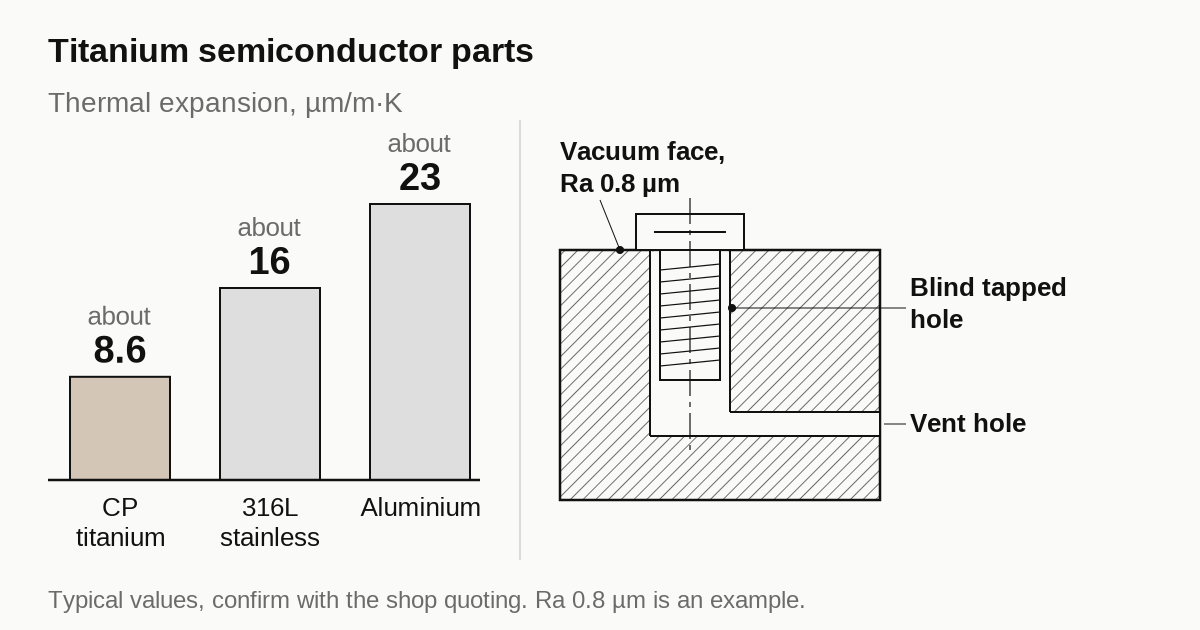
| Thermal expansion | Around 8.6 um/m.K for CP titanium | Nearer to ceramics such as alumina than aluminium is, against around 23 for aluminium and 16 for 316L |
| Magnetic permeability | Very low, titanium is paramagnetic | Parts near electron beam or magnetic equipment |
| Corrosion resistance | Strong in many oxidising and chloride media | Wet process and chemical handling parts |
| Density | Around 4.5 g/cm3 | Lighter than steel for moving stages and handling hardware |
| Thermal conductivity | Around 17 to 22 W/m.K | Low, which helps where heat must be kept out and hurts where it must be removed |
Values are typical and a material supplier confirms them. Common parts include vacuum chamber hardware, fasteners, brackets, fixtures, gas and fluid fittings, wafer handling parts and frames for stages. The choice always comes from the equipment maker’s design, and a machine shop supplies to that drawing.
Why commercially pure grades dominate
For these parts the rule of thumb is simple. If strength is modest, use a commercially pure grade. If strength is needed in a small section, use Ti-6Al-4V.
| Grade | Typical use here | Note |
|---|---|---|
| Grade 1 | Formed parts, corrosion service | Softest and most ductile, lowest strength |
| Grade 2 | General machined parts, fittings, chamber hardware | The usual compromise of strength and formability |
| Grade 4 | Parts needing more strength than Grade 2, still unalloyed | Harder to cut than Grade 2 |
| Grade 5 (Ti-6Al-4V) | Fasteners, fixtures, structural parts | Highest strength, aluminium and vanadium content |
An alloyed grade brings aluminium and vanadium into the material, which some process specifications restrict. If a customer’s contamination rules limit specific elements, state the limit on the RFQ and ask the supplier for the certificate chemistry. See the grade reference and Grade 2 vs Grade 5 titanium for how they differ.
Cleanliness starts at the machine
A clean part is easier to clean. The way a shop cuts and handles titanium sets the starting point.
- Coolant. Residues from coolant are what the cleaning step must remove. Some specifications restrict chlorine, sulphur or other elements in cutting fluids, because residual halogens can attack titanium or contaminate a process. Ask the shop what it uses and state any restriction on the RFQ. Titanium tooling and coolant covers coolant for titanium generally.
- Tools and fixtures. Steel tools and fixtures can embed iron in a soft titanium surface. Ask whether the shop dedicates tools and soft jaws to titanium work.
- Handling. Gloves, clean trays and no marking with unapproved inks. Write down what you expect.
- Swarf. Titanium chips and fines are a fire hazard, and a good shop manages that, which matters for your shop selection but not your drawing.
Surface finish and vacuum design
If the part runs in vacuum, geometry and finish both matter.
Surface finish. A smoother surface has less area to hold gas and particles. Vacuum faces are often specified at Ra 0.8 um or better, and sealing faces may be tighter. The value comes from the equipment design, and titanium surface finish lists what shops typically quote.
Trapped volumes. A blind tapped hole under a screw traps gas that leaks out slowly, called a virtual leak. Designers vent such screws with a cross hole or a slot. The drawing must show it, because a shop will not add venting on its own.
Welds. Vacuum welds are made under inert gas with controlled heat input, and are leak tested. The weld method and acceptance test belong on the drawing. Titanium welding and alpha case explains why shielding matters.
Leak rate. If a part must hold a stated leak rate, name the test method and the acceptance value. The shop confirms whether it tests in house or sends the part out.
Need a quote for this part? Get a titanium quote
Tolerances and flatness
Process tool parts often carry tight flatness and parallelism requirements on mounting and sealing faces. Titanium moves when stress releases, so a shop machines in stages, with stress relief between roughing and finishing where needed. See titanium thin-wall parts for the distortion causes and titanium machining tolerances for what is realistic. State which features carry the tight tolerance and give the others a general tolerance.
Cleaning, passivation and packaging
After machining, the part goes through the customer’s cleaning process. A shop may perform some steps and send others out.
- Remove coolant and chips.
- Clean with an agreed solvent or aqueous process.
- Passivate if specified, naming the specification.
- Rinse and dry.
- Inspect, and test for particles or residue if the specification asks for it.
- Bag in clean packaging, labelled with part number and lot.
Cleanroom cleaning and packaging are usually done by a specialist. Name the standard, the cleanliness class and the acceptance test. If you only write “clean room clean”, every shop will quote something different. Parts used in vacuum should not be handled bare after the final clean.
Traceability and export control
Equipment makers usually want the material certificate tied to a heat, which titanium mill certificates explains. Some semiconductor equipment and its parts may be subject to export control rules in the country of manufacture or use. If your part might be controlled, say so at the start, before a drawing circulates.
Documentation and change control
Equipment makers often ask for more paper than machinists expect, and shops price the paperwork.
- Revision control. Parts are made to a named drawing revision and the shop does not change a process without telling you.
- Lot traceability. Parts carry a lot or serial number linked to the heat, the operator records and the inspection data.
- Inspection report. Say which dimensions need a measured value on a report and which only need a pass mark.
- Process change notice. If a shop changes coolant, cleaning chemistry or a tool supplier, a cleanliness-sensitive part may behave differently. Ask the shop whether it will notify you before a change.
Many shops hold ISO 9001, and some customers require more, so ask the shop what its quality system covers and state what you need. We do not claim certifications on a shop’s behalf.
What to put on the RFQ
Part: chamber flange, drawing and STEP attached. Material: Grade 2 titanium, ASTM B348 bar. Certificate chemistry required. Certificate: EN 10204 3.1, heat number on the certificate of conformity. Surface: Ra 0.8 or better on the vacuum face, as machined elsewhere. Machining: no chlorinated or sulphurised cutting fluids, tools dedicated to titanium. Venting: vent holes on blind tapped holes as drawn. Cleaning: to our cleaning specification, attached. Double bagged, lot labelled. Leak test: if required, helium test to the value on the drawing, method attached. Quantity: 6 now, repeat likely. Needed by: date.
Shops typically confirm tolerances, finish, cleaning scope and lead time in their quote. Send the drawing through the RFQ form and we reply within 24 business hours with one itemised quote, made by a partner shop that cuts titanium.
For how purity requirements sit with the grade decision, read titanium grade selection.
Frequently asked questions
Why is titanium used in semiconductor equipment?
Its low thermal expansion compared with aluminium, its very low magnetic permeability, its corrosion resistance and its stiffness for the weight suit chamber parts, stages and handling hardware. It is chosen for specific parts, not as a general replacement for stainless steel or aluminium.
Which titanium grades are used for semiconductor parts?
Commercially pure Grades 1 and 2 are common where purity and corrosion resistance matter and strength is modest. Ti-6Al-4V is used where a part needs strength, such as fixtures and fasteners. The equipment maker's specification decides.
What cleanliness requirement should be on an RFQ?
Name the cleaning specification and the acceptance test, such as a particle count, residue limit or leak rate. If the part will run in vacuum, also state the surface finish, venting details and packaging. A shop will confirm which parts of that process it performs and which go to a specialist cleaner.
Need a quote for this part?
Send the drawing. We send one itemised quote for the finished parts and reply within 24 business hours.
Get a titanium quote