Guides / Industries
Titanium Parts for Hydrogen Electrolyzers: Grades, Bipolar Plates and Finish
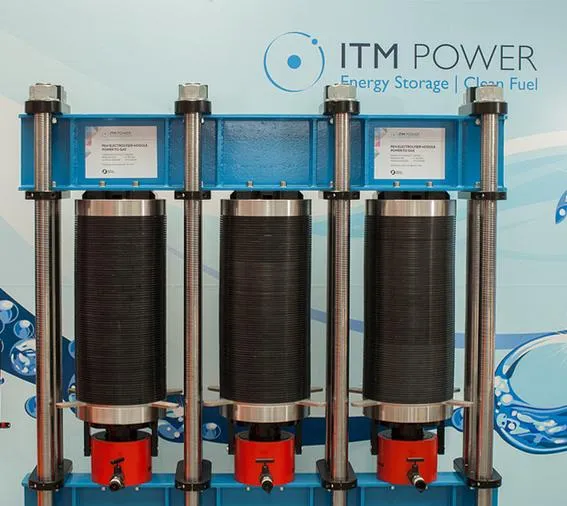
Titanium electrolyzer parts for hydrogen are mainly two things: the porous transport layers that carry water and gas through the stack, and the bipolar plates that separate the cells. In the public sources, only the plates look like a CNC job. Porous layers are felt, sintered or tape-cast titanium that is cut, not machined, and public sources say the plates carry a large share of stack cost because titanium is expensive and its flow fields are hard to machine. This guide covers what these parts are, which grade the sources point to, what a shop will see on a drawing and what to put on the RFQ. Facts are as of October 2026.
What the stack needs from titanium
A PEM (proton exchange membrane) electrolyzer splits water in a stack of cells. Between each pair of cells sits a bipolar plate, and between plate and membrane sits a porous transport layer (PTL). A 2025 preprint from the University of West Bohemia describes the job of both: transport water, electrons, gas and heat, keep cells apart, and hold the stack together. The metal must survive oxidizing conditions on the anode side and reducing conditions on the cathode side. The authors cite the US Department of Energy (DOE) lifetime target of 80,000 hours for 2026.
The same paper calls titanium the most commonly used base metal for PTLs and bipolar plates because of its corrosion resistance. It lists the drawbacks in one line: titanium is expensive, difficult to machine into complex flow-field designs and susceptible to hydrogen embrittlement. Over time it also grows an oxide layer that raises interfacial contact resistance, so the cell wastes energy. Precious metal coatings fix that and add cost.
| Component | Typical form in public sources | How it is made | Does a CNC shop see it? |
|---|---|---|---|
| Porous transport layer | Fibre felt, sintered powder or tape-cast titanium | Sintering, tape casting, then laser or mechanical cutting | Rarely |
| Bipolar plate, solid titanium | Plate with a milled flow field | Milling, then coating | Yes |
| Bipolar plate, alternatives | Titanium powder in polymer, or coated stainless steel | Moulding, or stamping and coating (cost-model baseline) | No |
The plate is the machining job
Two public sources describe the milled plate. The German TiCoB project (ISFH, 2021 to 2024, funded by the federal economics ministry) says bipolar plates are the largest cost item in a PEM stack, “a good half” of stack cost, mainly because of the price of pure titanium and the cost of milling the flow fields. Its aim is a composite plate of titanium powder in polymer that avoids milling, etching and polishing. A 2014 DLR paper in ECS Transactions says titanium plates drive up cost through the material price, the difficult and expensive machining of the flow fields and the coating needed to limit anodization. It tested coated stainless steel as a cheaper plate and found stainless needs a protective coating because it corrodes and releases ions that can poison the catalyst-coated membrane.
The preprint puts the combined cost differently. It says titanium PTLs and plates, with their precious metal coatings, make up roughly 50 to 70% of total stack cost, citing earlier work. An older NREL cost model presentation to the DOE (June 2018) assumed a sintered porous titanium PTL at an assumed titanium price of $4.5 per kg and 30% porosity, with stamped 316L stainless plates with a nitrided coating. That is a dated baseline, but it shows that cost models already assume the cheaper plate route, and that is the pressure a titanium plate quote faces.
No public source gives a per-plate price, a typical plate size or a typical flow-field depth for machined titanium. Do not accept a figure from a source that cannot name one. Compare quotes on your own drawing, as our machining cost guide explains.
Which grade
The sources say “pure titanium” without a grade for machined plates. The one clear datapoint is for porous layers. Bekaert’s vendor page lists a Grade 1 titanium fibre felt, 0.15 to 2.00 mm thick, with 56 to 78% porosity and a platinum-coated option, cut by laser or mechanically to a dimensional tolerance of plus or minus 0.5 mm. That is vendor data and covers the porous layer only.
For the plate, the drawing or the stack designer sets the grade. Commercially pure grades are the likely candidates, and ASTM B265 is the specification for titanium strip, sheet and plate. Its current edition, B265-25, covers unalloyed Grades 1, 2, 3 and 4 among others, so a plate quote can be written against it. Our grades chart and the Grade 2 versus Grade 5 guide show what the commercially pure grades give up in strength and gain in machining.
Coatings and what that means for finish
Because the oxide skin raises contact resistance, plates and layers are usually coated. The preprint lists examples from the literature: 60 to 180 nm of gold, 20 to 150 nm of iridium or 200 nm of platinum on titanium PTLs, and about 1 micron of gold on titanium plates. It says relatively thick platinum overlayers, typically hundreds of nanometres, remain the most reliable choice for long-term operation, and it states a DOE target of contact resistance below 10 mΩ·cm² after corrosion testing. The authors’ own work, on stainless steel substrates, aims to cut platinum loading by up to two orders of magnitude with a 200 nm titanium-niobium-oxide base layer.
For a shop, the layer thickness explains why finish and cleanliness get specified. A coating a few hundred nanometres thick sits on whatever the machining left, so a surface with burrs, smeared metal or residue will carry that through. Ask the buyer:
- Who applies the coating, and is it applied after final machining?
- What surface roughness and flatness does the drawing need on contact faces and seal faces?
- Is acid pickling allowed? Hydrogen pickup is a known hazard for titanium, see our guide to pickling and chemical milling.
- Which edges need a break and which must stay sharp? See deburring titanium.
- What cleaning and packaging does the coater require?
Thin ribs between flow channels behave like thin walls, so the points in our thin wall guide and the surface finish guide apply directly.
Need a quote for this part? Get a titanium quote
A trend, not a promise of volume
Hydrogen demand shapes this market and public cost pressure is clear. The TiCoB project, the DLR work and the NREL baseline all aim to reduce or replace machined titanium. The porous layer is also changing: a 2023 Lawrence Berkeley National Laboratory study of tape-cast titanium layers reported a design that beat a commercial titanium powder layer by 62 mV at 4 A per cm². The DOE and manufacturers will decide which route wins, and a shop should plan around quotes in hand, not forecasts.
What to put on the RFQ
- The part drawing with the flow-field geometry, depth, corner radii and land widths.
- Material grade and product form, for example plate to ASTM B265, with the certificate type needed.
- Flatness, thickness and parallelism limits, and which faces are seal faces or contact faces.
- Roughness on those faces and the method of measuring it.
- Coating specification, who applies it and the sequence relative to final machining.
- Cleaning, packaging and lot traceability.
- Annual quantity and the quantity of the first order, because setup is spread across it. See prototype cost.
Send the drawing through the RFQ form and we reply within 24 business hours with one itemised quote, made by a partner shop that cuts titanium. Each shop states its own price and what it assumes.
When the plate grade is not fixed by the stack designer, our guide to titanium grade selection helps frame the question.
Sources
- Kolenaty et al., Corrosion-resistant and conductive Ti-Nb-O coatings tailored for ultra-low Pt-loaded BPPs and PTLs in PEM electrolyzers, arXiv 2512.17721 (preprint, University of West Bohemia)
- ISFH, TiCoB: Titanium Composite Bipolar Plates for PEM Water Electrolyzers (project page, 2021 to 2024)
- Gago et al., Low Cost Bipolar Plates for Large Scale PEM Electrolyzers, ECS Transactions, 2014 (DLR)
- Mayyas and Mann, Manufacturing Competitiveness Analysis for Hydrogen Refueling Stations and Electrolyzers, NREL, DOE Annual Merit Review, 14 June 2018
- Bekaert, titanium porous transport layers (vendor page, specifications directional)
- Lee et al., Titanium porous-transport layers for PEM water electrolysis prepared by tape casting, Journal of Power Sources 559, 2023 (Lawrence Berkeley National Laboratory)
- ASTM B265-25, Titanium and Titanium Alloy Strip, Sheet, and Plate (scope and grade list)
Frequently asked questions
Why is titanium used in PEM water electrolyzers?
Titanium resists corrosion in the harsh anode environment, and a 2025 materials preprint calls it the most commonly used base metal for the plates and porous layers of PEM stacks. Its drawbacks are cost, difficult machining of flow fields, hydrogen embrittlement and an oxide skin that raises contact resistance, which is why precious metal coatings are common.
Which titanium grade do electrolyzer plates use?
Public sources say only pure titanium or commercially pure grades. One vendor makes its porous layer from Grade 1 felt. We found no public standard that fixes a grade for machined plates, so the stack designer's drawing sets it. ASTM B265 covers Grades 1 and 2 in plate, which is the usual product form to quote.
Do machine shops make the porous transport layer?
Generally not. Public sources describe these layers as fibre felt, sintered powder or tape-cast titanium, cut to size by laser or mechanical cutting. The part a CNC shop sees is the bipolar plate, where a flow field is milled into a titanium plate, as the German TiCoB project and a 2014 DLR paper describe.
How much does a titanium bipolar plate cost?
No public per-plate price exists. A 2025 preprint says titanium plates and porous layers with their coatings make up roughly 50 to 70% of stack cost, and a German project says plates alone are a good half. Quote the same drawing with several shops and compare setup, run time and coating lines.
Need a quote for this part?
Send the drawing. We send one itemised quote for the finished parts and reply within 24 business hours.
Get a titanium quote