Guides / Grades
Grade 9 Titanium and When a Machined Part Should Use It
A drawing arrives for a fitting that has to mate with a Grade 9 tube, or a bicycle part has to match a Grade 9 frame, and the RFQ says “Grade 9” and nothing else. That one omission decides most of the price and the lead time. Grade 9 is made mainly as tube, and bar in the sizes you need may not be on any shelf.
This guide covers what Grade 9 is, where it fits against the grades buyers know better, and what a shop needs to hear before it can quote a machined part in it. The grade reference lists its UNS and Werkstoff numbers next to the other nine grades.
What Grade 9 is
Grade 9 is Ti-3Al-2.5V. The name is the composition: roughly 3 percent aluminium and 2.5 percent vanadium, the rest titanium. People sometimes call it “half six four” because it carries about half the alloying of Ti-6Al-4V.
It is a near alpha alloy. That means it behaves more like the commercially pure grades than like Grade 5. It welds readily, it cold forms in a way Grade 5 does not, and it does not respond to heat treatment the way an alpha beta alloy does.
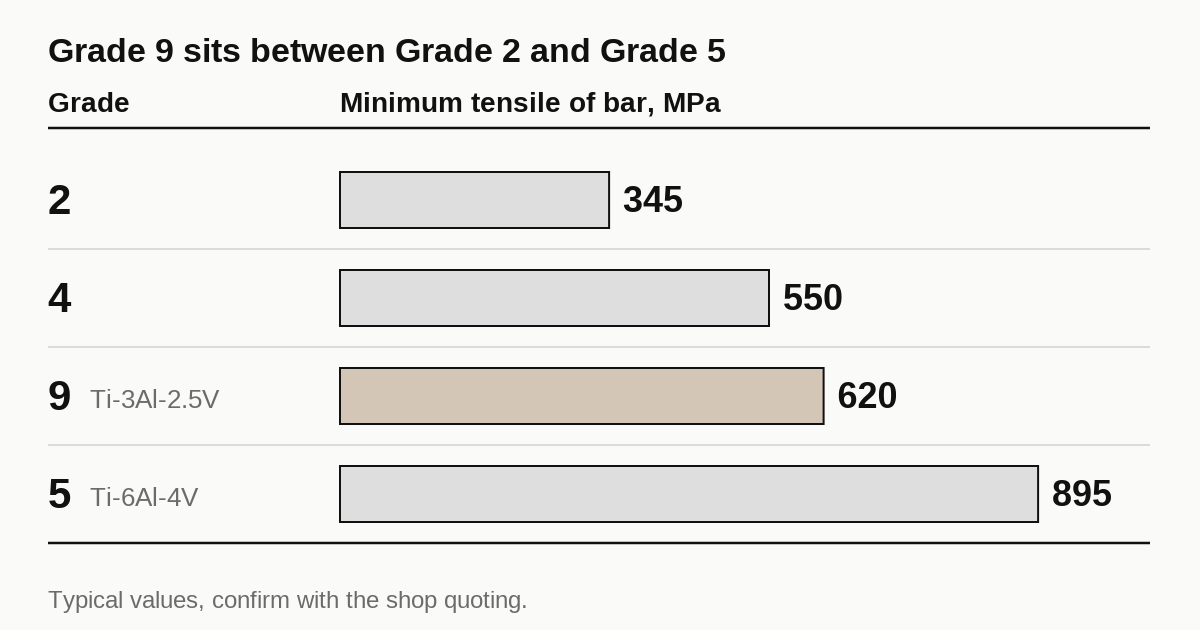
The strength sits in the middle of the range.
| Property | Grade 2 | Grade 9 | Grade 5 |
|---|---|---|---|
| Composition | Unalloyed | Ti, 3% Al, 2.5% V | Ti, 6% Al, 4% V |
| Typical minimum tensile | around 345 MPa | around 620 MPa | around 895 MPa |
| Typical minimum yield | around 275 MPa | around 483 MPa | around 828 MPa |
| Typical minimum elongation | around 20 percent | around 15 percent | around 10 percent |
| Strengthened by heat treatment | No | No | Yes |
| Usual product form | Bar, plate, tube | Tube first, then bar | Bar, plate, forgings |
These are specification minimums. A given heat usually tests above them, and the mill certificate for your heat is the number that counts.
Why most Grade 9 is tube
Grade 9 became popular because it can be cold worked into thin wall tube and then stress relieved. Aircraft hydraulic and fuel lines are the classic use, and bicycle frames and other sports tubing followed. The alloy is strong enough to cut weight against stainless steel and ductile enough to bend and flare.
The practical effect is that tube mills and the people who buy from them set the market. Bar in Grade 9 exists, and ASTM B348 covers it, but the sizes are limited and many are a mill order rather than a distributor item. The stock forms and lead time guide explains how that translates into weeks on a quote.
If you need a solid machined part and nothing forces Grade 9, a shop will often point you at Grade 5 or Grade 2 because they are easier to buy. If something does force Grade 9, because the part welds to a tube or the stress analysis was done on this alloy, say so on the RFQ.
How Grade 9 cuts
Shops generally treat Grade 9 as a step easier than Grade 5. Surface speeds typically land between the two grades, and tool life improves for the same reason. The behaviour is still titanium behaviour.
- It conducts heat poorly, so the heat stays at the cutting edge.
- It work hardens if the tool rubs instead of cutting, which is covered in the work hardening guide.
- It can smear and gall at low cutting speeds, much as Grade 2 does.
For starting points on speed and feed, see titanium speeds and feeds. A shop will confirm what it runs on your geometry.
The larger challenge is usually the stock form, not the alloy. Thin wall tube is hard to hold. Clamping pressure ovals it, and a cut that is fine on a solid bar chatters on a 1 mm wall. The advice in thin wall titanium parts applies directly, and a shop quoting a tube part should say how it plans to support the bore.
Welding and mating parts
Grade 9 welds well under proper shielding gas, and filler wire for it is listed in AWS A5.16. That is a reason some assemblies use it: a machined end fitting in Grade 9 welds to a Grade 9 tube without a dissimilar metal joint.
A welded assembly raises its own questions about shielding, colour inspection and the oxygen rich surface layer called alpha case. Those are covered in titanium welding and alpha case. Decide early whether the shop that machines the part also welds it or whether the weld goes to a second shop, because that changes the traceability chain.
Need a quote for this part? Get a titanium quote
When Grade 9 is the wrong choice
- The part needs Grade 5 strength. Grade 9 minimum tensile is roughly two thirds of Grade 5. If the design depends on a heat treated strength level, Grade 9 cannot reach it.
- The part is a solid block or thick plate. Grade 9 is rarely stocked in those forms. Grade 2 or Grade 5 will be quicker to buy.
- Corrosion is the only reason for titanium. Grade 2 is cheaper, easier to find and corrodes about as slowly. Grade 9 adds strength you may not need.
- The drawing came from a copied template. Grade 9 sometimes lands on a drawing because a similar part used it. Ask whether the load case needs it before you pay for a mill order.
Parts that usually call for Grade 9
Knowing the typical applications helps you judge whether the grade on your drawing is deliberate.
- Hydraulic and fuel line fittings. End fittings, unions and sleeves that join to Grade 9 tube.
- Bicycle and sports hardware. Dropouts, bottom bracket shells, seat clamps and similar parts that weld into or bolt to a Grade 9 frame.
- Tube-to-tube connectors. Machined sleeves and bosses that are welded onto tube and need matching chemistry.
- Lightweight structural spacers. Parts where Grade 2 is too soft and Grade 5 is more strength than the load case needs.
If your part is none of these and the grade appears without explanation, ask the drawing owner why. Sometimes the answer is a good one, such as a weld to existing tube. Sometimes it is inherited from an older design.
Cold work and what it does to the cut
Tube is usually supplied cold worked and stress relieved. Cold work leaves residual stress in the wall, and a stress relief step lowers it without removing it. When a shop cuts through that wall, the part can move a little as the stress releases, and a ring that measured round before parting can measure slightly oval after.
Shops that machine tube commonly manage this in three ways: leaving finish allowance, taking the last cut on the bore and outside diameter after the rough work, and supporting the wall with a mandrel or soft jaws. If your tolerances are tight, say so on the RFQ and expect the quote to carry a finishing pass. The figures in titanium machining tolerances show what shops typically hold on round parts, and the shop quoting will confirm what it can hold on yours.
What to put on the RFQ
A shop can quote a Grade 9 part quickly if the first message answers these.
- Grade and composition: Grade 9, Ti-3Al-2.5V.
- Standard: ASTM B348 for bar, ASTM B338 for tube, or the aerospace tubing specification your customer names. Check which one applies, because the certificate follows the standard.
- Stock form and size: tube outside diameter and wall, or bar diameter. If the part will be cut from tube, say so.
- Condition: annealed or cold worked and stress relieved.
- Quantity and delivery: a mill order for a tube size may only make sense above a minimum quantity.
- Mating parts: what it welds or threads to, and in which grade.
- Certificates: whether you need EN 10204 type 3.1 and the heat number on the certificate of conformity. The mill certificates guide lists what each document proves.
Send the drawing and the points above through the RFQ form and we reply within 24 business hours with one itemised quote.
For where Grade 9 sits among the other grades, see our guide to titanium grade selection.
Frequently asked questions
What is Grade 9 titanium?
Grade 9 is Ti-3Al-2.5V, titanium with about 3 percent aluminium and 2.5 percent vanadium. It is a near alpha alloy with a specification minimum tensile strength of around 620 MPa, which puts it between Grade 2 and Grade 5.
Is Grade 9 easier to machine than Grade 5?
Yes, typically. It cuts somewhere between Grade 2 and Grade 5, so shops can run it faster than Ti-6Al-4V. It is still titanium, so it still needs sharp carbide, steady feed and plenty of coolant at the cutting edge.
Can Grade 9 be heat treated to higher strength?
Not in any useful way. Grade 9 gets its strength from its chemistry and from cold work, not from solution treating and ageing. A shop can stress relieve it. If the part needs a heat treated strength level, Grade 5 is the grade to look at.
Need a quote for this part?
Send the drawing. We send one itemised quote for the finished parts and reply within 24 business hours.
Get a titanium quote