Guides / Industries
Machining Titanium Bicycle Components: Which Grade, Which Finish
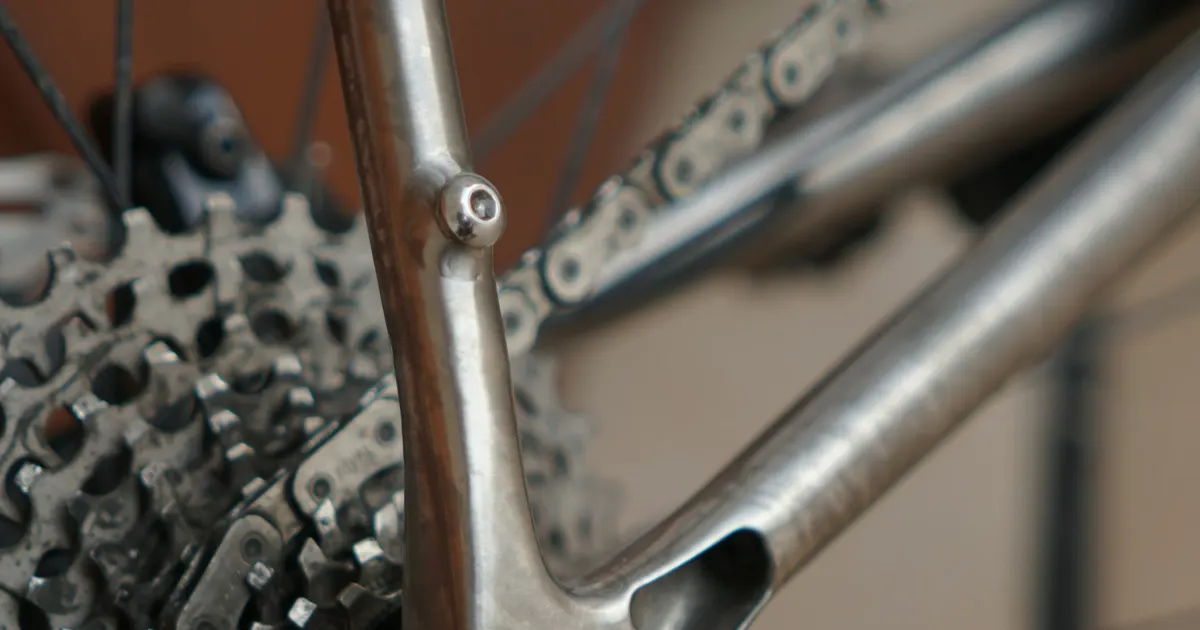
A bicycle part looks easy to quote. A stem body, a seatpost clamp, a set of dropouts: small, a few hours of machine time, nothing exotic. Then the quotes come back far apart, because one shop priced a plain part and another priced the threads, the anodize and the edge finish you assumed were included.
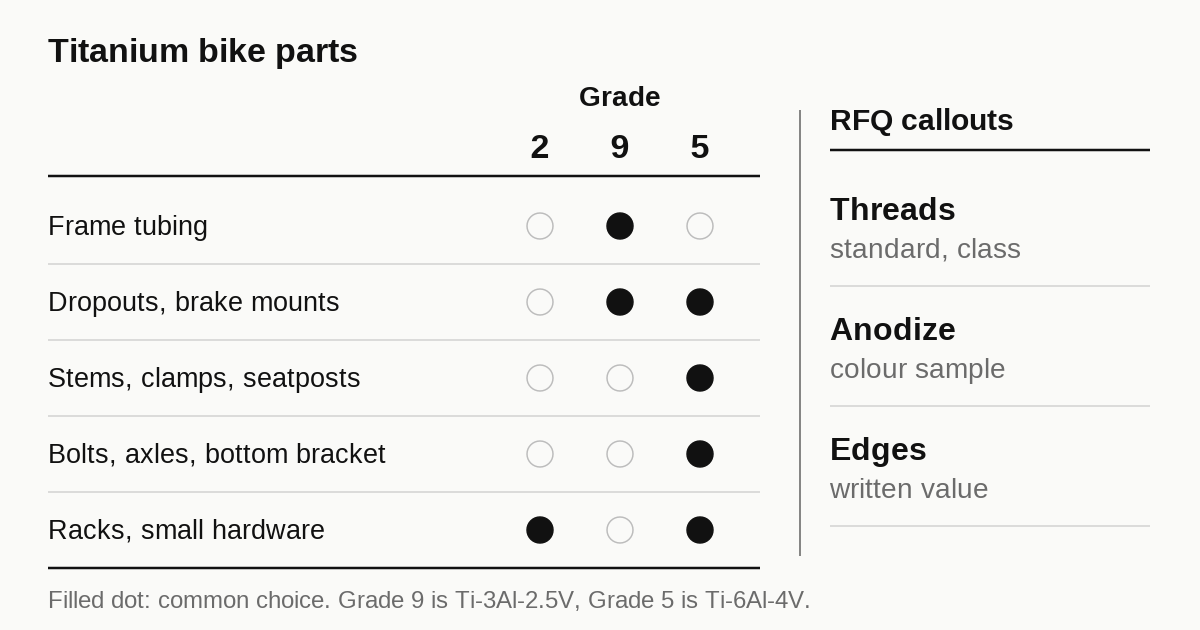
Bike parts go wrong in three places: the grade, the threads and the colour. This guide covers each, so the RFQ carries what a shop needs to price the part you mean.
Which grade goes where
Most of a titanium bike is tube, and the tube is usually a different alloy from the machined parts bolted to it.
| Part | Typical material | Why |
|---|---|---|
| Frame tubing | Ti-3Al-2.5V (Grade 9) | Cold formable, weldable, good strength in thin wall |
| Dropouts and brake mounts | Ti-6Al-4V (Grade 5) or Grade 9 | Machined from bar or plate, then welded to the tubes |
| Stems, clamps, seatpost heads | Ti-6Al-4V (Grade 5) | Strength in a small section |
| Bolts, axles, bottom bracket parts | Ti-6Al-4V (Grade 5) | Higher strength than Grade 2 for threads under load |
| Racks, bottle cage bolts, small hardware | Grade 2 or Grade 5 | Lower load, price decides |
Grade 5 is stronger than Grade 2 by a wide margin, with a typical minimum yield around 830 MPa annealed against around 275 MPa for Grade 2. The stronger grade costs more to cut. For the tradeoff in detail, see Grade 2 vs Grade 5 titanium, and the grade reference lists the designations for each.
Put the grade and the product standard on the drawing, for example Ti-6Al-4V to ASTM B348 for bar. Tube is a separate standard, ASTM B338. If a part is welded to tube, tell the shop which tube alloy it joins, because the weld filler and shielding follow from that.
Threads are where the money goes
Titanium threads are the most common source of both scrap and field complaints on bike parts.
Galling. Clean titanium sliding against clean titanium or stainless under load will pick up material and seize. A bolt that galls in the shop is a lost part. A bolt that galls in a customer’s frame is a warranty claim. Specify a thread lubricant or anti-seize for assembly, and ask the shop what thread finish it holds.
Cutting versus forming. Taps in titanium break easily, and a broken tap in a finished part is a scrapped part. Shops often use thread milling for machined threads in titanium because a milling cutter that breaks leaves the hole recoverable. Rolled threads on bolts are stronger in fatigue than cut threads because the grain flows with the profile. If you buy bolts as machined parts rather than from a fastener supplier, ask which method the shop uses.
Thread class. Call out the thread standard and tolerance class on the drawing. A bike part with an M5 threaded hole in a thin boss needs a stated depth, a full thread length and whether a chamfer is wanted. Blind holes need a relief at the bottom or the tap has nowhere to go.
Anodize and threads. Anodizing adds a film to the threads. Colour films are thin, but they still matter on a tight fit. Say whether threads are masked, anodized or gauged after anodizing.
Related reading on cutting these features: drilling titanium and titanium tooling and coolant.
Fatigue, edges and radii
A bike is a fatigue machine. Parts see millions of load cycles at modest stress, and a crack starts at a stress concentration.
- Sharp internal corners concentrate stress. Give corners a radius and say so on the drawing.
- Tool marks across a highly stressed section can start a crack. Call out a surface finish on loaded faces, and see titanium surface finish for the values shops normally quote.
- Edges that touch a rider or a cable need a break, usually a small chamfer or radius. Write the value rather than “break all edges”.
- Welded parts need the heat-affected zone kept clean, which is covered in titanium welding and alpha case.
A shop cannot decide your load case. If a part is safety critical, such as a stem, fork part or crank, the testing and the design validation stay with the designer. A shop supplies the part to the drawing.
Anodize and colour
Titanium anodizing produces colour without dye. A thin oxide film grows on the surface, and light interference through that film gives blue, gold, purple and others depending on film thickness. A higher anodizing voltage grows a thicker film and shifts the colour.
That has three consequences for a buyer.
- Colour depends on the surface underneath. A bead blasted part and a brushed part will not match even in the same bath. Specify the finish before anodize, and see titanium anodizing for the process in more detail.
- Batch to batch variation is real. Approve a sample part, keep it and send the same sample reference with each order.
- Scratches show. The film is thin, so a scratch through it shows bare metal. Parts that rub, such as clamps and cable guides, will show wear faster than parts that do not.
Colour names are not a specification. “Gold” from one shop is not “gold” from another. A physical sample, or a measured colour value, is the only reliable reference.
Need a quote for this part? Get a titanium quote
Contact with other materials
Titanium sits close to carbon fibre on the galvanic series, so it is a safe partner for a carbon frame, bar or seatpost. Against aluminium the issue is less galvanic corrosion than fretting and galling at clamped joints, so prepare those surfaces and use assembly grease. Stainless steel bolts in titanium parts are common and workable, but the thread galling advice above applies.
What drives price on a bike part
| Feature | Effect on quote |
|---|---|
| Number of set-ups (parts needing flips for holes on several faces) | Largest driver on stems and dropouts |
| Threads per part | Each thread adds machining time, especially thread milling |
| Cosmetic surface on all faces | Hand finishing time, scrap risk |
| Colour anodize with masking | Extra process, extra handling |
| Quantity of 1 to 10 | Set-up cost spread over very few parts |
| Bar versus plate or forged blank | Buy-to-fly ratio on the material |
Our buy to fly calculator gives the stock weight from the part geometry, and titanium machining cost explains how those factors combine.
Interface sizes and clamp fits
Many bike parts exist to grip another part, so the bore matters as much as the outside shape. Common interface diameters include handlebar clamps at 31.8 and 35 mm and seatposts at 27.2, 30.9 and 31.6 mm, though you should state the exact size and tolerance from your own design.
Clamp parts deserve three lines on the drawing.
- Bore size and tolerance. A slit clamp opens and closes, so say whether the bore is measured free or with the clamp bolts tightened to a stated torque.
- Bolt faces. The faces under bolt heads need to be flat and square to the bolt axis, or the bolt bends and fatigues.
- Inside edges. A sharp bore edge cuts into a carbon tube. Give it a radius or chamfer.
Shops with bike experience will ask which method you mean, because a slit part can measure differently free and clamped.
What to put on the RFQ
Part: stem body, drawing attached, STEP file attached. Material: Ti-6Al-4V, ASTM B348 bar, annealed. Certificate: EN 10204 3.1 mill certificate. Threads: M5 x 0.8, 6H, full thread depth 12 mm. Thread milled preferred. Finish: bead blast on visible faces, edges broken 0.3 mm, loaded faces Ra 1.6 or better. Anodize: blue, match the sample part we will send. Threads masked. Quantity: 25 now, 100 per year. Needed by: date.
Shops typically confirm tolerances, finish values and lead time in their quote. Send the drawing through the RFQ form and we reply within 24 business hours with one itemised quote, made by a partner shop that cuts titanium.
For the grade decision behind a bike drawing, see titanium grade selection.
Frequently asked questions
Which titanium grade is used for bike parts?
Ti-6Al-4V (Grade 5) is the usual choice for machined parts such as stems, dropouts, clamps and bolts. Ti-3Al-2.5V (Grade 9) is common for tubing. Commercially pure Grade 2 shows up where a part is welded and formed more than it is loaded.
Why do titanium bolts seize in a bike?
Titanium galls when a clean titanium thread slides against another clean thread under load. Grease or anti-seize on assembly, a good thread finish and a sensible torque value prevent most seizures.
Can any shop anodize titanium in a specific colour?
Titanium colours come from a thin oxide film whose thickness sets the colour, so the shop controls voltage and surface preparation. Colour will shift with the surface finish underneath, so approve a sample before a batch run.
Need a quote for this part?
Send the drawing. We send one itemised quote for the finished parts and reply within 24 business hours.
Get a titanium quote