Guides / Industries
Titanium Phone Frame Machining: Which Grade, What the Finish Costs You and Where Heat Goes
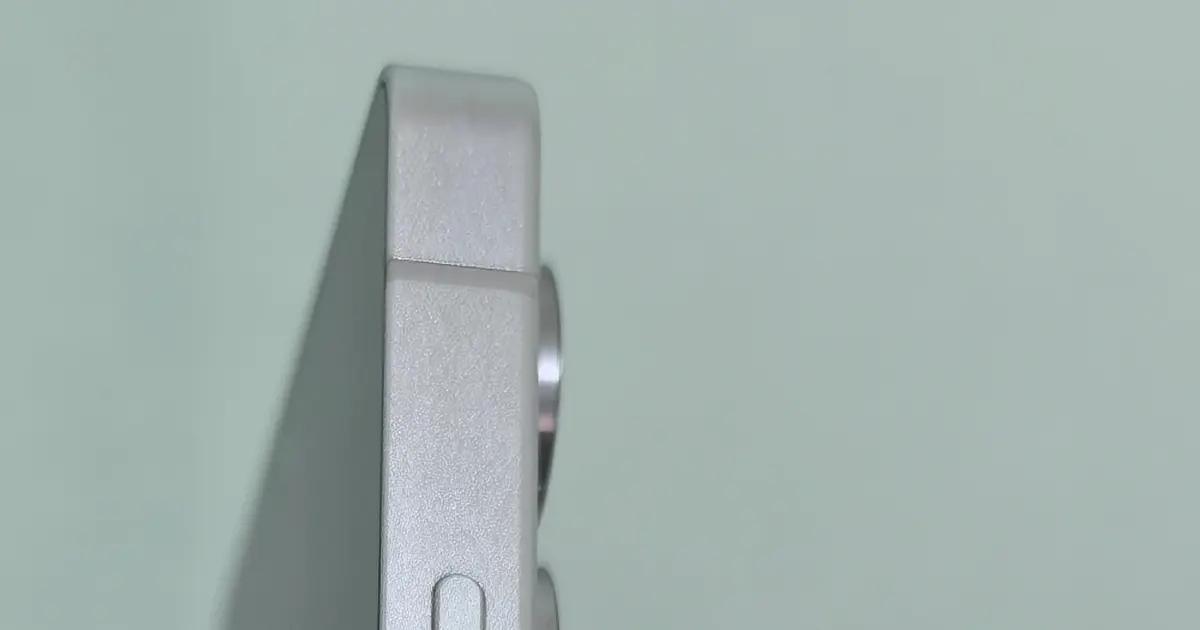
A titanium phone or wearable frame is usually grade 5 (Ti-6Al-4V), machined from bar or a forged blank, then blasted, brushed, anodized or coated. What drives the quote is rarely the metal. It is the cosmetic standard on the visible faces, the thin walls that hold them, and how many pieces fail inspection. The other design question is heat: titanium keeps heat where it is made, which is why the big brands pair it with something else.
What the large phone makers actually did
Apple describes the titanium in the iPhone 15 Pro as aerospace-grade and does not name a grade. Its announcement says titanium bands are attached to an internal frame with an industry-first thermo-mechanical process, the two metals joining by solid-state diffusion, around a new substructure of 100 percent recycled aluminium. Apple says the aluminium helps thermal dissipation and makes the back glass easier to replace, and it describes a refined brush texture on the finish.
In September 2025 Apple moved the iPhone 17 Pro to a brushed aluminium unibody in a 7000-series aerospace-grade alloy, which it says was chosen for thermal performance, with a laser-welded vapor chamber inside. That announcement does not mention titanium, so there is no stated comparison. For Samsung, a Galaxy S25 Ultra review reports a grade 5 titanium frame.
Two practical lessons for a smaller buyer. First, a titanium frame is often only the visible shell, bonded or fitted to something else that handles heat and holds electronics, so the joint is part of the design. Second, no public source gives a machining time, a yield or a price for these frames, and anyone who quotes one without your drawing is guessing.
The grade and what it gives a thin frame
| Property | Ti-6Al-4V | Source |
|---|---|---|
| Yield strength | 880 to 920 MPa | Wikipedia, Ti-6Al-4V |
| Ultimate tensile strength | 900 to 950 MPa | Wikipedia, Ti-6Al-4V |
| Young’s modulus | 104 to 113 GPa (aluminium about 68 GPa) | Wikipedia, Ti-6Al-4V and Young’s modulus |
| Thermal conductivity | 6.7 to 7.5 W/(m K) | Wikipedia, Ti-6Al-4V |
Higher stiffness than aluminium and high strength let a frame wall stay thin without bending. That is the engineering case for titanium. The cost of that case shows up in the thin wall guide: thin titanium walls move and chatter in the cut. Our grade 2 vs grade 5 guide explains why commercially pure titanium is softer and marks more easily, and the grade reference lists the standards behind each.
Bar, plate or a forged blank
A frame is a hollow, thin-walled shape cut from a solid, so most of the metal ends up as chips. The mass bought divided by the mass shipped is the buy to fly ratio, and the buy to fly calculator gives the figure for simple shapes. For a large run a near-net blank can change the material line, as the forging vs bar guide explains. For a first batch or a design that may still change, quote from bar and keep the die decision for later. Ask every shop which starting form its price assumes, because two quotes with different blanks are not comparable.
The heat trade-off
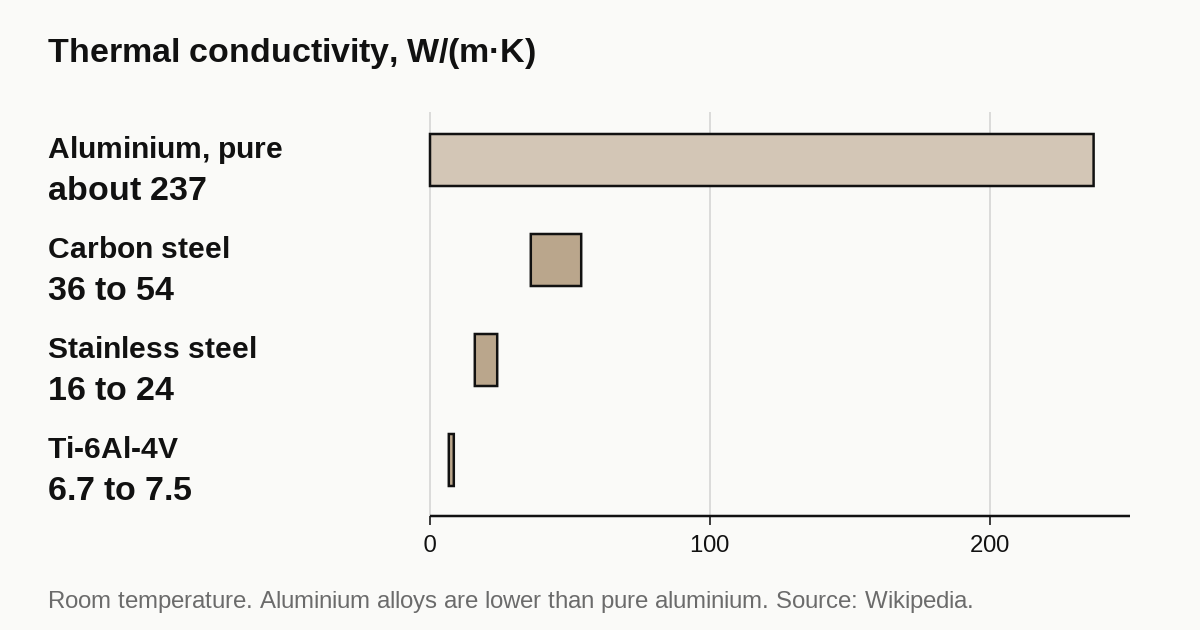
Pure aluminium conducts about 237 W/(m K) at room temperature, carbon steel about 36 to 54 and stainless steel about 16 to 24. Ti-6Al-4V sits at 6.7 to 7.5. Aluminium alloys are lower than pure aluminium, so the real gap is smaller than the chart edge suggests, but it stays large.
In a handheld device, heat from the processor and battery has to leave through the case. A titanium shell can hold heat near the source unless the design spreads it with a metal that conducts better. Apple gives thermal dissipation as one reason for the aluminium substructure in the 15 Pro. The same property makes titanium hard to cut, because the heat of the cut stays near the tool. The speeds and feeds guide covers what shops do about it. If your product sees sustained heat, ask the designer where the heat goes before you ask the shop what the frame costs.
Cosmetic finish: where the money and the rejects go
A frame is judged by eye and by finger. Finish choices and what to watch:
| Finish | What it does | Watch for |
|---|---|---|
| Machined and brushed | Directional lines from the brushing step | Tool marks and fixture marks show unless planned for |
| Bead blasted | Uniform matte on machined parts | Wikipedia describes glass bead blasting as used to give a uniform surface finish on machined parts. Media, pressure and time need a standard, or lots vary |
| Anodized | Coloured oxide film from the part’s own surface | Colour follows the surface underneath. See our anodizing guide |
| PVD | Thin metallic or ceramic film, many colours | Wikipedia notes most PVD is line of sight, so recesses and edges need fixture planning |
None of these hides a bad machined surface. Anodizing and PVD copy what is underneath, and a scratch from handling after machining carries through. Our surface finish guide lists Ra values, and the watch case guide covers a part that faces the same eye-level scrutiny.
There is no published cosmetic acceptance standard for titanium consumer parts that we could find. Define your own: which faces are visible, a boundary sample of acceptable and rejectable parts, the lighting and distance used to inspect, and what counts as a defect (a scratch width, a dent, a colour shift between lots). The shop cannot guess where your line is, and every disagreement later is a reject.
Need a quote for this part? Get a titanium quote
Machining a thin visible frame
- Walls and fixturing. Thin walls need support during the cut and a plan for removing support marks from visible faces. See the thin wall guide.
- Edges. A frame is touched constantly, so burr control and edge break are functional as well as cosmetic. Our deburring guide covers it.
- Heat marks. A discoloured edge from a hot cut is an appearance defect before it is a metallurgical one. See our guide to heat discoloration.
- Tolerances. Fit with glass, buttons and the substructure sets the tight features. No public figure applies to every design, so state what each fit needs, as in the tolerances guide.
What to put on the RFQ
- Drawing with visible faces marked, and the cosmetic standard with a boundary sample.
- Grade and bar specification, and whether a forged blank is acceptable.
- Finish route in order: machine, deburr, blast or brush, anodize or PVD, and who does each step.
- Joint to the inner structure, if any, and the features it controls.
- Packaging: separated parts, no contact between visible faces.
- Quantity, repeat rate and lot size, because finish lots are set by batch.
- Inspection method: visual with a defined light, plus dimensional report for the critical fits.
Send the drawing through the RFQ form and we reply within 24 business hours with one itemised quote, made by a partner shop that cuts titanium.
For how the frame grade fits the wider decision, read titanium grade selection.
Sources
- Apple Newsroom: iPhone 15 Pro and iPhone 15 Pro Max (September 2023) (titanium bands, aluminium substructure, brush texture)
- Apple Newsroom: iPhone 17 Pro and iPhone 17 Pro Max (September 2025) (aluminium unibody, vapor chamber)
- GSMArena: Samsung Galaxy S25 Ultra review (grade 5 titanium frame)
- Ti-6Al-4V (Wikipedia) and Young’s modulus (Wikipedia)
- List of thermal conductivities (Wikipedia)
- Abrasive blasting (Wikipedia) and Physical vapor deposition (Wikipedia)
Frequently asked questions
What titanium grade is used for phone frames?
Grade 5, Ti-6Al-4V, is the usual choice. A review of the Samsung Galaxy S25 Ultra describes its frame as grade 5. Apple calls the titanium in the iPhone 15 Pro aerospace-grade and does not name a grade. Commercially pure grades are softer.
Why do some phones use aluminium instead of titanium?
Heat. Ti-6Al-4V conducts about 6.7 to 7.5 W/(m K), pure aluminium about 237. Apple describes the iPhone 17 Pro as a brushed aluminium unibody chosen for its thermal performance, with a vapor chamber inside. Apple does not compare it with titanium in that announcement.
Can a titanium frame be anodized or PVD coated?
Yes. Anodizing grows a coloured oxide film on titanium and PVD deposits a thin metallic or ceramic film. Both copy the machined surface underneath, so scratches and blast variation show through. Agree a boundary sample before production.
How much does a machined titanium phone frame cost?
No public price exists, and it depends on wall thickness, cycle time, finish and reject rate. Send the drawing with the finish standard and the quantity. A shop quote is the only reliable number.
Need a quote for this part?
Send the drawing. We send one itemised quote for the finished parts and reply within 24 business hours.
Get a titanium quote