Guides / Grades
Grade 4 Against Grade 5: Choosing the Stronger Pure Titanium
Grade 5 is the default answer to “which titanium”. It is strong, common and every shop knows it. That default hides a group of parts where Grade 5 is the wrong call: parts that weld, form or sit in the body, parts that need corrosion behaviour more than strength, and parts where a heat treatment cycle adds cost and risk.
Grade 4 is the strongest of the commercially pure grades. This guide compares it with Grade 5 so you can see where it fits.
What Grade 4 is
Grade 4 is unalloyed titanium with the highest oxygen content of the four CP grades. Oxygen is the strengthening agent. More of it raises strength and lowers ductility. Iron rises too. The titanium grades chart shows the whole family.
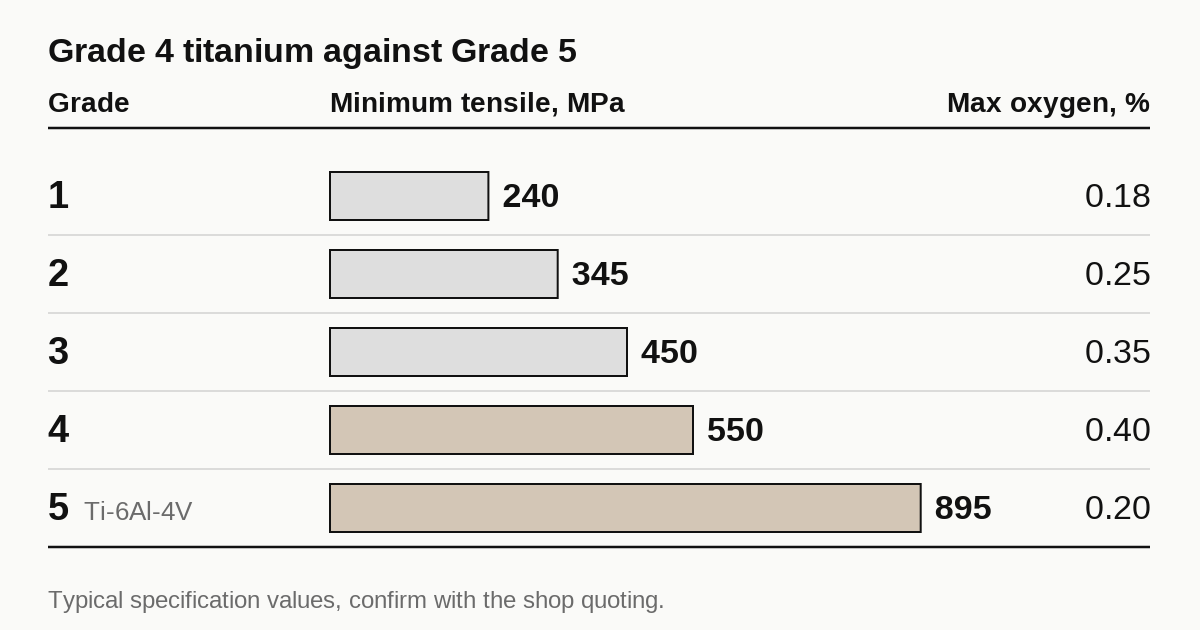
| Grade | Typical min tensile | Typical min yield | Max oxygen | Max iron |
|---|---|---|---|---|
| Grade 1 | around 240 MPa | around 138 MPa | 0.18 percent | 0.20 percent |
| Grade 2 | around 345 MPa | around 275 MPa | 0.25 percent | 0.30 percent |
| Grade 3 | around 450 MPa | around 380 MPa | 0.35 percent | 0.30 percent |
| Grade 4 | around 550 MPa | around 483 MPa | 0.40 percent | 0.50 percent |
| Grade 5 | around 895 MPa | around 828 MPa | 0.20 percent | 0.40 percent |
These are specification limits for bar to ASTM B348, rounded. The Grade 1 yield is 138 MPa (20 ksi) in the Rolled Alloys table of B348 minimums; at least one distributor, FW Metals, prints 170 MPa (25 ksi) instead, and we did not read the ASTM text. The mill certificate for your heat shows actual values, and the standard named on your drawing governs. The Grade 4 yield (70 ksi, 483 MPa) and the Grade 5 yield (120 ksi, 828 MPa) are the Rolled Alloys figures; Rolled Alloys prints 150 ksi for Grade 5 yield in one table and 120 ksi in its Ti-6Al-4V table, and we used 120 ksi.
Grade 5 gets its strength from aluminium, vanadium and heat treatment instead of oxygen. That is why its oxygen limit is low while its strength is high.
Where Grade 4 wins
Parts that weld or form. Grade 4 is a single phase metal with no alloy chemistry to manage. It welds readily under shielding gas, and its microstructure after welding is simple. It can be cold formed within limits, though less freely than Grade 2.
Parts that are in or on the body. ASTM F67 covers the CP grades for surgical implants, and Grade 4 is the strongest of them. Dental implants are the common example. It carries no aluminium or vanadium, which some device designers prefer. That choice belongs to the device maker, and the standard on the drawing decides it. See the titanium medical parts guide.
Parts that need CP corrosion behaviour. The CP grades resist corrosion across a wide range of environments, and a part that needs a bit more strength than Grade 2 can get it from Grade 4 without leaving the family.
Parts that need ductility. Grade 4 has a higher minimum elongation than Grade 5, typically around 15 percent against 10 percent. That helps with parts that deform in service.
Parts that skip heat treatment. Grade 4 gets no strength from solution treating and ageing, so there is no heat treatment step to schedule, inspect or distort a thin part. If the design lives within its strength, that removes a cost and a risk. The solution treated and aged guide shows what that step involves on Grade 5.
Where Grade 5 wins
Be honest about the trade. Grade 5 is far stronger, and the gap is not small.
- Strength to weight. Grade 5 minimum tensile is around 60 percent higher than Grade 4. If weight matters, Grade 5 allows thinner sections.
- Fatigue and elevated temperature. Grade 5 holds its strength to higher temperature and generally carries higher fatigue loads.
- Heat treatability. Grade 5 can be strengthened further. Grade 4 cannot.
- Availability. Grade 5 is common in bar, plate and forgings. Grade 4 is sometimes stocked, and some sizes are a mill order.
If the load case needs Grade 5, Grade 4 does not replace it. Look at the comparison in Grade 2 versus Grade 5 for the same logic one step down.
How Grade 4 cuts
Grade 4 sits in the easy half of the titanium range. It is harder and less gummy than Grade 2, and it is far kinder to tools than Ti-6Al-4V. Typical carbide surface speeds land between those two grades, so a shop that runs Grade 2 at around 80 m/min and Grade 5 at around 50 m/min will usually start Grade 4 in between and adjust.
| Behaviour | Grade 2 | Grade 4 | Grade 5 |
|---|---|---|---|
| Typical carbide speed | around 80 m/min | between the two | around 50 m/min |
| Chip character | Gummy | Less gummy | Tough, abrasive |
| Tool wear | Moderate | Moderate | High |
The rules for all titanium still apply. Keep the feed steady, avoid dwelling in a cut and use coolant at the edge. Start from titanium speeds and feeds and let the shop confirm its own numbers.
One practical point: Grade 4 can still smear on a dull tool and burr on exit edges. Ask whether the shop deburrs by hand or with a process, because that is where time hides on a small CP part.
Need a quote for this part? Get a titanium quote
Cost and stock
Bar price depends on the market, the size and the heat quantity, and no figure in this guide is a price. What we can say is how the stock positions compare.
- Grade 5 bar is common and easy to find.
- Grade 4 bar is sometimes stocked and sometimes a mill order, which can add weeks.
- Machining time on Grade 4 is typically lower than on Grade 5 for the same geometry, because of the faster cutting speed and slower tool wear.
So the answer to “which is cheaper” depends on whether the shop has bar on hand. Ask for stock and machining lead time separately, as the stock forms and lead time guide explains.
Three example parts
Abstract comparisons only go so far. These examples show how the choice tends to play out.
A welded process fitting. The fitting joins a Grade 2 tube network and sees a pressure rating that Grade 2 meets only with a thick wall. Grade 4 allows a thinner wall without changing the corrosion behaviour or adding a heat treatment step. Grade 5 would also work for strength, but the weld and the dissimilar chemistry add questions for no gain.
A dental implant abutment. The standard on the drawing, ASTM F67, names Grade 4. There is no choice to make, and the shop needs to know the standard before it buys bar.
A flight critical bracket. The load case needs yield strength well above 483 MPa, and weight is tight. Grade 5, probably heat treated, is the answer. Grade 4 would need a thicker section and would lose the weight saving.
The pattern is simple. Grade 4 fits where the loads are moderate and the environment, joining method or standard drives the choice. Grade 5 fits where strength to weight drives it.
What to put on the RFQ
- Grade and standard: Grade 4, ASTM B348 for bar, or ASTM F67 if the part is an implant component.
- Why Grade 4: one line on the service. A shop that sees “welded, no heat treatment” can advise on the weld and the sequence.
- Strength requirement: the yield or tensile the part has to meet, so the shop can flag a mismatch early.
- Stock position: whether you will supply bar or the shop buys it.
- Certificates: EN 10204 type 3.1 with the heat number, and a certificate of conformity from the shop. The mill certificates guide covers what each proves.
- Surface and finishing: Ra, anodize or passivation, with the standard.
Send the drawing and the service note through the RFQ form and shops that cut titanium will reply within 24 business hours. The grade reference lists UNS numbers for every grade named here, with any unverified cell marked as such.
Grade 4 is one branch of a wider decision, set out in our guide to titanium grade selection.
See also: the Grade 4 titanium reference page.
Frequently asked questions
How strong is Grade 4 titanium?
The specification minimum tensile strength is around 550 MPa and minimum yield is around 483 MPa (70 ksi). That is the highest of the four commercially pure grades and well below Grade 5, which has a minimum tensile of around 895 MPa.
Is Grade 4 easier to machine than Grade 5?
Yes, typically. It is harder and less gummy than Grade 2 and still far easier on tools than Ti-6Al-4V. Shops generally run it at higher surface speeds than Grade 5.
Can Grade 4 replace Grade 5 on an existing drawing?
Only if the design allows for the lower strength, and only with approval from whoever owns the drawing. Grade 4 has no heat treated strength level, so a part designed around Grade 5 strength usually needs a redesign, not a substitution.
Need a quote for this part?
Send the drawing. We send one itemised quote for the finished parts and reply within 24 business hours.
Get a titanium quote