Guides / Industries
Titanium Marine Hardware: Choosing Grades for Seawater Service
Titanium earns its place in marine work because seawater does very little to it. The trouble is that buyers carry that reputation too far. Titanium itself survives, but the part next to it may not, and a crevice under a washer can still cause trouble in warm water.
This guide covers which grade to ask for, where the real corrosion risks are and what a marine titanium RFQ should state.
Why titanium works in seawater
Titanium grows a thin, tightly bonded oxide film on its surface, and the film re-forms within moments if it is scratched in the presence of oxygen. In chloride solutions that film holds, so general corrosion rates in seawater are typically negligible. That is why titanium is used for heat exchanger tube, desalination plant parts, dive equipment, ROV and subsea housings, shackles, cleats, fittings and propulsion hardware on boats where weight and maintenance cost matter.
Strength is the other half. A titanium part can match a steel part’s load capacity at a lower weight and without paint or sacrificial coatings.
Grade selection for marine parts
| Grade | Typical marine use | Watch for |
|---|---|---|
| Grade 2 (CP) | Plate, tube, heat exchangers, fittings, low load hardware | Lower strength than alloyed grades |
| Grade 5 (Ti-6Al-4V) | Fasteners, shackles, shafts, structural fittings | Cracking at notches under sustained load in seawater, ask the designer |
| Grade 23 (Ti-6Al-4V ELI) | Pressure housings, parts with critical flaw tolerance | Higher cost, same cutting behaviour |
| Grade 7 or Grade 12 | Crevice-prone service in hot chloride | Less stock availability, longer lead time |
Grade 5 is stronger and more widely stocked as bar, which is why most machined marine fasteners and fittings are cut from it. For a part under sustained tensile load in seawater with a sharp notch or a flaw, the ELI grade has better fracture toughness and is often preferred, but the choice belongs to the designer who knows the load. A shop will quote what the drawing says. See grade 23 ELI titanium for how the two alloys differ, and the grade reference for the designations.
Crevice corrosion, the real limit
Titanium’s weak spot in seawater is the crevice: a gasket seat, a washer face, a threaded joint with trapped water. Inside a tight crevice the oxygen runs out, the chemistry turns acidic and the protective film can break down. This is more likely in warm, stagnant chloride water. Grade 2 is generally considered safe in cold and ambient seawater, with the risk rising once temperatures climb toward the range of roughly 70 C and above. Check the designer’s source data for the actual limit, because it depends on chloride level, pH and crevice geometry.
What the machined part can do about it:
- Avoid deep, narrow crevices in the design where possible.
- Specify good surface finish on sealing faces, because a pitted or scratched sealing surface starts a crevice.
- Keep gasket grooves to the dimensions on the drawing and report any change before cutting.
- For hot brine or heat exchange service, ask the designer about Grade 7 or Grade 12, which add small palladium or nickel and molybdenum content to resist crevice attack.
Galvanic pairs, where the damage actually happens
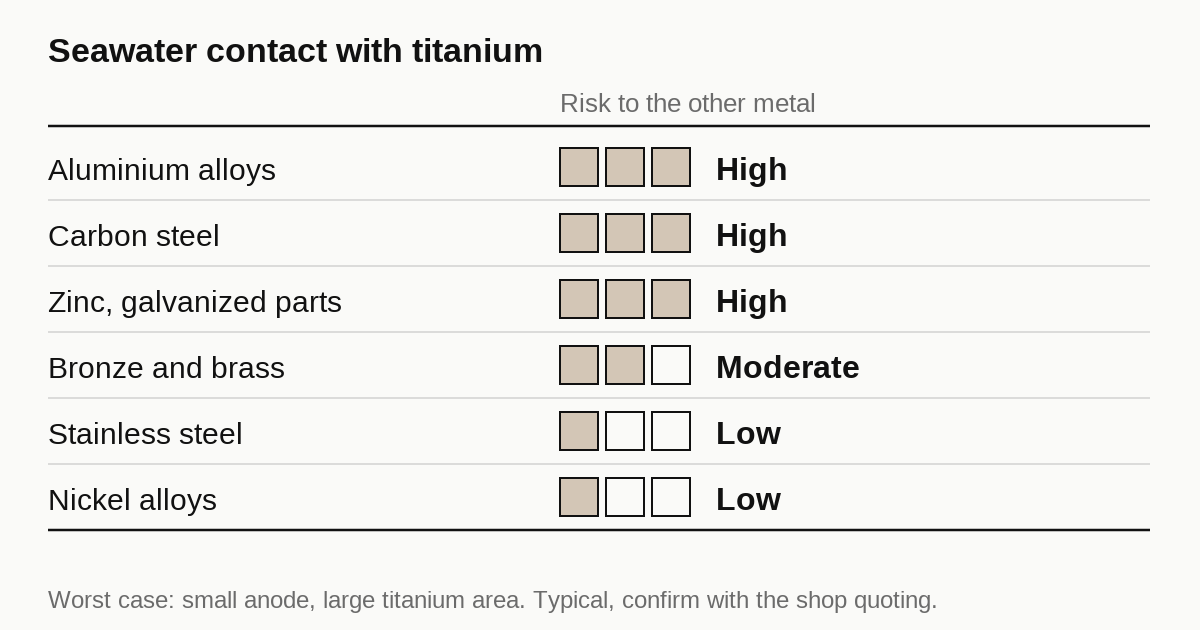
Titanium is noble in seawater. It sits near the cathodic end of the galvanic series with stainless steel, nickel alloys and graphite. When titanium is electrically connected to a less noble metal through seawater, the less noble metal corrodes faster.
| Titanium in contact with | Result in seawater |
|---|---|
| Aluminium alloys | Aluminium corrodes faster, high risk |
| Carbon steel | Steel corrodes faster, high risk |
| Zinc anodes and galvanized parts | Sacrificial metal is used up faster |
| Bronze and brass | Moderate, depends on area ratio |
| Stainless steel | Low risk |
| Nickel alloys | Low risk |
| Carbon fibre | Low risk for titanium itself, check the other metals in the joint |
Area ratio matters. A small titanium fastener in a large aluminium plate does limited harm. A large titanium plate with small aluminium fasteners is the dangerous arrangement, because the small anode takes the whole current. If you must join titanium to a less noble metal, use insulating sleeves and washers, sealant in the joint and a coating on the cathode area near the joint.
None of this is machining work, but a shop quoting a titanium fastener or fitting for a marine assembly should be told what it will touch. A good shop will ask.
Need a quote for this part? Get a titanium quote
Threads, galling and cavitation
Titanium threads gall, in the same way as on any titanium hardware: clean titanium sliding under load picks up material. For marine fasteners use a compatible anti-seize on assembly and ask the shop which thread method it uses. Titanium tooling and coolant covers the machining side.
Where parts move through water fast, such as propulsion hardware, titanium resists erosion and cavitation damage better than many bronzes and aluminium alloys. Finish still matters. Rough surfaces trap marine growth and start local attack, so call out a surface finish on wetted faces and see titanium surface finish.
Welds and assemblies
Welded titanium in marine service must be welded under inert gas shielding with a clean joint, or the weld picks up oxygen and nitrogen and loses ductility. A discoloured weld, past a light straw colour, is a warning sign. Our article on titanium welding and alpha case explains how to read colour and what to ask.
Certificates and standards
Marine and offshore buyers often need material traceability, and classification societies and customers can add their own requirements for materials in critical service. Ask the designer or class society what applies. The usual minimum on the RFQ is an EN 10204 3.1 mill certificate tied to a heat number, which titanium mill certificates explains. Product standards commonly named are ASTM B348 for bar, ASTM B265 for plate and sheet, ASTM B338 for tube and ASTM B381 for forgings.
Cleanliness and surface condition
Corrosion resistance depends on the surface as well as the alloy. Steel tools, steel wool and steel fixtures can leave particles of iron on a titanium surface, and iron that stays in a wet marine environment starts rust spots and can seed local attack. Ask the shop how it avoids iron pickup and whether the part is cleaned after machining. ASTM B600 is a guide to descaling and cleaning titanium surfaces, and you can name it on the drawing if a pickling or cleaning step matters to you.
A machined titanium part in seawater should also be free of heat tint from welding or hot work, unless the designer accepts it. Light straw is usually accepted, and darker blue or grey tint is a sign of contamination. If a part is finished by anodizing or blasting, say so, because those change the surface the water meets. Titanium anodizing covers the process. Tell the shop the intended service so it can flag any surface treatment that does not suit seawater.
What to put on the RFQ
Part: shackle body, drawing and STEP attached. Material: Ti-6Al-4V to ASTM B348 bar, annealed. Certificate: EN 10204 3.1, heat number on the certificate of conformity. Service: seawater, ambient temperature, sustained load. Designer confirms notch sensitivity. Contact materials: aluminium bracket, stainless pin. Insulating washer supplied by us. Threads: M12 x 1.75, 6H, thread milled. Surface: Ra 1.6 on wetted faces, all edges broken 0.5 mm. Quantity: 20 now. Needed by: date.
Shops typically confirm tolerances, finish and lead time in their quote. Send the drawing through the RFQ form and we reply within 24 business hours with one itemised quote, made by a partner shop that cuts titanium.
If you are still choosing the grade for a wet service, our guide to titanium grade selection covers the choice end to end.
Frequently asked questions
Does titanium corrode in seawater?
Not in ordinary seawater at ambient temperature. Titanium forms a stable oxide film and shows very low general corrosion in chloride environments. The risk areas are crevices in warm seawater and the damage titanium causes to less noble metals it touches.
Which titanium grade is best for marine hardware?
Commercially pure Grade 2 is the usual seawater grade for plate, tube and fittings. Grade 5 is chosen when strength decides, and Grades 7 and 12 are considered for crevice conditions in hot chloride service.
Will titanium fasteners damage an aluminium hull or fitting?
They can. Titanium is cathodic against aluminium, steel and zinc in seawater, so the less noble metal corrodes faster when the two are connected through water. Insulating sleeves, washers and sealant in the joint reduce the risk.
Need a quote for this part?
Send the drawing. We send one itemised quote for the finished parts and reply within 24 business hours.
Get a titanium quote