Guides / Industries
Titanium Vacuum and Cryogenic Components: Grade, Cleanliness and What the RFQ Must Say
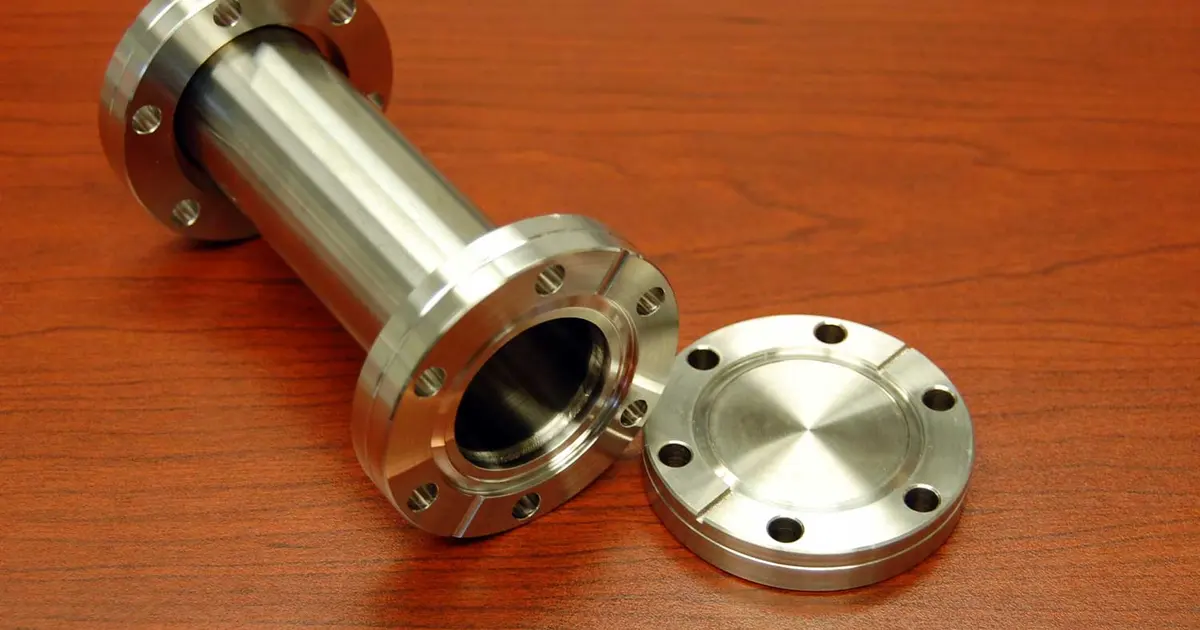
For titanium vacuum parts the grade is the easy decision and cleanliness is the hard one. Commercially pure Grade 2 has measured low outgassing in a controlled chamber study, Grade 23 ELI is the structural candidate when the part must stay tough when cold, and neither choice helps if the part leaves the machine shop with cutting oil on it. Write the grade, the machining fluid rules, the cleaning method, the proof of cleanliness and the packaging on the drawing or the RFQ, and treat the cleaning record as part of the deliverable.
What the outgassing data says about titanium
A 2021 study from NIST (Fedchak and co-authors, Journal of Vacuum Science & Technology B 39, 024201) measured seven chambers of identical geometry made by one manufacturer: 304L, 316L and 316LN stainless, a titanium chamber in ASTM Grade 2 and a 6061 aluminium chamber, plus two vacuum-fired 316 variants. After a bake of 125 to 150 °C for at least 72 hours, the titanium, aluminium and the two vacuum-fired steel chambers all showed hydrogen outgassing below 1e-11 Pa L s-1 cm-2, at least 100 times lower than 304L. The unfired steel chambers sat at 4.0 to 8.0e-11. Water outgassing of the titanium chamber was close to 304L and slightly lower.
Two cautions. It was one chamber per material, so it shows what is possible and does not guarantee your part. And the bake matters: the numbers are after a 125 to 150 °C bake, so a part that cannot be baked will not behave the same.
DESY’s public guideline for UHV components lists titanium among the UHV-compatible pure materials, next to aluminium, copper, molybdenum, tantalum and tungsten. It also names titanium screws as an example of unlubricated, uncoated screws that do not cold weld inside stainless steel components in clean assemblies. Our semiconductor guide covers finish, particle limits and why commercially pure grades are common in that equipment, so this article concentrates on cleanliness records and cryogenic service.
Choosing the grade
| Service | Grades to consider | Why | What to check |
|---|---|---|---|
| UHV chamber hardware, fittings | Grade 2 | The grade used in the NIST outgassing study | Bake limits, weld procedure |
| Structural brackets, rods, flanges at room temperature | Grade 5 | Strength | Cleaning route that suits the finish |
| Structural parts used cold | Grade 23 ELI, or Ti-3Al-2.5V | Tighter interstitials, or an alloy designed for low temperature | Property data at your service temperature |
| Fasteners | Agree with the equipment maker | DESY names titanium screws as an example of screws that do not cold weld in stainless components | Vented, unlubricated, uncoated |
Our own Grade 23 guide and Grade 9 guide cover each grade. For cryogenic use these facts are on the record. Wikipedia says lower oxygen and iron in the ELI grade improve ductility and fracture toughness at some cost in strength, that Ti-3Al-2.5V was designed for low-temperature environments and keeps toughness and ductility under cryogenic conditions, and that some beta alloys can transform into a hard, brittle omega phase at cryogenic temperatures. Carpenter Technology’s product page for Ti-6Al-4V ELI, a vendor source, lists maximum oxygen at 0.130 wt% and hydrogen at 0.013 wt%, and says the ELI grade has better mechanical properties at cryogenic temperatures than the standard grade.
We found no public table of fracture toughness against temperature in the sources we opened, so none is quoted here. For a cold load path, ask the supplier for test data at the temperature, from the same heat or process route.
Heat and shrinkage at low temperature
Two numbers from the NIST cryogenic materials database for Ti-6Al-4V (UNS R56400) help with design. We calculated these from the coefficients the database publishes.
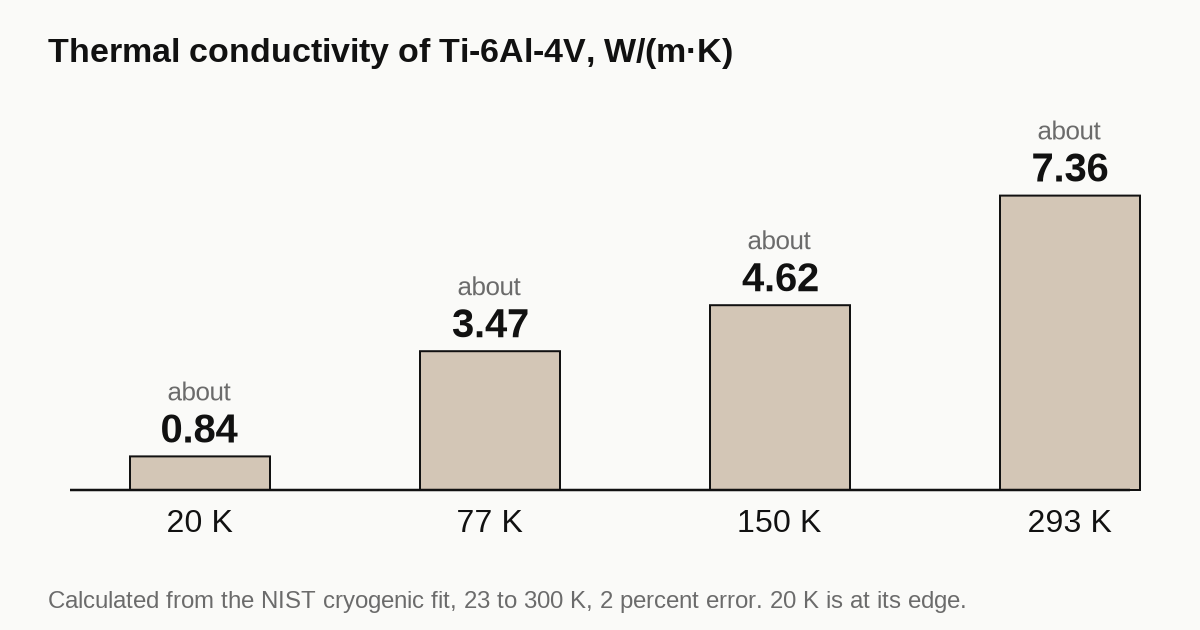
Conductivity. About 7.4 W/(m K) at 293 K, about 3.5 at 77 K and about 0.84 at 20 K, from a fit the database says is accurate to 2% against its data (data range 23 to 300 K, so the 20 K value sits at the edge). A part that carries load between warm and cold stages carries little heat, which is why designers consider titanium for supports. That is a design choice for your engineer, not a property we can promise.
Shrinkage. The database’s linear expansion fit gives (L − L293)/L293 of about −0.16% at 77 K and about −0.17% below roughly 24 K. On a 100 mm dimension that is about 0.17 mm. Dimensions on the drawing are normally for room temperature, so say whether a fit or a flatness callout applies at room temperature or at the service temperature, and check the mating material separately.
Need a quote for this part? Get a titanium quote
Cleanliness: copy a laboratory specification and cite it
There is no single standard for vacuum cleanliness, so the RFQ should name the one your equipment maker uses. DESY’s UHV component guideline (Vacuum 005/2008, version 1.6, September 2010) is a public example of how detailed it gets:
- Machining: necessary subsequent machining must be approved in advance. Only isopropanol may be used as cooling fluid, new cutting tools must be used, and standard cooling lubricants and cutting oils are not allowed.
- Cleaning: a high-pressure prewash, then an ultrasonic bath with hot deionised water and detergent, for example 3 to 6 times for 5 minutes with rinses of at least 1 minute between, a final rinse in hot deionised water and drying in a hydrocarbon-free atmosphere such as dry nitrogen. The example detergents are listed for stainless steel, copper and aluminium, not titanium.
- Handling: lint-free gloves on all vacuum surfaces and isopropanol only for wiping flanges.
- Proof: a residual gas analyser scan. A component counts as hydrocarbon-free when the leak-free system reaches a total pressure below 1e-7 mbar and the sum of partial pressures from mass 45 up to at least 100 is below 1e-3 of the total. The specific desorption rate of a baked component should be 5e-12 mbar l s-1 cm-2 or lower.
- Packaging: fill vessels with dry nitrogen and fit blank flanges, or wrap in polyethylene film. Aluminium foil is not allowed for particle-free parts.
That is one laboratory’s rulebook, written for its own accelerators, not a universal limit. The point for a buyer is that every line is something a shop can quote, document and be audited against. Before you copy it, check the detergent step with a processor that cleans titanium.
Design matters as much as washing. DESY tells designers to avoid virtual leaks and inaccessible volumes, to include vent holes in screws and pins where possible, to weld on the vacuum side and to avoid fluxed brazing. For titanium, finishing steps carry their own risk: our pickling guide explains why etching can add hydrogen and why a hydrogen limit or a vacuum bake may be called up. DESY’s own vacuum firing rule at 950 °C is for stainless steel, and we found no equivalent public rule for titanium, so agree any heat step with the processor against your heat treatment condition.
Documents to ask for
- Mill certificate with heat number and hydrogen result, as in our mill certificate guide.
- Cleaning record: process, chemistry, bath times and date, signed off by the processor.
- Machining fluid statement: fluid used and tooling policy, such as new tools for the job.
- Leak test result with the method and leak rate, if the part is a pressure boundary.
- RGA or desorption test if the spec asks for hydrocarbon-free proof.
- Packaging description that matches the drawing note.
What to put on the RFQ
State the grade and condition. State the cleaning specification by name and revision. State the machining fluid rule. State the proof required and who pays for it. Give surface finish for sealing faces (see the surface finish guide). Say whether the part is baked, and to what temperature. Say what temperature the dimensions refer to. Send the drawing through the RFQ form and we reply within 24 business hours with one itemised quote, made by a partner shop that cuts titanium. Whether a shop has clean-room space or a vacuum cleaning partner is for the shop to answer, and we ask it as part of how an order runs.
For the general grade decision, see titanium grade selection.
Sources
- Fedchak et al., “Outgassing rate comparison of seven geometrically similar vacuum chambers of different materials and heat treatments”, J. Vac. Sci. Technol. B 39, 024201 (2021), arXiv 2009.10560
- DESY Technical Specification Vacuum 005/2008 v1.6, Guidelines for UHV-Components at DESY (September 2010)
- NIST Cryogenic Materials: Ti 6Al 4V (UNS R56400), thermal conductivity and linear expansion
- Titanium alloy (Wikipedia)
- Carpenter Technology, Ti 6Al-4V ELI (vendor page, chemistry limits)
Frequently asked questions
Is titanium good for ultra-high vacuum?
It can be. In a NIST study of seven geometrically similar chambers, the Grade 2 titanium chamber showed hydrogen outgassing below 1e-11 Pa L s-1 cm-2 after a 125 to 150 °C bake, at least 100 times better than unfired 304L stainless. It was one chamber per material, so treat it as direction, not a guarantee.
Which titanium grade for cryogenic parts?
For structural parts, designers look at Grade 23 ELI, the extra low interstitial version of Ti-6Al-4V, because lower oxygen and iron improve toughness and ductility at some cost in strength. Ti-3Al-2.5V was designed for low-temperature use. Ask the shop for property data at your service temperature, because grade names alone do not tell you.
How should titanium vacuum parts be cleaned?
Follow the specification your equipment maker names. One accelerator laboratory's public guideline uses an ultrasonic bath of hot deionised water with detergent, 3 to 6 cycles of 5 minutes with rinses between, drying in a hydrocarbon-free atmosphere and handling with lint-free gloves. Titanium detergents are not listed there, so confirm the chemistry with the processor.
Can machining coolant ruin a vacuum part?
Yes, it can. Residues leave hydrocarbons, which DESY's guideline requires to be absent from UHV components. The same laboratory guideline allows only isopropanol as cooling fluid for subsequent machining, forbids standard cooling lubricants and cutting oils, and asks for new cutting tools. Machining fluid rules differ by lab, so state it on the drawing and ask the shop which coolant it plans to use.
Need a quote for this part?
Send the drawing. We send one itemised quote for the finished parts and reply within 24 business hours.
Get a titanium quote