Guides / Grades
Grade 7 or Grade 12: Picking Titanium for Hot Chloride and Acid
Grade 2 titanium corrodes about as slowly as any engineering metal. Then a part goes into hot brine, or into a gasket joint where chloride sits in a crevice, and Grade 2 starts to pit. The usual answer is a different grade of titanium, not a different metal. Grade 7 and Grade 12 are the two buyers most often asked to evaluate.
This guide covers what each adds, what it costs to buy, how it cuts and what the shop needs to know. The grade reference lists the UNS and Werkstoff numbers where they are verified.
What goes wrong with Grade 2
Titanium resists corrosion by forming a thin oxide film that heals itself. In most sea water, nitric acid and oxidising service, that film is enough.
It can fail in two situations.
- Crevice corrosion. Under a gasket, a bolt head or a deposit, oxygen runs out and the local chemistry turns acidic. In hot chloride solutions that is enough to break the film. A commonly cited threshold for Grade 2 is brine above roughly 70 C, though pH and crevice geometry move it.
- Reducing acids. In hot dilute hydrochloric or sulfuric acid, the film does not hold and Grade 2 dissolves.
Both grades below address that, by different routes.
What each grade adds
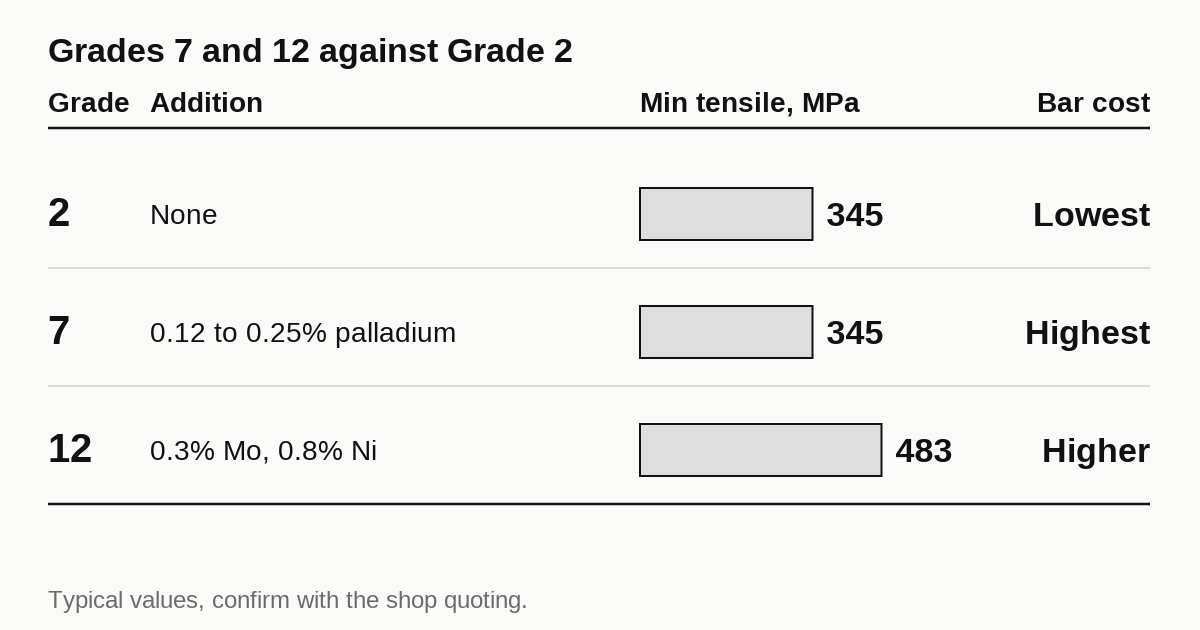
| Grade | Base | Addition | Typical min tensile | Typical min yield |
|---|---|---|---|---|
| Grade 2 | Unalloyed | None | around 345 MPa | around 275 MPa |
| Grade 7 | Grade 2 | Palladium, 0.12 to 0.25 percent | around 345 MPa | around 275 MPa |
| Grade 12 | Own chemistry | Molybdenum 0.3 percent, nickel 0.8 percent | around 483 MPa | around 345 MPa |
Palladium works by making the surface a more effective cathode, which keeps the metal in a passive state even in conditions that would break down Grade 2. Molybdenum and nickel in Grade 12 do a similar job through alloying.
These are specification minimums for bar, rounded. The current standard and the heat certificate govern.
Where each grade is used
Grade 7 goes into chemical process equipment that sees reducing acids or the hottest, most acidic chloride conditions. Heat exchanger internals, valve parts, pump components and vessel linings are typical. It is the highest corrosion tier of the family.
Grade 12 covers hot chloride service where crevice corrosion is the threat and reducing acid exposure is not severe. Heat exchangers, offshore and geothermal hardware and chemical plant parts show up. It is stronger than Grade 7 and Grade 2 for the same wall thickness, which sometimes lets the design use a thinner section.
Grade 11 is the Grade 7 chemistry on a Grade 1 base. It is more formable and softer, and it appears when a part is formed and then exposed.
Two other grades with a lower precious metal content, Grade 16 and Grade 26, exist for the same reason: crevice resistance at lower material cost. If the process engineer approved a cheaper corrosion grade, name it on the drawing and confirm stock.
How they cut
For machining purposes, Grade 7 behaves like Grade 2. Same speeds, same gummy chip, same need for sharp tools and a steady feed. A programmer would use the same cutting data, and the starting points in titanium speeds and feeds apply.
Grade 12 is slightly stronger and a little less gummy. Shops typically cut it at speeds close to Grade 2 and watch for faster flank wear.
The risk with both is cost of failure. A scrapped part in Grade 7 wastes expensive bar. Shops that know this tend to rough conservatively and verify setups before the first cut.
Contamination also matters on process parts. Iron picked up from steel tooling can seed corrosion later. Ask how the shop keeps steel and titanium swarf apart, and whether it cleans or pickles afterwards. The surface finish guide covers what a shop can do to the surface.
Cost and stock
Both grades are priced above Grade 2, and Grade 7 is priced far above it. This guide quotes no price because bar prices depend on size, heat quantity and a palladium cost that moves. What can be said:
| Grade | Relative bar cost | Typical stock position |
|---|---|---|
| Grade 2 | Lowest of the three | Common |
| Grade 12 | Higher | Usually a mill order |
| Grade 7 | Highest | Usually a mill order |
The practical effect is lead time. A Grade 2 diameter is often a phone call away. Grade 7 or Grade 12 in a specific diameter may be a mill order with a minimum heat size. The stock forms and lead time guide explains how to read that on a quote, and the cost guide shows how bar price enters the total.
Need a quote for this part? Get a titanium quote
Choosing between them
Ask the process engineer or the plant’s materials group which grade the service needs. If you have to decide yourself, these questions narrow the field.
- Is the service reducing acid, or chloride? Reducing acid points to Grade 7. Chloride alone often allows Grade 12.
- How hot is it? The higher the temperature, the less margin Grade 2 has.
- Is there a crevice? Gasket faces, flange joints and threaded connections all count. A smooth open surface is far less at risk.
- Does the part carry load? Grade 12 gives more strength than Grade 7.
- Can the project wait for a mill order? If not, a stocked grade that is adequate beats a perfect one that arrives late.
A design change can also remove the crevice. Sometimes a different gasket or a welded joint costs less than a more expensive grade.
Cleanliness on process parts
A corrosion grade only keeps its advantage if the surface stays clean. Three habits on the shop floor protect it.
- Keep steel away from the part. Iron smeared from steel tooling, vises or wire brushes can sit in the surface and start corrosion later. Dedicated titanium tooling and clean jaw covers help.
- Avoid chloride contamination in cutting fluids. Coolant that carries chlorinated additives can leave residue. Ask the shop what coolant it uses and how it cleans parts afterwards.
- Clean and pickle where the specification asks. Nitric and hydrofluoric pickling baths remove surface contamination, and some process customers specify a pickle or passivation step on the drawing.
Ask whether the shop has done corrosion grade work before and how it handles these points. The questions are the same for Grade 7, Grade 11 and Grade 12.
Weld and joint design
Many process parts are welded, and the choice of grade interacts with the weld. Weld filler wire exists for the common grades in AWS A5.16, and the filler should match the base metal grade. A welded Grade 12 assembly takes Grade 12 filler where the specification calls for it, and a mixed joint needs a plan.
The heat affected zone can lose some corrosion resistance if shielding is poor, which shows as a colour change on the weld. Shops that weld titanium inspect colour as a quick indicator. See titanium welding and alpha case for how shielding and colour inspection work.
What to put on the RFQ
- Grade and standard: Grade 7 or Grade 12 to ASTM B348 for bar, ASTM B265 for plate, ASTM B338 for tube, or ASTM B381 for forgings.
- Service conditions: temperature, fluid, pH and whether the part has crevices. This lets a shop advise on the grade.
- Stock position: whether you supply material or the shop buys it, and the acceptable lead time.
- Certificates: EN 10204 type 3.1 with heat numbers and chemistry, including palladium or molybdenum and nickel as relevant. The mill certificates guide explains the document types.
- Cleanliness: whether the part needs pickling or passivation and to what standard.
- Quantity: a spare part and a production run price differently when bar is a mill order.
Send the drawing and the service notes through the RFQ form and shops that cut titanium will reply within 24 business hours.
For how corrosion grades fit with the other grade decisions, read our guide to titanium grade selection.
See also: the Grade 2 titanium reference page.
Frequently asked questions
What is the difference between Grade 7 and Grade 2 titanium?
Grade 7 is Grade 2 with about 0.12 to 0.25 percent palladium added. Strength and machining are close to Grade 2. What changes is resistance to crevice corrosion in hot chloride and to reducing acids, and the price, which is much higher.
Is Grade 12 a cheaper alternative to Grade 7?
Often, yes. Grade 12 adds about 0.3 percent molybdenum and 0.8 percent nickel instead of palladium. It gives much of Grade 7's crevice corrosion resistance in many chloride services at a lower material cost. Reducing acid service is where Grade 7 keeps its edge.
Are Grade 7 and Grade 12 easy to buy?
Usually not. Both are often a mill order in bar sizes, and Grade 7 in particular carries a palladium cost that moves with the metal market. Ask the shop for stock lead time before you fix the grade on a drawing.
Need a quote for this part?
Send the drawing. We send one itemised quote for the finished parts and reply within 24 business hours.
Get a titanium quote