Guides / Grades
Ti-6Al-7Nb or Ti-6Al-4V ELI: Reading an Implant Drawing
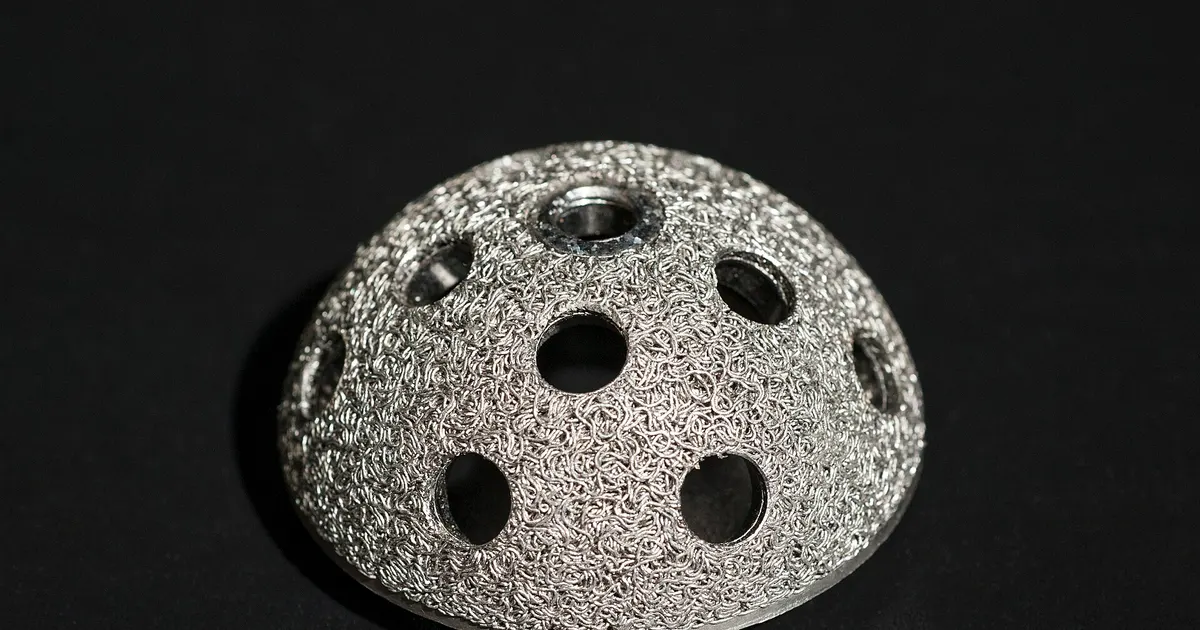
A medical drawing names its alloy in a note that is easy to skim past: Ti-6Al-4V ELI to one standard, or Ti-6Al-7Nb to another. The two look almost the same on a quote request. They are not interchangeable, and the difference decides which mill can supply the bar, how long it takes and which certificate has to arrive with the parts.
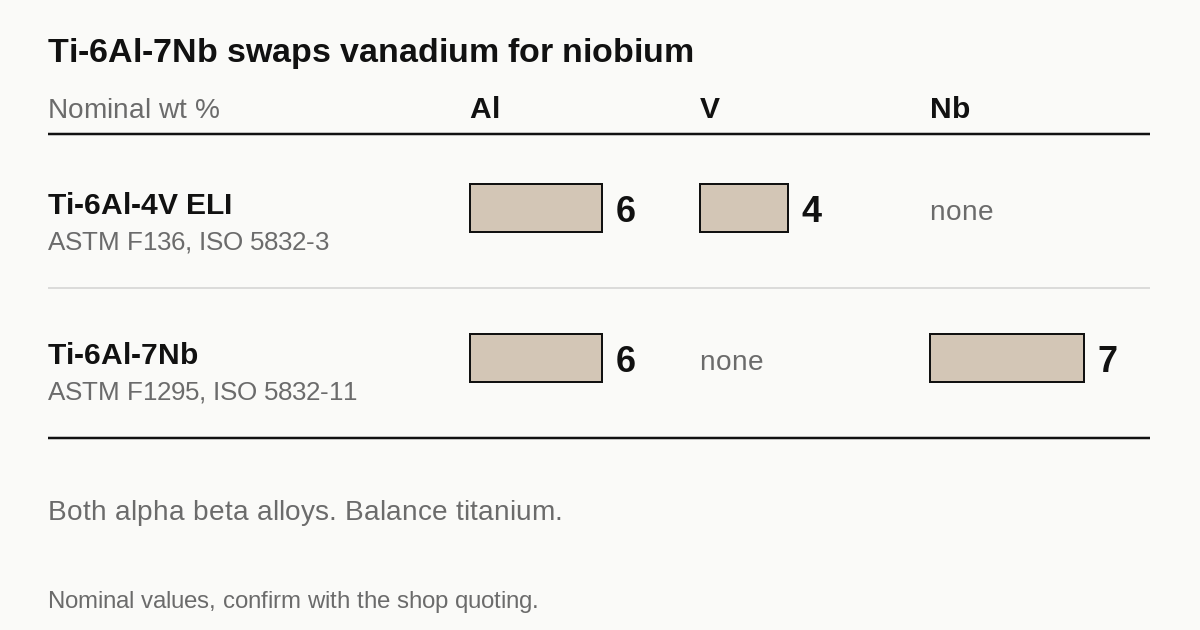
This article compares the two alloys for people who buy machined implant components and need to ask the right questions. For the wider picture of grade 23 itself, see the Grade 23 ELI guide.
Why niobium replaced vanadium
Ti-6Al-4V has been the standard implant alloy for decades. Vanadium is one of its two alloying additions, and concern about vanadium release in the body led alloy developers in the 1980s to look for a substitute. Ti-6Al-7Nb is the result: aluminium stays at about 6 percent and niobium takes the place of vanadium at about 7 percent.
Niobium stabilises the beta phase in the same way vanadium does, so the alloy keeps the alpha beta microstructure and the strength level of the original. It has been used for hip stems and other load bearing components.
Whether a particular device should use one or the other is a design and regulatory decision. The machinist and the buyer do not make it. What you can do is read the drawing correctly and buy to the named standard.
The two alloys side by side
| Item | Ti-6Al-4V ELI | Ti-6Al-7Nb |
|---|---|---|
| Nominal composition | Ti, 6% Al, 4% V | Ti, 6% Al, 7% Nb |
| ASTM standard for implants | F136 | F1295 |
| ISO standard for implants | ISO 5832-3 | ISO 5832-11 |
| Typical minimum tensile | around 860 MPa (F136 bar under 1.75 in, 825 MPa above) | around 900 MPa |
| Typical minimum yield | around 795 MPa (F136 bar under 1.75 in, 760 MPa above) | around 800 MPa |
| Typical minimum elongation | around 10 percent | around 10 percent |
| Approximate density | around 4.43 g/cm3 | around 4.5 g/cm3 |
| Availability | Sometimes stocked | Usually a mill order |
Figures are specification minimums and rounded. The Ti-6Al-4V ELI figures are those a distributor prints for ASTM F136 bar; we did not read the standard, and ASTM B348 Grade 23 bar lists a lower 828 MPa tensile minimum. The current revision of each standard governs, and the certificate for your heat shows what that heat tested at. If your drawing quotes different numbers, the drawing wins.
The close strength figures are the reason the two get confused. A tensile test on a finished part will not tell you which alloy it is. Only chemistry and the certificate do.
How each cuts
On the machine, the two behave alike. Both are alpha beta alloys with similar hardness, similar thermal conductivity and the same tendencies: heat stays at the cutting edge, tools wear on the flank, chips weld to the insert if the cut is interrupted.
A programmer would not change the toolpath. Insert grades, coolant pressure and fixturing are the same, and the speeds and feeds guide applies to both. The tooling and coolant guide covers the insert and coolant side.
Two practical differences do show up.
- Material handling. A shop that mostly cuts Ti-6Al-4V ELI may never have held Ti-6Al-7Nb. Segregation and marking procedures exist for the first alloy and have to be extended to the second. Ask how.
- Surface condition. Implant surfaces are often specified in Ra and finished with a cleaning or passivation step. ASTM F86 is commonly called out for implant surface preparation and marking. Whatever your drawing names applies to either alloy.
Why the stock is the real difference
Ti-6Al-4V ELI bar to F136 comes from several mills and sits in some distributor stock. Ti-6Al-7Nb bar to F1295 comes from fewer sources. A diameter that is a phone call away in one alloy can be a mill order in the other, with a minimum heat quantity and a longer wait.
That has three consequences for a buyer.
- Lead time. Ask the shop for stock lead time and machining lead time separately. The stock forms and lead time guide shows how to read that split.
- Minimum quantities. A mill may only cut a heat for a quantity larger than your first order. Some shops hold bar across several customers. Ask whether yours does.
- Price. Price per kilogram usually reflects the smaller supply. The machining time will not differ by much.
If a program is about to start production, order bar early and agree the heat number with the shop before cutting starts. A shop that quotes both alloys at the same lead time is worth a follow-up question about where the Ti-6Al-7Nb comes from.
What substitution means
Some RFQs arrive with the line “or equivalent”. For an implant, there is no equivalent. The alloy named on the drawing is part of the device file, and swapping it means change control on the device maker’s side before any shop touches it.
A shop that machines the wrong alloy because the right one was hard to find has made a part you cannot use. Treat any offer to substitute as a reason to ask for the drawing owner’s approval in writing, not as a saving.
For the wider rules on medical work, including cleanliness and the paperwork chain, read the titanium medical parts guide.
Need a quote for this part? Get a titanium quote
Other implant alloys you may see on the same drawing set
A device file rarely uses one alloy only. The standards below turn up beside the two compared here, and a shop quoting a family of parts will see all of them.
| Standard | Material | Typical role |
|---|---|---|
| ASTM F67 | Commercially pure titanium, Grades 1 to 4 | Dental and surgical CP parts |
| ASTM F136 | Ti-6Al-4V ELI | Load bearing implants |
| ASTM F1472 | Ti-6Al-4V, standard interstitial | Implant components, check the drawing |
| ASTM F1295 | Ti-6Al-7Nb | Vanadium free load bearing implants |
| ASTM F1713 | Ti-13Nb-13Zr | Beta alloy implants |
| ASTM F2066 | Ti-15Mo | Beta alloy implants |
Do not infer one from another. Each standard has its own chemistry, its own certificate and its own supplier list, and the figures vary. Where a shop is new to one of them, ask for a sample certificate of the kind it expects to receive, so the paperwork is clear before the order.
Records worth agreeing before the first order
Implant parts live or die on records, and the record set is easy to agree early and hard to rebuild later.
- Heat number at every stage, from the mill certificate to the final certificate of conformity.
- Marking method and location, so the heat number survives machining or is transferred before it is removed.
- Retention period, meaning how long the shop keeps certificates, inspection data and traveller documents.
- Cleaning and packaging record, where the drawing requires one.
- Nonconformance process, meaning what the shop does when a part misses a dimension and who decides disposition.
These are questions for the shop, and a good one answers them in writing within the quote.
What to put on the RFQ
- Alloy by composition and designation: Ti-6Al-7Nb, not “medical titanium”.
- Standard and revision: ASTM F1295 or ISO 5832-11, whichever the device file names.
- Whether the alternative alloy is acceptable: only if the drawing owner has approved it. Otherwise say it is not.
- Heat traceability: certificate of conformity naming the heat number and the original mill certificate. See the mill certificates guide.
- Quality system questions: ask the shop which medical quality system it works under and what that covers. Treat the answer as a question you ask, not a claim we make for the shop.
- Surface and cleaning requirements: Ra values, passivation or cleaning standard, marking method.
- Stock position: whether you can supply bar or will rely on the shop to buy it.
Send the drawing, the standard and the quantity through the RFQ form. Shops that cut implant alloys will reply within 24 business hours. The grade reference covers Ti-6Al-4V ELI and its neighbours if you need to compare more grades.
For the general grade decision behind a medical drawing, see titanium grade selection.
See also: the Grade 23 titanium (Ti-6Al-4V ELI) reference page and the titanium medical parts reference.
Frequently asked questions
What is Ti-6Al-7Nb?
Ti-6Al-7Nb is an alpha beta titanium alloy with about 6 percent aluminium and 7 percent niobium. It was developed as a vanadium free alternative to Ti-6Al-4V for surgical implants and is covered by ASTM F1295 and ISO 5832-11.
Can a shop substitute Ti-6Al-4V ELI for Ti-6Al-7Nb?
No. The alloy named on the drawing is part of the device file, and a change goes through the device maker's own change control. A shop that offers a substitute without that approval is giving you a certificate problem.
Does Ti-6Al-7Nb machine differently from Ti-6Al-4V?
Not meaningfully. The microstructure and strength are close, so tooling, coolant and cutting data are close too. The real differences are stock availability, lead time and the paperwork for the standard.
Need a quote for this part?
Send the drawing. We send one itemised quote for the finished parts and reply within 24 business hours.
Get a titanium quote