Guides / Sourcing
Purchase Order Terms for Machined Titanium Parts: Eight Clause Groups to Settle
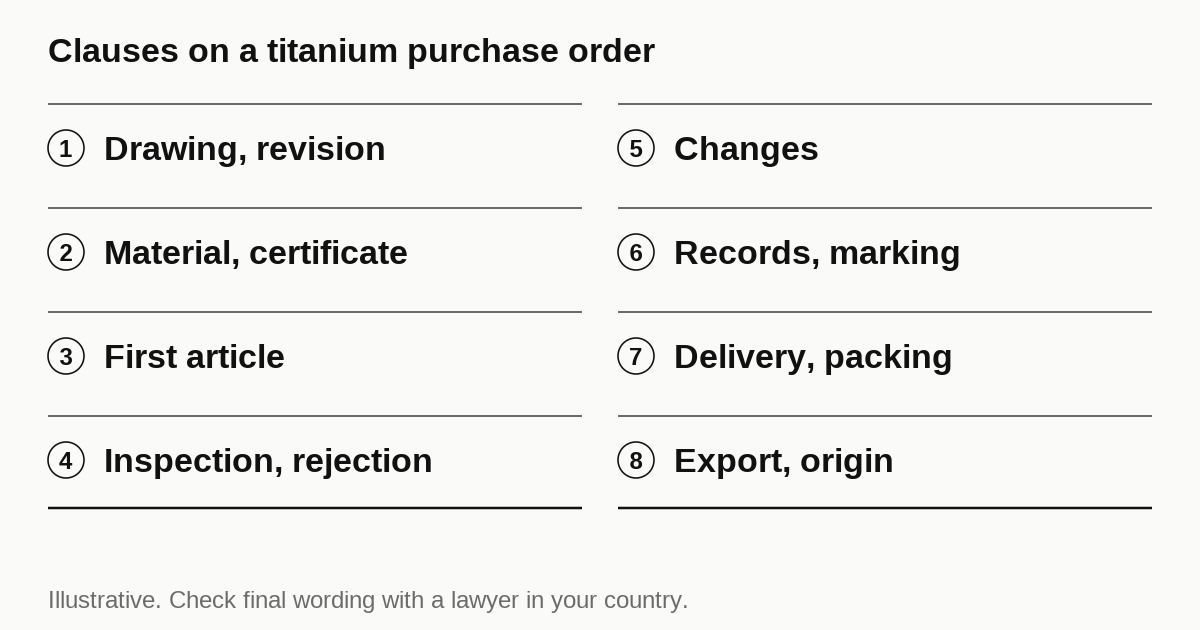
A purchase order for machined titanium parts should settle eight things in writing: the drawing revision, the material and certificate, the first article, inspection and claims, changes, records and marking, delivery and packing, then export and origin. Each is a short paragraph, and the ones left out are the ones a dispute later turns on. This post goes through the eight groups, quotes how published terms word them and ends with a checklist. It builds on our guides to quote validity and to who pays when a titanium part is rejected.
We name no shop and nothing here is legal advice. The examples are the published terms of other companies, shown as wording to learn from and not as a standard. Have your own counsel check the final text.
The eight groups at a glance
| Clause group | What it fixes |
|---|---|
| Drawing and revision | The revision the order is made to and who may change it |
| Material and certificate | Grade, specification, mill source if named, EN 10204 type |
| First article | Whether production waits for sign-off and what the report shows |
| Inspection and rejection | Claim period, limits per feature, who pays for a remake |
| Changes | Written approval for changes to material, process or place of work |
| Records and marking | Heat number on the part, record retention, lot identity |
| Delivery and packing | Incoterms rule and named place, packing, wood packaging mark |
| Export and origin | Export control status, origin, customs documents |
1. Drawing and revision
Name the drawing number and the revision letter, and say who may issue a new one. If the revision changes after cutting starts, the shop and you decide who pays, which our guide to drawing revision control explains. A revision that changes the program may also bring back a first article, so the PO and the drawing have to agree on the revision.
2. Material and certificate
State the grade, the product standard and the certificate type. EN 10204 sets four main types. Type 2.2 reports non-specific inspection results validated by the manufacturer. Type 3.1 reports specific inspection results on the delivered material, validated by the manufacturer’s authorised inspection representative, independent of the production department. Type 3.2 reports the same specific results and adds validation by the buyer’s authorised representative or an official inspector, according to the summary on Wermac’s EN 10204 page. A shop that supplies a 2.2 against a 3.1 order has not met the order, so write the type. Our guide to mill certificates shows what a titanium certificate carries.
If the parts end up in a US defence contract, a further rule can apply. DFARS clause 252.225-7009 treats titanium and titanium alloys as specialty metals and requires that titanium incorporated in delivered items be melted or produced in the United States, its outlying areas or a qualifying country, with listed exceptions. The clause must flow down to subcontracts. If your end use may fall under it, ask your customer or contracting officer, and put the melt source requirement on the PO in the customer’s own words.
3. First article
Say whether production waits for first article sign-off. Nikon AM Synergy’s published terms bar a supplier from submitting production parts before the buyer accepts the first article, when the order requires acceptance. GKN Aerospace’s guidance lists the triggers for a new full or partial first article: design changes, a change of source, process, inspection method, tooling or material, a change in the NC program and a production lapse of two years. A PO can copy that list so both sides know when the step comes back. See our post on lead time step by step for what it does to the schedule.
4. Inspection and rejection
Name the claim period and the limit for each feature. Avalon’s published quote terms give three periods: a short count must be claimed in writing within 48 hours of delivery, shipping damage within one business day of receipt and a nonconformance within five business days of delivery. Nikon’s terms require a response to a corrective action request within seven business days. Both are examples. Your period should be long enough for your receiving inspection to measure the critical features. Say who pays return freight and any lab tests, and whether the shop remakes or credits. The rejected part post gives sample wording and the defect table.
5. Changes
Titanium orders are exposed to quiet changes: a substitute bar, a different heat treatment route, a new outside processor. Nikon’s terms say the supplier shall not implement any change to product, process, service or place of manufacture without prior notification and written approval, and that outsourcing needs written approval with the supplier’s terms applying to the sub-tier supplier. Copy the idea. Name the changes that need approval, list the outside processors you have approved and require the shop to flow the requirements down. Our guide to grade substitution covers one such change in detail.
6. Records and marking
Three items belong here.
- Identity. Nikon’s terms set the minimum identification at part number, revision letter and lot number, on the smallest unit packaged. For titanium, add the heat number. Our post on heat lot segregation shows how a shop keeps it attached.
- Certificate of conformance. The same terms require a signed certificate with each shipment stating that the material, process and services are those the order specifies, supported by test records.
- Retention. The same terms keep records for 20 years unless they ship with the product and make them retrievable within 48 hours of a request. Twenty years is that buyer’s number and is long for a small shop, so agree a period you will both stand behind.
The same terms also require material to be authentic and traceable to the original manufacturer, with records on request. If provenance matters, say so.
Need a quote for this part? Get a titanium quote
7. Delivery and packing
Name an Incoterms rule and a place. The International Chamber of Commerce describes Incoterms 2020 as eleven rules that clarify the tasks, costs and risks of delivering goods from seller to buyer. Avalon’s quote terms, for comparison, use FOB Origin with freight and insurance prepaid and added to the invoice. A PO that says only “delivered” leaves risk transfer open. State packing requirements too: Nikon’s terms ask for packaging that protects against cross contamination, mix-up, corrosion and environmental conditions. If parts cross borders in wooden crates, the wood packaging has to meet the importing country’s rules, as our first lot checklist explains.
8. Export and origin
State the export control status of the drawing and the part. Our post on export controls covers the EAR and ITAR split. For US imports, the commercial invoice regulation 19 CFR 141.86 asks for the country of origin, a description with grade or quality, quantities, unit price and currency and each itemized charge. It also asks for assists: goods or services used in production but not in the invoice price, such as dies, molds, tools or engineering work. If you supply fixtures or drawings, that line can apply to you, so ask your customs broker. Duties depend on the classification of the finished part and change over time, so check them with a broker before you commit to a price.
Tooling and who owns it
If the order needs special fixtures, say who owns them. Avalon’s quote terms make tooling developed by the shop its property unless the quote says otherwise, keep buyer-owned tooling at the buyer’s risk and let the shop dispose of tooling left unclaimed two years after final delivery, on 30 days’ written notice. That is one shop’s wording. Decide yours before the fixture is built.
A short checklist
- Drawing number and revision named on the PO.
- Grade, standard and EN 10204 type named.
- First article required or not, and who signs.
- Claim period, per-feature limits and return freight.
- Changes needing written approval and approved outside processors.
- Heat number marking, certificate per shipment and record period.
- Incoterms rule, named place and packing.
- Export status, origin and customs documents.
- Tooling ownership.
- Which document governs if quote and PO differ.
What to put on the RFQ
Tell the shops which certificate type, first article rule and delivery terms you intend to put on the PO, so their quotes price them. Send the drawing through the RFQ form and we reply within 24 business hours with one itemised quote. Our guide to comparing titanium quotes line by line shows how to read the replies.
Sources
- Nikon AM Synergy, supplier terms and conditions F020 Rev F, 16 July 2024 (one buyer’s published terms)
- Avalon, quote terms, revision 4/15/2024 (one manufacturer’s published terms)
- GKN Aerospace, AS9102 first article inspection report common mistakes, revision A, March 2022
- Wermac, EN 10204 certificate types (summary of the standard)
- DFARS 252.225-7009, restriction on acquisition of certain articles containing specialty metals
- International Chamber of Commerce, Incoterms 2020 rules
- 19 CFR 141.86, contents of invoices (Legal Information Institute)
Frequently asked questions
What should a purchase order for machined titanium parts include?
At minimum: the drawing and its revision, the material specification and certificate type, whether a first article is required, inspection and claim terms, who approves changes, record and marking rules, the Incoterms rule with a named place and the export status of the part. Each group is a short paragraph, and the details follow your drawing.
Which EN 10204 certificate should a titanium PO ask for?
Type 3.1 is the usual request for traceable bar: it reports specific inspection results and is validated by the manufacturer's authorised inspection representative, independent of production. Type 2.2 reports non-specific results validated by the manufacturer. Type 3.2 adds validation by the buyer's representative or an official inspector. The PO should name the type.
Does a purchase order override the shop's quote terms?
It can. If both documents carry terms and they differ, say in writing which one governs, and have both sides accept that. Quote terms such as price validity or material price adjustment can disappear if the PO is silent and the PO terms replace them. Ask your own counsel to check the wording.
How long does a buyer have to claim a defect in titanium parts?
The period comes from the contract. One manufacturer's published quote terms require a written nonconformance claim within five business days of delivery. Another buyer's published terms require a corrective action response within seven business days of a request. Put your own period on the PO and measure the critical features inside it.
Need a quote for this part?
Send the drawing. We send one itemised quote for the finished parts and reply within 24 business hours.
Get a titanium quote