Guides / Cost
A Titanium Part Fails Inspection: Causes, Rework Limits and Who Pays
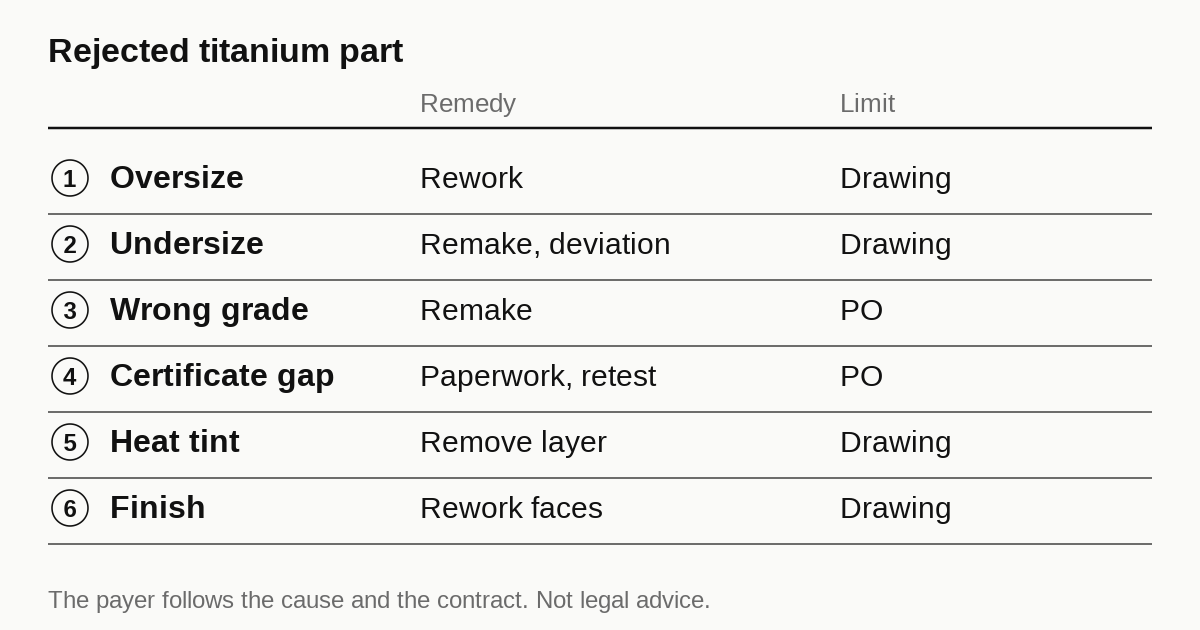
A titanium part that fails inspection is paid for by the party that caused the miss, as the contract defines it: the shop for a feature that is out of tolerance on a clear drawing, the buyer for an unclear or changed drawing or for bar the buyer supplied. The practical questions are what can be reworked, how fast you must say so, what a remake really costs and what the file looks like when a dispute starts. This post is part of our guide to how to reduce titanium machining cost, because the cheapest titanium part is the one that is not made twice.
We own no machines and we name no shop. The terms of an order are confirmed on your quote. Nothing here is legal advice. The defaults in the table are our reading of common practice and of the few published terms we opened, not a standard, and your contract governs.
The defect table
| Symptom | Likely cause | Prevention | Limit that decides it | Default payer |
|---|---|---|---|---|
| Feature oversize | Tool wear, offset error, heat during the cut | In-process gauging, first piece measured | Drawing tolerance, or the general tolerance class named on the drawing | Shop reworks at its cost if correctable and the drawing was clear |
| Feature undersize | Over-cut, offset error, bar too small to clean up | Check bar size against the allowance, as the blank sizing guide explains | Drawing tolerance | Shop remakes; buyer if it supplied a short bar or revised the drawing after cutting |
| Wrong grade, condition or specification | Wrong bar pulled, certificate not matched to the stock | Heat number marked on the bar and parts, certificate checked before cutting | Material line of the drawing and PO | Shop; buyer if buyer-furnished material |
| Certificate gap | Missing heat number, wrong specification revision, wrong EN 10204 type | Certificate list agreed on the PO | Certificate line of the PO | Shop if the PO named it and it was not delivered |
| Surface layer or heat tint left on | Heat treatment or stress relief in air without removal | State the process route and the removal on the drawing | Drawing note; we found no standard figure for depth | Whoever chose the process route |
| Surface finish out of limit | Chatter, tool marks, handling damage | Ra and zones on the drawing | Ra value and zone on the drawing | Shop if the limit was on the drawing; buyer if it was only “good finish” |
Tolerance classes: ISO 2768-1 sets general tolerances in four classes for dimensions without individual indications, as the EVS catalogue page describes. We did not read the standard.
Oversize and undersize
An oversize feature on a turned or milled part can often be recut, if the geometry still allows a finish pass and the new size remains inside the limit. An undersize one cannot. The two usual causes in titanium are tool wear that creeps the size and a bar that was too small to clean up. The second is a quote-stage problem: if the shop priced a bar that runs close to the finished size, the margin for a recut is gone. Our blank sizing guide shows how a hot-worked bar can run undersize.
Wrong material or condition
A wrong bar is rarely visible on the part. It shows on the certificate, on the heat number or in a lab test. This is why the heat number should be on the bar, the traveller, the parts and the certificate. If the bar was supplied by the buyer, a published example of shop terms from Avalon says defective customer-furnished material found during processing is replaced by the buyer at no charge and that the shop is not liable for scrapping it. That wording protects the shop. If you supply the bar, write down who checks it on arrival.
Certificate gaps
The part can be perfect and still fail on paper. Type 3.1 under EN 10204:2004 reports specific inspection on the delivered batch and is validated by the manufacturer’s inspection representative, independent of production. Type 2.2 reports non-specific inspection. A shop that supplies a 2.2 against a 3.1 order has not supplied the certificate. The fix is usually the paperwork, not the part, so state in the PO what the certificate must show and who may correct it. One aerospace supplier requirement document, GKN Aerospace’s first article guidance (revision A, 2022), asks for copies of the original mill certifications with the specification revision.
Surface layer and finish
Titanium heated in air above roughly 400 degrees Celsius forms a hard, brittle, oxygen-rich layer called alpha case. A vendor, Boze Titanium Manufacturing Center, gives depths of 20 to 50 micrometres for stress relief in air at 500 to 700 degrees and 100 to 200 micrometres for Ti-6Al-4V solution treatment. A 2016 Stellenbosch study found it readily removed by machining, with notching and faster tool wear at high speeds. We found no standard value for how much to remove, so the drawing note and the shop’s route decide it. If the part is heat treated after machining in air, ask who removes the layer and who inspects for it.
Finish limits fail more often on paper than on the part. “Good finish” is not a limit. An Ra value on named faces is.
What a remake costs
Take the example from our batch size post: a setup of 16 hours at 85 per hour, 1.5 hours of run time per part and 4 kg of bar at 55 per kg. Those are our assumptions, not prices. The variable cost of one part is 347.50, of which bar is 220, or 63 percent. If the job is still running, a remake costs about that. If the job is closed and the fixture, program and first article have to be redone, one part costs 1,707.50, because the setup of 1,360 returns. The gap between 347.50 and 1,707.50 is why the question “is the job still open?” matters. We found no public figure comparing remake cost in titanium and other metals. The direction follows from the lines: bar is a large share of titanium cost and cycles are long.
Need a quote for this part? Get a titanium quote
What the law says in one paragraph
In the United States, UCC article 2 governs sales of goods under state law. Section 2-601 lets a buyer reject the whole delivery if the goods fail in any respect to conform to the contract, accept the whole or accept some units and reject the rest. Section 2-602 requires rejection within a reasonable time and prompt notice to the seller. Section 2-508 lets a seller cure by notifying the buyer and delivering conforming goods before the contract deadline, and in some cases allows extra time. Section 2-608 allows revocation of acceptance where a nonconformity substantially impairs value and was hard to discover, with notice within a reasonable time. Parties often replace these defaults with contract terms, as the five-business-day claim period above shows. Other countries apply other law, and we did not open any. Ask a lawyer in your jurisdiction.
How to write the limit into the contract
A paragraph you can adapt, not legal advice:
Parts not conforming to the drawing revision named on the PO may be rejected by written notice within 10 business days of receipt. At the buyer’s choice the seller remakes or credits the rejected parts and pays return freight. Material for a remake carries the same grade, specification and certificate as the original order. Material supplied by the buyer is replaced at the buyer’s cost, and the seller confirms in writing before cutting that it has checked the size.
Name the limit for each feature, state the claim period and say who pays for return freight, lab tests and material.
Who inspects and when
Ask for a measured report, not a statement. GKN Aerospace’s guidance asks for a ballooned drawing with characteristic numbers and says coordinate measuring machine data alone is not acceptable for a positional tolerance, because the actual value must be shown. It also asks for a full or partial first article after a change in the NC program, tooling or materials, among other triggers. Your own receiving inspection should measure the critical features within the claim period, not after.
The dispute file
If a part is disputed, send the shop one message with:
- The PO, drawing revision and quote with its terms.
- The certificate and the packing list.
- The measured values, the instrument, the date and who measured.
- Photographs with a scale.
- The date and time of receipt and of your notice.
- The rejected parts, kept in their packing and not used.
- What you want: rework, remake or credit.
Keep the parts. Under UCC 2-602 a buyer that has taken possession of rightfully rejected goods must hold them with reasonable care long enough for the seller to collect them, and exercising ownership over them afterwards is wrongful against the seller.
What to put on the RFQ
State the claim period you expect, the limit for each critical feature and who supplies the bar. Ask each shop to say in the quote how it handles a nonconforming part and whether it will repeat the setup for a remake. Our guide to comparing quotes line by line shows where to put those lines, and our reduce titanium machining cost guide sets the lever in context. Send the drawing through the RFQ form and we reply within 24 business hours with one itemised quote.
Sources
- Avalon, quote terms, revised 15 April 2024 (example of a manufacturer’s published terms)
- Cornell Legal Information Institute, UCC article 2: 2-508, 2-601, 2-602 and 2-608
- GKN Aerospace, AS9102 first article inspection report common mistakes, revision A, March 2022
- Wermac, EN 10204 certificate types (secondary summary; standard not read)
- Boze Titanium Manufacturing Center, alpha case formation (vendor page, updated October 2026)
- Conradie, Oosthuizen and Sacks, feasibility of removing alpha case by machining, Stellenbosch University, 2016
- EVS, ISO 2768-1:1989 catalogue page (scope and four classes; standard not read)
Frequently asked questions
Who pays when a titanium part fails inspection?
It depends on the contract and on who caused the miss. As a default, the shop pays to rework or remake a part that misses a clear drawing. The buyer pays when the drawing was unclear or changed after cutting, or when the buyer supplied the bar. A published example of shop terms says repair or replace nonconforming goods, and caps liability at the price of the products.
How fast must I report a rejected part?
As fast as your contract says. One published set of quote terms requires written notice of a nonconformance claim within five business days after delivery, or acceptance is assumed. US sales law, UCC 2-602, says rejection must come within a reasonable time and the seller must be notified promptly. Check the terms before the parts arrive.
Can a shop rework an undersize titanium part?
No. Material cannot be put back, so an undersize feature means a remake, unless the drawing owner approves a deviation. An oversize feature can often be reworked if the geometry allows. Ask the shop to say which it is and to confirm the remake will use material with the same heat number and certificate.
Is a remake of a titanium part more expensive than in other metals?
We found no public figure comparing remake costs by metal. The direction follows from the cost lines: titanium bar is a large share of the per-part cost and cycle times are long, so a scrapped part loses both. In our illustrative example the bar is 63 percent of the variable cost of each part.
Need a quote for this part?
Send the drawing. We send one itemised quote for the finished parts and reply within 24 business hours.
Get a titanium quote