Guides / Sourcing
The Kroll Process: How Titanium Sponge Becomes the Bar You Buy
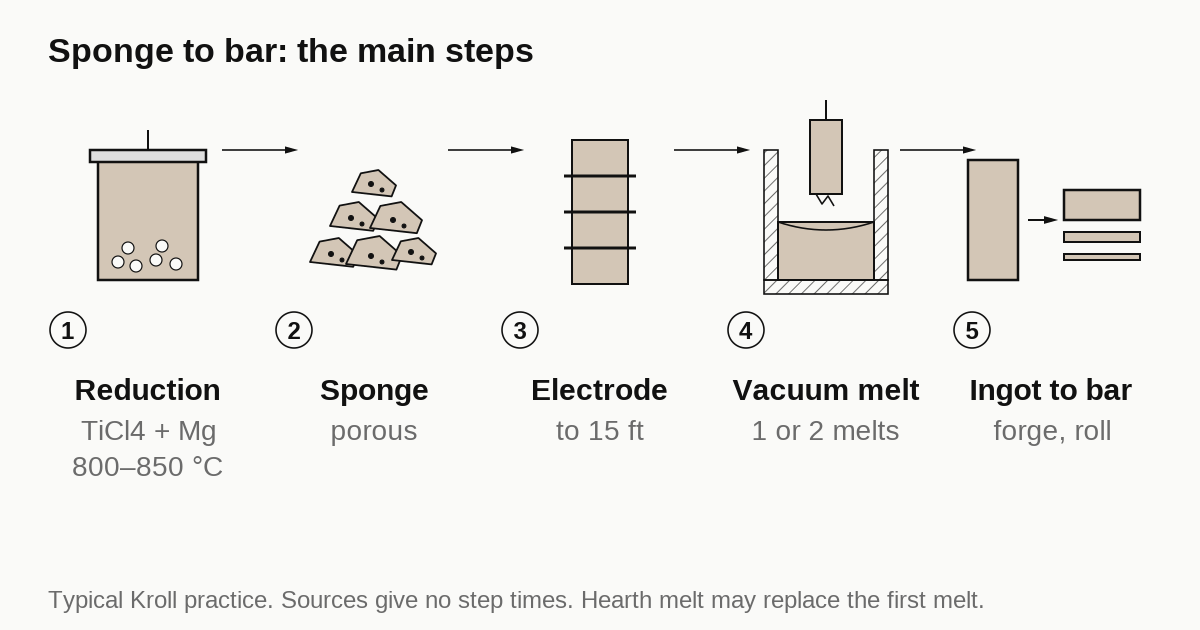
Titanium sponge is the first solid form of the metal. It is made by the Kroll process, which reduces titanium tetrachloride with liquid magnesium at about 800 to 850 °C, and it becomes bar only after it is pressed, melted under vacuum at least once and then forged or rolled. Every bar a shop cuts has been through those steps, which is one reason a titanium machining quote moves with the mill’s schedule as well as the shop’s.
This guide follows the route in order and says where each fact comes from. The sources give temperatures and plant data but no step durations, so we give no lead times. Facts were read in October 2026 and are typical, not a specification.
From ore to tetrachloride to sponge
The Kroll process is named for William Kroll, who developed it in Luxembourg and reported it to the Electrochemical Society around 1940, according to Wikipedia’s summary of the literature. The reaction is simple on paper: liquid magnesium takes the chlorine from titanium tetrachloride (TiCl4), leaving titanium metal and magnesium chloride. The same source gives the operating range as 800 to 850 °C in a stainless steel retort.
What comes out is a porous mass, which is why it is called sponge. Rolled Alloys describes it as brittle, with low levels of iron and oxygen and a purity that can exceed 99 percent. Magnesium and magnesium chloride are removed afterwards, by vacuum distillation or by leaching. A sponge maker, Toho Titanium, states its Grade A sponge at a minimum of 99.4 to 99.7 percent titanium depending on the product, with separate limits for iron, oxygen and chlorine. It also says one production run can yield up to 13 tons of sponge lumps. That is a batch scale, not a continuous line.
From sponge to ingot
Sponge is not used as it comes. Rolled Alloys describes pressing sponge and alloying additions into compacts, then welding the compacts into an electrode up to 15 feet (about 4.6 m) long. The electrode is melted by an electric arc in a vacuum chamber, and the pool freezes in a water-cooled copper crucible to form an ingot. This is vacuum arc remelting, or VAR.
For critical parts the same source says the usual practice is a double VAR melt, or a hearth melt followed by VAR. ATI’s data sheet for Ti-6Al-4V says the alloy is made by VAR, electron beam or plasma arc hearth melting, with remelting by one or two vacuum arc steps. Hearth melting can take a lot of scrap and can cast slabs of 40,000 to 50,000 pounds (about 18 to 23 tonnes) that go straight to a hot rolling mill, but aerospace grade titanium still needs VAR as the final melt.
| Stage | What happens | Figure in the source | Source |
|---|---|---|---|
| Reduction | Liquid magnesium reduces TiCl4 in a retort | 800 to 850 °C | Wikipedia |
| Purification | Magnesium and MgCl2 removed | vacuum distillation or leaching | Wikipedia |
| Sponge | Porous, brittle metal lumps | Ti 99.4 to 99.7 % min (Toho Grade A) | Toho Titanium |
| Electrode | Sponge and alloy compacts welded together | up to 15 ft (about 4.6 m) | Rolled Alloys |
| Melt | Vacuum arc remelt, once or twice | 1 or 2 VAR steps | ATI, Rolled Alloys |
| Hearth slab | Direct to hot rolling | 40,000 to 50,000 lb (18 to 23 t) | Rolled Alloys |
| Mill product | Forged bar, rolled plate and sheet | no figure given | Rolled Alloys |
Source: the five pages listed under Sources, read October 2026. Wikipedia is a secondary summary of the process literature. Figures are typical, and we did not open the ASM or Kroll-era papers behind them.
From ingot to bar
Rolled Alloys says forging makes slabs, bars and open-die shapes such as rings, and rolling makes coil, sheet and plate. Bars can go on to die forging or be drawn into wire. After heat treatment the surface can carry a brittle, oxygen-rich layer called alpha case, which the same source says is removed by pickling, chemical milling, blasting or machining. Our guides to alpha case and pickling cover that step from the buyer’s side.
Need a quote for this part? Get a titanium quote
Who makes sponge, and why a buyer sees it
The US Geological Survey puts world sponge production at about 370,000 tonnes in 2025, with China at 260,000, Japan 53,000, Russia 25,000, Kazakhstan 16,000 and Saudi Arabia 12,000. The United States made none: its last domestic plant closed in 2024, a Nevada plant of 12,600 tonnes a year capacity has been idle since 2020 and a Utah plant of 10,900 tonnes a year has been idle since 2016. US sponge imports were an estimated 44,000 tonnes in 2025, mainly from Japan (73 percent through July), Kazakhstan and Saudi Arabia (13 percent each). USGS gives a landed sponge value of USD 12 per kg for 2025, against USD 13.30 in 2024. That is an import unit value, not a price list, and our price note explains the gap to what a shop pays for bar.
What this means for your quote
The route has five separate operations before a bar exists: reduction, purification, electrode making, melting and conversion. The sources give no waiting time for any of them, so we cannot say where lead time sits. What a buyer can do is ask the shop for the mill, the melt country and the heat number, then keep the certificate in the order file, as set out in the stock forms and lead time guide. Changing the bar source after the cut is expensive, so state any origin requirement at quote stage.
When a part needs a specific bar, send the drawing through the RFQ form and we reply within 24 business hours with one itemised quote, made by a partner shop that cuts titanium.
Back to cost
The long route is one reason the stock form you ask for matters. Reducing titanium machining cost starts with the blank size and the bar or plate you specify, not only the cutting time.
Sources
- Wikipedia, Kroll process: reaction, 800 to 850 °C retort, purification and melting (secondary summary), read 25 October 2026
- Toho Titanium, titanium sponge: Kroll process, Grade A purity and batch size, read 25 October 2026
- Rolled Alloys, How titanium sponge and scrap become final products: electrodes, VAR, hearth melting, forging and rolling, read 25 October 2026
- ATI, Ti-6Al-4V Grade 5 technical data sheet: VAR, electron beam and plasma hearth melting, one or two remelts
- USGS, Mineral Commodity Summaries 2026, Titanium and titanium dioxide: sponge production, plants, imports and value
Frequently asked questions
What is the Kroll process?
It is the batch process that makes titanium metal by reducing titanium tetrachloride with liquid magnesium at roughly 800 to 850 °C in a sealed retort. The product is a porous lump called sponge. Sponge is not a finished metal: it is pressed, alloyed and melted in a vacuum before it is rolled or forged into bar.
Why is titanium made in batches and not cast from ore like steel?
Titanium reacts with oxygen and nitrogen at high temperature, so it cannot be smelted in air. The sources we read describe sealed retorts for the reduction and vacuum or inert atmosphere melting afterwards. That is why the route has separate chemical, melting and mill stages instead of one furnace.
Does the sponge supplier matter for a machined part?
Not directly. Your certificate names the mill and the heat, and the mill chooses its sponge. It matters for supply risk: sponge comes from a few countries, and the United States made none in 2025. If origin matters for your part, name it on the RFQ so the shop buys bar that meets it.
Need a quote for this part?
Send the drawing. We send one itemised quote for the finished parts and reply within 24 business hours.
Get a titanium quote