Guides / Cost
How to Compare Three Titanium Machining Quotes Line by Line Before You Pick the Cheapest
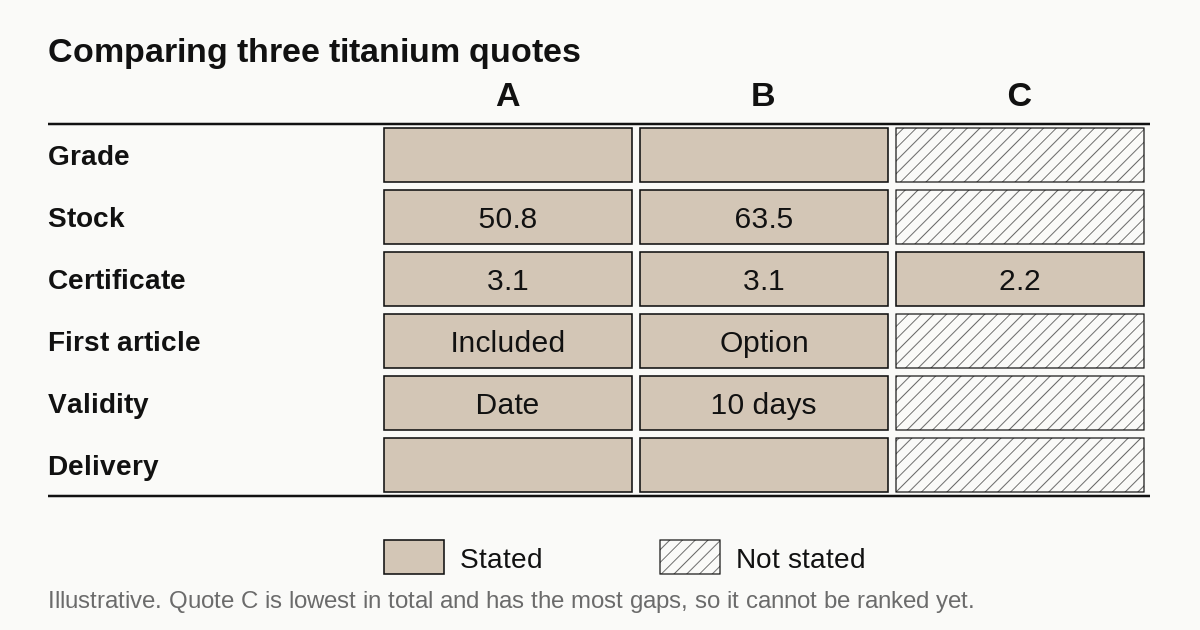
Compare titanium machining quotes by making them cover the same scope first and reading the totals second. Ten lines decide whether two quotes are the same job: the grade and specification, the stock size priced, the condition, the tolerance, the finish, the inspection report, the certificate type, the quantity breaks, the validity and the delivery terms. A quote that is silent on a line has not priced it. This post is part of our guide to how to reduce titanium machining cost, and it is written for a buyer holding two or three quotes that differ by more than the geometry can explain.
We own no machines, we name no shop and we do not rank shops: the comparison is yours. The quote example below is illustrative.
Why the lowest total is often the smallest scope
Three quotes for 50 pieces of the same drawing can differ for reasons that have nothing to do with price. The table shows an illustrative set, with each shop’s silence marked.
| Line | Quote A | Quote B | Quote C |
|---|---|---|---|
| Total for 50 pieces (illustrative) | 9,800 | 8,400 | 7,900 |
| Grade and specification as drawn | Yes | Yes | Not stated |
| Stock size priced | 50.8 mm bar | 63.5 mm bar | Not stated |
| Certificate | EN 10204 type 3.1 | EN 10204 type 3.1 | Type 2.2 |
| First article report | Included | Option | Not stated |
| Validity | Calendar date | 10 days | Not stated |
Read down column C. It is the lowest total and the least complete. Three lines are missing, so it cannot be ranked against A and B until they are priced. Rank only once every line is filled or marked as an option.
Stage 1: before the RFQ
- Fix the lines the drawing fixes. Grade, specification and revision, condition and form. Why: shops can only quote what is written, and an open line is filled with the cheapest stock. Good looks like “Ti-6Al-4V, ASTM B348 Grade 5, annealed bar”, with a revision if your customer fixes one.
- Say which tolerances matter. Mark the tight features and leave the rest to a named general tolerance. ISO 2768-1 sets general tolerances in four classes for dimensions without individual indications, so say which class you assume. Why: a generic cost page puts a plus or minus 0.01 mm callout at 100 to 200 percent above 0.05 mm, and a tight tolerance on every dimension means every dimension is machined and measured to that level. Good looks like two or three called-out features.
- Decide the paperwork. Certificate type, first article, test reports. Why: each line is real work. Our mill certificate guide says what each document proves. Good looks like the exact list your customer requires.
- Say whether the part repeats and in what lots. Why: the setup share falls with quantity, and release rules change later prices. See batch size price breaks.
Stage 2: the RFQ itself
- Send the same package to every shop. Same drawing revision, same model, same notes, same quantities. Why: a revision that differs between shops makes the quotes incomparable from the start.
- Ask for the quote to be itemised. Material with stock size, programming and fixturing, machine time per part, outside finishing, inspection and documents. Why: you cannot see which line differs from a lump total. Good looks like five lines per quantity break.
- Ask for options, not substitutions. Any alternative grade, stock size or certificate should come as a separate priced line. Why: it keeps a swap visible, as we explain in our grade substitution guide.
- State the delivery term. Name an Incoterms 2020 rule if the part ships across a border; the ICC describes the eleven rules as clarifying the tasks, costs and risks of delivery from seller to buyer. Why: two quotes on different terms differ by freight, insurance and who carries the risk in transit.
Stage 3: reviewing the quotes
Use this grid. Mark each cell Yes, No, Option or Not stated, then ask for the gaps.
| Line | What to check | Why | What good looks like |
|---|---|---|---|
| Grade and specification | Same as the drawing, revision named | A different spec changes the certificate | The drawing line copied back |
| Stock size priced | A bar or plate size, not just a part weight | Blank size sets the material line, as the buy to fly calculator on this site shows | A size in millimetres |
| Condition | Annealed, solution treated and aged or other | Condition changes strength and cutting | As drawn |
| Tolerance | Which features, which general class | Tight features add passes and inspection | Same list as your RFQ |
| Finish | Ra, process and colour or coating | Outside operations are a separate line | Same process named |
| Inspection | Sampling plan or full inspection, first article | Time on a coordinate measuring machine | Named, with the report form |
| Certificate | EN 10204 type, heat number | The type decides what is proved | The type you asked for |
| Quantity breaks | Breaks at your quantities | Setup share | Same breaks in each quote |
| Validity | A calendar date | The bar price may move | A date, with the rule for re-quote |
| Delivery | Incoterms 2020 rule, place, lead time basis | Freight and risk differ by term | A rule and a named place |
Certificate types follow EN 10204:2004 as summarised by Wermac, a standards reference. Type 2.1 is a declaration. Type 2.2 is non-specific inspection, so the tests may not be on the parts you receive. Type 3.1 reports specific inspection and is validated by the manufacturer’s inspection representative, independent of production. Type 3.2 is validated by that representative and by the buyer’s representative or an official inspector. We did not read the standard itself.
For terms, read what each shop says about claims and liability. A published example, Avalon’s quote terms, requires written notice of a nonconformance claim within five business days of delivery, agrees to repair or replace nonconforming goods and limits liability to the price of the products involved. The wording of your shops will differ, and these terms are one manufacturer’s, not a standard.
Need a quote for this part? Get a titanium quote
Stage 4: before shipment
- Match the paperwork to the quote. The certificate, the packing list and the first article report should name the lines you accepted. Why: receiving inspection compares them with the drawing. One aerospace supplier requirement document, from GKN Aerospace (revision A, 2022), asks for copies of the original mill certifications with the specification revision, and says no material substitutions are allowed unless it approves them.
- Ask for a measured report. The same document asks for a ballooned drawing with characteristic numbers and says coordinate measuring machine data alone is not acceptable for a positional tolerance. Why: a report that shows measured values is the evidence if a part is disputed. Good looks like numbers against each toleranced feature.
- Confirm what was agreed on validity and later releases. Why: a price accepted after expiry is a new quote. Our quote validity guide shows how shops word it.
Red flags
- A total with no lines.
- No stock size named.
- “Or equivalent” on the grade or specification.
- A certificate type that is lower than the one you asked for, with no note.
- No expiry date, or an expiry shorter than the shop’s own bar price hold.
- A price that is firm only if you order within hours.
- Unwillingness to quote as drawn.
The RFQ fields that carry this
The RFQ form on this site asks for the part description, titanium grade, quantity, tightest tolerance, needed-by date, certificates needed, preferred supplier region, the drawing or model and an NDA tick. Use the part description box for what the form has no field for: the specification and revision, condition, stock rule, finish, validity request and delivery term.
What to put on the RFQ
Send the same package to every shop, ask for itemised lines and priced options, and say how you will compare the quotes. For the other levers on a titanium quote, read our guide to how to reduce titanium machining cost. Send the drawing through the RFQ form and we reply within 24 business hours with one itemised quote.
Sources
- Avalon, quote terms, revised 15 April 2024 (example of a manufacturer’s published terms)
- Carpenter Technology, raw materials surcharge (surcharge applied at shipment; page dated 1 October 2026)
- Wermac, EN 10204 certificate types (secondary summary; standard not read)
- ICC, Incoterms 2020 rules
- EVS, ISO 2768-1:1989 catalogue page (scope and four classes; standard not read)
- MakerVerse, how CNC manufacturing costs are calculated, June 2026 (vendor page; generic CNC, directional)
- GKN Aerospace, AS9102 first article inspection report common mistakes, revision A, March 2022
Frequently asked questions
How do I compare titanium machining quotes fairly?
Put the quotes side by side on ten lines: grade and specification, stock size priced, condition, tolerance, finish, inspection report, certificate type, quantity breaks, validity and delivery terms. Mark every line that is missing. A quote that is silent on a line has not priced it, so ask for it before you rank the totals.
Why is one titanium quote much cheaper than the others?
Often because it prices a smaller scope: a different grade or specification, a smaller stock size, a lighter certificate, no first article report or a shorter validity. It can also be a shop with spare capacity. Ask the cheap shop to confirm each line in writing before you read the gap as a saving.
What certificate type should I ask for on titanium?
Ask for what your customer requires, no more. EN 10204 type 3.1 reports test results from specific inspection of the delivered heat, validated by the manufacturer's independent inspection representative. Type 2.2 reports non-specific inspection. Type 3.2 adds the buyer's representative or an official inspector. Each higher type adds cost and lead time.
How long should a titanium quote stay valid?
No longer than the bar supplier holds its price. One manufacturer's published quote terms default to 10 days when none is stated, and a mill that applies its surcharge at shipment can reprice material after that. Ask for a calendar expiry date, not a number of days.
Need a quote for this part?
Send the drawing. We send one itemised quote for the finished parts and reply within 24 business hours.
Get a titanium quote