Home / Alloy families
Types of Titanium Alloys: CP, Alpha, Alpha Beta and Beta
Every titanium grade belongs to one of four families, set by which crystal phase its alloying elements keep stable. The family tells you, before any datasheet, whether a grade can be heat treated, how well it welds and forms, how hot it can run and how hard it will be to cut.
The four families at a glance
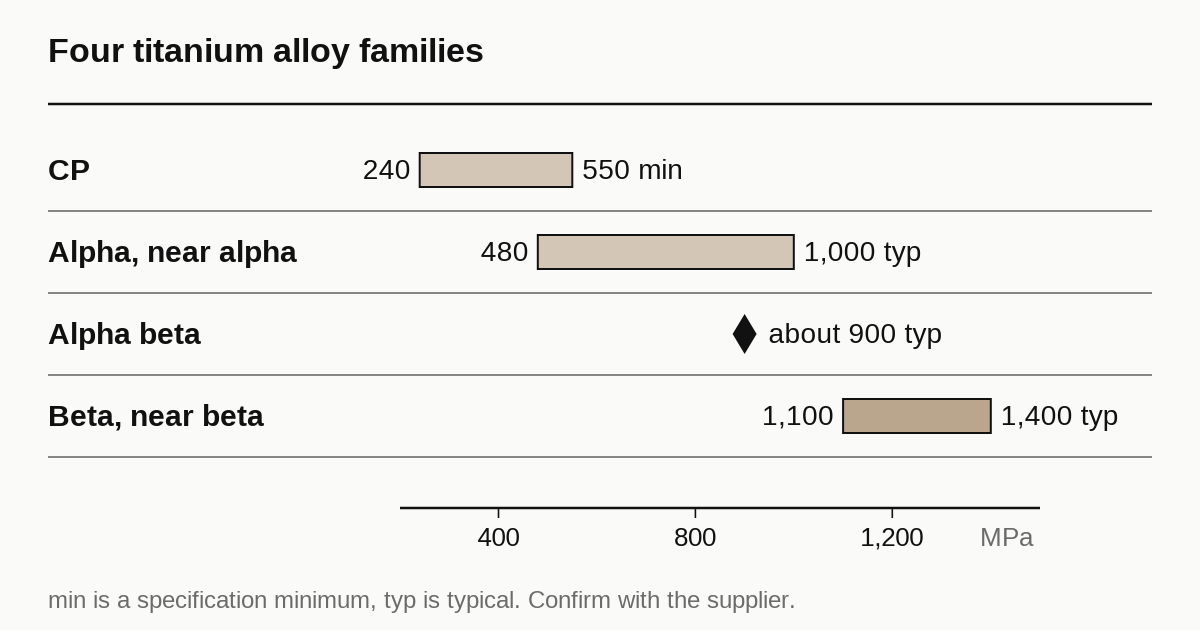
Typical values, rounded from the ASTM bar standards and published handbook data. The standard named on the drawing and the mill certificate for the heat govern every individual part.
| Family | Phase at room temperature | Tensile strength | Heat treatable | Welding | Forming | Hot service | Machining | Stock cost |
|---|---|---|---|---|---|---|---|---|
| Commercially pure (CP) | Alpha, single phase | about 240 to 550 MPa minimum, by grade | No. Strength comes from oxygen and iron content and cold work | Excellent with full inert shielding | Best of the four, Grade 1 most of all | Moderate, roughly to 300 °C | Easiest, but gummy on a dull tool | Lowest |
| Alpha and near alpha | Alpha, or alpha with a little beta | about 480 MPa (corrosion grades) to around 1,000 MPa typical (Ti-6242) | Limited. Annealed or duplex annealed | Good | Fair, Grade 9 cold forms well as tube | Best creep resistance, near alpha alloys to around 540 °C typical | Close to Grade 5 for the strong alloys | Medium to high |
| Alpha beta | Alpha plus beta | about 828 MPa (Grade 23) to 895 MPa (Grade 5) minimum for ASTM B348 bar, higher after STA | Yes. Solution treated and aged (STA) adds strength in thinner sections | Fair. Needs care and usually a stress relief | Limited at room temperature, hot formed | To roughly 400 °C for Ti-6Al-4V | The baseline most shops quote against | Medium. Ti-6Al-4V is the volume alloy |
| Beta and near beta | Mostly beta, retained by beta stabilisers | roughly 1,100 to 1,400 MPa typical after ageing | Yes, strong ageing response and deep hardening in thick sections | Limited, alloy dependent | Good in the solution treated condition for some alloys | Lower than alpha alloys, most are used near room temperature | Slowest. Shops typically quote longer cycle time than Grade 5 | Highest, often mill orders |
Why titanium splits into families
Pure titanium has two crystal forms. Below roughly 880 °C it is alpha, a close packed hexagonal structure. Above that it turns to beta, a body centred cubic structure. The temperature where the change happens is the beta transus, and every alloying element either raises it, lowers it or leaves it alone.
A grade with mostly alpha stabilisers stays alpha at room temperature. Add enough beta stabilisers and some beta survives cooling, which gives an alpha beta alloy. Add more again and the alloy can be held almost entirely beta. That balance is the whole classification, and it explains the rest of the matrix: beta responds to heat treatment, alpha resists creep and the single phase CP grades weld and form most easily. The Wikipedia article on titanium alloys covers the metallurgy in more depth.
| Element group | Elements | Effect |
|---|---|---|
| Alpha stabilisers | Aluminium, oxygen, nitrogen, carbon | Raise the temperature at which alpha turns to beta. Add strength and creep resistance, cost ductility when overdone. Oxygen is why Grade 4 is stronger than Grade 1. |
| Beta stabilisers | Vanadium, molybdenum, iron, chromium, niobium, nickel | Keep some or all of the beta phase at room temperature. Make the alloy heat treatable and, in large amounts, very strong after ageing. |
| Neutral additions | Tin, zirconium | Strengthen without moving the phase balance much. Common in the near alpha alloys for hot service. |
Which grades sit in which family
ASTM grade numbers do not follow the families. Grade 5 and Grade 23 are alpha beta, Grade 9 is near alpha, Grade 19 is a beta alloy. Grade names on bar come from ASTM B348, the alloy names come from the industry and many aerospace alloys have no ASTM grade number at all. The grade reference cross-references UNS and Werkstoff numbers.
| Family | Grades and alloys | Typical machined parts |
|---|---|---|
| Commercially pure | Grade 1, Grade 2, Grade 3, Grade 4 (UNS R50250, R50400, R50550, R50700) | Chemical plant, marine hardware, heat exchangers, dental and surgical CP parts to ASTM F67 |
| Alpha, corrosion grades | Grade 7 and Grade 11 (palladium), Grade 12 (Ti-0.3Mo-0.8Ni), Grade 16 and 17 (lower palladium), Grade 26 and 27 (ruthenium) | Hot chloride and reducing acid service where Grade 2 is at its limit |
| Alpha and near alpha | Grade 6 (Ti-5Al-2.5Sn), Grade 9 (Ti-3Al-2.5V), Ti-6Al-2Sn-4Zr-2Mo (Ti-6242), Ti-8Al-1Mo-1V | Hydraulic tube, compressor and hot section parts, cryogenic parts (ELI versions) |
| Alpha beta | Grade 5 (Ti-6Al-4V), Grade 23 (Ti-6Al-4V ELI), Ti-6Al-7Nb, Ti-6Al-2Sn-4Zr-6Mo (Ti-6246), Grade 35, Grade 38 | Airframe fittings, motorsport, implants and instruments, general structural parts |
| Beta and near beta | Ti-10V-2Fe-3Al (Ti-10-2-3), Ti-5Al-5Mo-5V-3Cr (Ti-5553), Ti-15V-3Cr-3Sn-3Al (Ti-15-3), Grade 19 (Beta C), Grade 21 (Ti-15Mo-3Al-2.7Nb-0.25Si) | Landing gear and heavy forgings, springs, high strength fasteners, thin sheet parts |
Commercially pure titanium
Grades 1 to 4 are unalloyed titanium separated by their oxygen and iron limits. Grade 1 carries the least and is the most formable. Grade 4 carries the most and is the strongest, with a specification minimum tensile around 550 MPa in ASTM B348. None of them can be strengthened by heat treatment.
CP titanium is chosen for the oxide film, not for strength. In sea water, wet chlorine and oxidising acids it outlasts stainless steel, and it welds readily under full shielding. Grade 2 is the workhorse, Grade 4 covers the stronger CP parts and dental fixtures.
Alpha and near alpha alloys
The corrosion grades (7, 11, 12 and the ruthenium grades) are alpha titanium with a small noble metal or nickel and molybdenum addition. The structural alpha and near alpha alloys add aluminium, tin and zirconium for strength and creep resistance, which is why Ti-6242 runs in compressor sections hotter than Ti-6Al-4V can. Grade 9, Ti-3Al-2.5V, is close to this family and is bought mostly as tube. The Grade 7 and Grade 12 guide and the Grade 9 guide cover the two most quoted.
Alpha beta alloys
Ti-6Al-4V is the reference alloy of the whole metal and the grade most titanium quotes are written for. It is used annealed for most machined parts, and solution treated and aged where a thinner section has to carry more load. Its extra low interstitial version, Grade 23, gives up a little strength for toughness and is the implant and cryogenic choice.
Other alpha beta alloys, such as Ti-6246 and the vanadium free Ti-6Al-7Nb, fill specific gaps: hotter service, deeper hardening or a medical drawing that excludes vanadium. The STA guide explains what the heat treatment does to the machining sequence.
Beta and near beta alloys
Ti-10V-2Fe-3Al and Ti-5Al-5Mo-5V-3Cr are forging alloys for landing gear and other thick, highly loaded parts, because they harden through sections where Ti-6Al-4V would not. Beta C and Ti-15-3 are used for springs, fasteners and cold formed sheet. They are denser than Ti-6Al-4V, cost more as stock and cut slower, especially after ageing. The beta titanium machining guide covers the shop side.
Choosing a family from the service conditions
Start from what the part has to survive, not from a grade name. Most drawings land in the first two rows, and the cheapest family that meets the service is usually the right one.
| If the part mainly needs | Start with | Then check |
|---|---|---|
| Corrosion resistance, light load | CP Grade 2 | Grade 7 or 12 above about 70 °C in brine or in reducing acids |
| Load at room temperature | Alpha beta, Ti-6Al-4V annealed | STA if the section must be thinner; Grade 4 if the load is moderate and the part is welded |
| An implant standard | Grade 23 to ASTM F136, CP to ASTM F67 | Ti-6Al-7Nb to ASTM F1295 if the drawing excludes vanadium |
| Service above roughly 400 °C | Near alpha, such as Ti-6242 | The specification and creep data the drawing owner requires |
| Very high strength in a thick forging | Beta or near beta, such as Ti-10-2-3 or Ti-5553 | Forging source, ageing condition and the longer machining time |
| Cold formed tube | Grade 9 | Tube specification and wall tolerance |
A family choice on a regulated part belongs to the drawing owner. A shop can point out a cheaper family; it cannot substitute one.
Grade pages by family
Detail pages published so far, sorted into the four families.
| Family | Grade pages |
|---|---|
| Commercially pure (CP) | Grade 2 Titanium for Machined Parts, Grade 4 Titanium Properties and Uses |
| Alpha beta | Grade 5 Titanium (Ti-6Al-4V), Grade 23 Titanium (Ti-6Al-4V ELI) |
Family questions we get
Something not covered? Email and the answer goes on this page.
What are the main types of titanium alloys?
Four families: commercially pure titanium (Grades 1 to 4), alpha and near alpha alloys, alpha beta alloys such as Ti-6Al-4V and beta or near beta alloys such as Ti-10V-2Fe-3Al and Ti-5Al-5Mo-5V-3Cr. The family follows from which crystal phase the alloying elements keep stable at room temperature.
Is Grade 5 an alpha or an alpha beta alloy?
Alpha beta. Aluminium stabilises the alpha phase and vanadium stabilises beta, so annealed Ti-6Al-4V holds both. That is why it can be solution treated and aged, which a CP grade cannot.
Which titanium family is easiest to machine?
Commercially pure titanium, then the alpha alloys, then alpha beta, with beta alloys the slowest. CP grades are gummy rather than hard, so they still want sharp tools and a steady feed. Beta alloys in the aged condition are where cycle times and tool cost rise most.
Which family should I pick for corrosion resistance?
Usually commercially pure Grade 2, or a corrosion grade such as Grade 7 or Grade 12 for hot chloride and reducing acids. All titanium relies on the same oxide film, so the strong alloys are not more corrosion resistant, only stronger and dearer.
Can a beta alloy replace Ti-6Al-4V to save weight?
Sometimes, where the higher aged strength lets a section get thinner. Beta alloys are denser, cost more as stock and cut slower, so the saving has to come from the design. It is a decision for the drawing owner, never a shop substitution.
Not sure which family fits?
Describe the service on the RFQ: what the part touches, its temperature and its load. We price it with partner shops that cut that family, and reply within 24 business hours.