Home / Titanium grades / Grade 23 Titanium (Ti-6Al-4V ELI)
Grade 23 Titanium (Ti-6Al-4V ELI)
Grade 23 titanium is Ti-6Al-4V ELI: the same 6 percent aluminium and 4 percent vanadium alloy as Grade 5, with oxygen held to 0.13 percent and iron to 0.25 percent, which buys fracture toughness and ductility for implants, cryogenic hardware and fracture critical parts at the cost of a little strength and a much heavier certificate.
Key facts
| Item | Grade 23 (Ti-6Al-4V ELI) |
|---|---|
| Family | Alpha beta alloy |
| UNS, ASTM B348 Grade 23 | R56407 |
| UNS, ASTM F136 implant material | R56401 |
| Implant standards | ASTM F136, ISO 5832-3 (not identical) |
| Industrial bar standard | ASTM B348 Grade 23 |
| Max oxygen | 0.13 percent |
| Max iron | 0.25 percent |
| Min tensile, F136 bar | about 860 MPa (125 ksi) |
| Min yield, F136 bar | about 795 MPa (115 ksi) |
| Min tensile, B348 Grade 23 bar | about 828 MPa (120 ksi) |
| Density | 4.43 g/cm3 typical |
| Machining | As Grade 5 |
Minimums are as published in earlier editions of the standards and rounded. ASTM F136-26 is the active edition as of October 2026 and is written in dual units; check its tables against your device file.
ELI limits against Grade 5
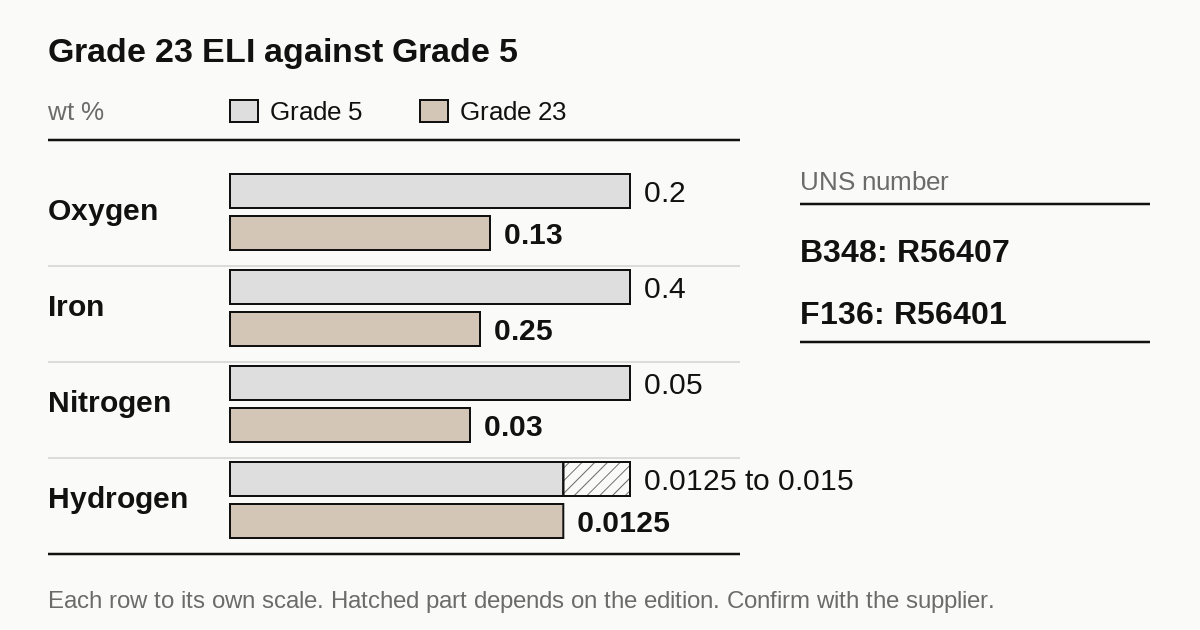
The difference between Grade 23 and Grade 5 is entirely in the small numbers. Every interstitial ceiling comes down.
| Element, weight percent | Grade 5, ASTM B348 | Grade 23, ASTM B348 | Ti-6Al-4V ELI, ASTM F136 |
|---|---|---|---|
| Aluminium | 5.50 to 6.75 | 5.50 to 6.50 | 5.50 to 6.50 |
| Vanadium | 3.50 to 4.50 | 3.50 to 4.50 | 3.50 to 4.50 |
| Oxygen max | 0.20 | 0.13 | 0.13 |
| Iron max | 0.40 | 0.25 | 0.25 |
| Nitrogen max | 0.05 | 0.03 | 0.05 |
| Carbon max | 0.08 | 0.08 | 0.08 |
| Hydrogen max | 0.0125 to 0.015, check the edition | 0.0125 | 0.012 |
Typical limits as published; individual editions differ slightly, so the edition on the drawing governs. Note that the B348 and F136 columns are close but not the same. They are two documents with two UNS numbers, and a heat certified to one is not automatically certified to the other.
What the lower interstitials do
Oxygen and iron are the cheapest way to strengthen titanium. They also make a crack easier to grow. Capping them shifts the balance:
| Property | Grade 5 annealed | Grade 23 annealed |
|---|---|---|
| Specification minimum tensile | 895 MPa (B348) | 828 MPa (B348), about 860 MPa (F136) |
| Fracture toughness | Good | Higher, the reason the grade exists |
| Ductility and reduction of area | Good | Higher on average |
| Fatigue crack growth | Baseline | Slower in most published data |
| Low temperature toughness | Falls as temperature drops | Retained better, the cryogenic choice |
| Sensitivity to oxygen pickup | Moderate | Higher: alpha case and contamination must be controlled |
Values are qualitative on purpose. Fracture toughness depends on microstructure, product form and test direction as much as on chemistry, so ask for test data to the method the drawing owner requires rather than relying on a handbook figure.
Where Grade 23 is specified
Surgical implants. The main use. Bone screws, pedicle screw bodies, spinal rods and connectors, trauma plates, hip and knee components and dental abutments are commonly machined from F136 bar. The medical applications page covers the documents and cleaning that go with it.
Cryogenic and fracture critical parts. Pressure vessel fittings, cryogenic tank hardware and some aerospace parts specify ELI because toughness, not strength, is the limiting property. These are usually bought to B348 Grade 23 or an aerospace ELI specification rather than to F136.
Subsea and offshore. Where a fracture mechanics case has to be made for a part that cannot be inspected in service.
Outside those cases Grade 23 adds stock cost and lead time for toughness the part does not use. Grade 5 is the default for structural work.
Standards and product forms
| Form | Implant | Industrial and cryogenic | Notes |
|---|---|---|---|
| Bar | ASTM F136, ISO 5832-3 | ASTM B348 Grade 23 | Centreless ground bar is common for Swiss turning |
| Wire | ASTM F136 | ASTM B863 Grade 23 | Pins, small screws, springs |
| Plate and sheet | ASTM F136 | ASTM B265 Grade 23 | Plates and flat implant parts |
| Forging bar | ASTM F136 | ASTM B381 Grade F-23 | Repeat implant shapes |
| Additive powder parts | ASTM F3001 for powder bed fusion | Customer specification | Machined and finished after printing |
| ELI with ruthenium | Not an implant callout | ASTM B348 Grade 29 | Corrosion grade, rare |
F136 bar is held by fewer distributors than Grade 5 bar, mostly in the diameters implant work uses, and some sizes are a mill order. A shop that does medical work usually knows where its approved sources are; a shop that does not should not learn on a Grade 23 order.
Machining and traceability
On the machine Grade 23 is Ti-6Al-4V: the same carbide grades, the same surface speeds, the same coolant and fixturing. The work that is different happens around the cut.
- Receiving. The heat number on the bar is checked against the mill certificate, and the certificate against the specification and edition on the drawing.
- Segregation. Grade 23 and Grade 5 bar look identical. Physical separation and labelling are the only protection against a mix.
- Transfer marking. The heat number moves onto every blank before the original marking is cut away, and someone other than the operator witnesses it.
- Work in progress. Lot identity survives every operation and every outside process, including heat treatment, passivation and marking.
- Release. The certificate of conformity names the part, the quantity and the heat, and attaches or references the mill certificate.
The Grade 23 ELI guide explains why that chain costs money, and the mill certificate guide what each document proves. Surface condition on implants is usually specified by the device owner; the surface finish guide covers Ra and lay.
Alternatives and when to switch
| If | Consider | Note |
|---|---|---|
| The part is structural and no standard names ELI | Grade 5 | Larger stock pool, lower cost |
| The implant drawing excludes vanadium | Ti-6Al-7Nb to ASTM F1295 | A different alloy, not a substitution |
| The implant is a CP part, such as a dental fixture | Grade 4 or Grade 2 to ASTM F67 | Lower strength, no alloying additions |
| Higher strength is needed with good toughness | Ask the drawing owner | No shop may substitute on a regulated part |
The titanium families page places Grade 23 among the alpha beta alloys.
What to write on the RFQ
- Grade and specification: Ti-6Al-4V ELI to ASTM F136, edition as in the device file, or ASTM B348 Grade 23 for non implant parts.
- UNS number: R56401 for F136 material, R56407 for B348 Grade 23, if your system records it.
- Certificates: mill certificate with the heat number and the specification edition, plus a certificate of conformity naming the heat.
- Traceability: heat or lot traceability through every operation, and whether you need the routing record.
- Quality system: whether your file requires an ISO 13485 shop. This is a question we put to shops, never a claim we make.
- Cleaning, passivation and marking: the specifications or your own procedure, attached.
Send the drawing through the RFQ form and shops used to implant paperwork reply within 24 business hours. Compare Grade 23 with the other grades on the grade reference.
Frequently asked questions
What does ELI mean in Grade 23 titanium?
Extra low interstitial. Oxygen, nitrogen, carbon, hydrogen and iron are capped lower than in Grade 5, which raises fracture toughness and ductility at a small cost in strength. The alloy is otherwise the same Ti-6Al-4V.
What is the UNS number for Grade 23 titanium?
ASTM B348 lists Grade 23 as UNS R56407. Ti-6Al-4V ELI made to ASTM F136 for surgical implants is UNS R56401. The two numbers point to different specifications, so the certificate must match the one on the drawing.
Is ASTM F136 the same as ISO 5832-3?
Not exactly. Both cover wrought Ti-6Al-4V for implants, but their limits and test requirements are not identical. A device file that names one does not automatically accept material certified only to the other. Check both texts or ask your regulatory team.
Does Grade 23 cost more to machine than Grade 5?
The cutting is the same. The extra cost is in the stock, the testing behind an F136 certificate and the segregation and heat traceability the shop has to run through every operation.
Sources
- ASTM F136-26, Wrought Titanium-6Aluminum-4Vanadium ELI Alloy for Surgical Implant Applications (UNS R56401), scope
- ASTM B348/B348M-25, Titanium and Titanium Alloy Bars and Billets (Grade 23, UNS R56407; Grade 29)
- ISO 5832-3:2021, Implants for surgery, Metallic materials, Part 3: Wrought titanium 6-aluminium 4-vanadium alloy
- Wikipedia, Ti-6Al-4V
Last reviewed November 22, 2026. Figures are typical values from the standards and handbooks named above. The standard on your drawing and the mill certificate for your heat govern.
Need a quote for this part?
Send the drawing with the grade and specification lines. We send one itemised quote for the finished parts and reply within 24 business hours.
Get a titanium quote