Home / Titanium grades / Grade 5 Titanium (Ti-6Al-4V)
Grade 5 Titanium (Ti-6Al-4V)
Grade 5 titanium is Ti-6Al-4V: titanium with about 6 percent aluminium and 4 percent vanadium, an alpha beta alloy that carries close to three times the strength of commercially pure Grade 2 at a density of 4.43 g/cm3, and the grade most machined titanium parts are quoted in.
Key facts
| Item | Grade 5 (Ti-6Al-4V) |
|---|---|
| Family | Alpha beta alloy |
| UNS | R56400 |
| Werkstoff number | 3.7165 |
| Common names | Ti-6Al-4V, Ti 6-4, TA6V in older French usage |
| Bar standard | ASTM B348 Grade 5 |
| Aerospace bar | AMS 4928 (annealed), AMS 4965 (solution treated and aged) |
| Aerospace plate and sheet | AMS 4911 |
| Min tensile, annealed bar | 895 MPa (130 ksi) |
| Min yield, annealed bar | 828 MPa (120 ksi) |
| Min elongation | 10 percent |
| Density | 4.43 g/cm3 typical |
| Useful service temperature | to roughly 400 °C |
Specification minimums are from ASTM B348 for bar. Typical values elsewhere on this page are rounded handbook figures, not guarantees for any heat.
Composition limits
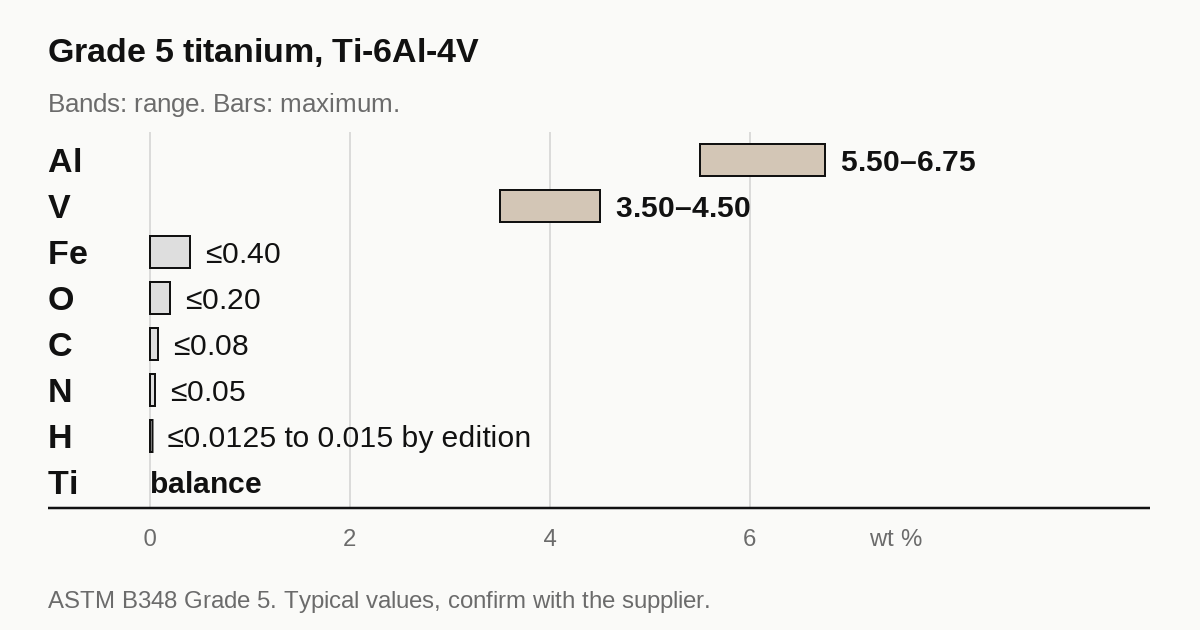
Ti-6Al-4V is defined by its two main additions and by the ceiling on everything else. Aluminium stabilises the alpha phase and adds strength. Vanadium stabilises the beta phase, which is what makes the alloy heat treatable. Oxygen, nitrogen, carbon, hydrogen and iron are held below set limits, because each one raises strength and lowers toughness.
| Element | ASTM B348 Grade 5, weight percent | Why it matters |
|---|---|---|
| Aluminium | 5.50 to 6.75 | Alpha stabiliser, strength |
| Vanadium | 3.50 to 4.50 | Beta stabiliser, heat treat response |
| Iron | 0.40 max | Strength, lowers toughness when high |
| Oxygen | 0.20 max | Strongest interstitial strengthener |
| Carbon | 0.08 max | Interstitial |
| Nitrogen | 0.05 max | Interstitial, embrittles in excess |
| Hydrogen | 0.0125 to 0.015 max, depending on the edition | Embrittlement risk, checked on the product. Check the edition on the drawing |
| Other elements | 0.10 each, 0.40 total | Residuals |
Typical limits as published for B348 Grade 5. Aerospace specifications such as AMS 4928 tighten some of these, iron among them, so read the revision the drawing names. The Grade 23 ELI page shows how far the interstitial limits come down for the implant version.
Mechanical properties: annealed against STA
Most Grade 5 parts are machined from annealed bar or plate and used as supplied. Solution treating and ageing (STA) adds strength where a section has to be thinner, at the cost of ductility and an extra heat treatment step in the routing.
| Property | Annealed, specification minimum | Annealed, typical | STA, typical in smaller sections |
|---|---|---|---|
| Tensile strength | 895 MPa | 930 to 1,000 MPa | 1,000 to 1,150 MPa |
| Yield strength (0.2 percent) | 828 MPa | 860 to 930 MPa | 930 to 1,050 MPa |
| Elongation | 10 percent | 12 to 16 percent | 8 to 12 percent |
| Reduction of area | 25 percent | 30 to 40 percent | 20 to 35 percent |
| Hardness | not specified | about 30 to 36 HRC | about 36 to 41 HRC |
Ti-6Al-4V does not harden through thick sections. STA strength falls as section size rises, which is why AMS 4965 steps its minimums by size and stops at a maximum diameter. If a thick part needs STA strength at its core, the titanium families page explains why a beta alloy is often the answer instead.
Annealed values above are from the standard; typical ranges are rounded from published handbook data. The STA machining guide covers where the heat treatment goes in the sequence.
Physical properties
| Property | Typical value |
|---|---|
| Density | 4.43 g/cm3 |
| Elastic modulus | about 110 to 114 GPa |
| Thermal conductivity | about 6.7 W/m K |
| Thermal expansion, 20 to 100 °C | about 8.6 µm/m K |
| Beta transus | about 980 to 1,010 °C, depends on the heat |
| Melting range | about 1,600 to 1,660 °C |
| Magnetic | No |
Two of these numbers drive the quote more than the strength does. The low thermal conductivity keeps heat at the cutting edge, so tools wear fast. The modulus is around half that of steel, so long parts and thin walls deflect under the cutter.
Standards and product forms
Grade 5 is sold to several specifications. The grade is the same; the testing, records and stock pool are not.
| Form | General industry | Aerospace | Notes |
|---|---|---|---|
| Bar and billet | ASTM B348 Grade 5 | AMS 4928 (annealed), AMS 4965 (STA) | Round, square, hex and flat bar |
| Plate, sheet, strip | ASTM B265 Grade 5 | AMS 4911 | Flat parts, brackets, covers |
| Forgings | ASTM B381 Grade F-5 | AMS 4928 covers forgings | Near net shapes for repeat parts |
| Wire | ASTM B863 | AMS 4928 covers wire | Fasteners, springs, small pins |
| Additive powder parts | ASTM F2924 for powder bed fusion | Customer specifications | Machined after printing |
Bar to B348 is annealed and may be supplied descaled, sandblasted, ground or rough turned. Diameters from a few millimetres to well above 200 mm are traded, and AMS 4928 revision W raised its coverage to 10 inches. Which sizes are actually on the shelf changes with the market. The ASTM B348 page and the AMS 4928 page cover each specification in depth.
How Grade 5 machines
Ti-6Al-4V is the grade most titanium cutting data is written for. Shops typically start carbide turning around 50 m/min and milling between 30 and 60 m/min, well below steel, with high pressure coolant at the edge and a feed that never lets the tool rub.
- Heat at the edge. Low conductivity keeps heat in the tool. Sharp positive geometry, coated carbide and flood or through tool coolant are normal.
- Spring back. Thin walls and long slender features need support, stepped finishing passes and a sequence that leaves stiffness in the part until the last cut.
- Work hardening and smearing. A dwelling or dull tool hardens the surface it leaves and builds up material on the edge.
- Chips and fines. Ti-6Al-4V chips are not a fire risk in bulk, but fines and grinding dust are. Shops that cut it every week manage swarf for it.
- Alpha case. Heat treatment or hot forming in air leaves a hard, brittle oxygen rich layer. It has to be removed by machining allowance or chemical milling before final dimensions.
The titanium speeds and feeds guide gives starting ranges. A shop’s own data from its own machines always replaces them.
Cost tier and stock
Grade 5 sits in the middle of the titanium price range. It costs more per kilo than CP Grade 2 bar and less than the beta alloys, and it is the most widely stocked titanium alloy in bar and plate. AMS material is a smaller pool than B348 material, and certified Grade 23 smaller again.
The cost the buyer feels comes twice: once in the stock, often at a buy to fly ratio of several to one, and again in machine time at half the cutting speed of Grade 2. The Grade 2 versus Grade 5 guide compares the two lines in a quote. Ask the shop for stock lead time and machining lead time separately.
Alternatives and when to switch
| If | Consider | Trade off |
|---|---|---|
| The part mainly needs corrosion resistance | Grade 2 | About 40 percent of the strength, cuts faster, cheaper bar |
| The part is welded and the load is moderate | Grade 4 | No heat treatment step, lower strength |
| The drawing names an implant standard or needs toughness | Grade 23 ELI | Smaller stock pool, more paperwork |
| The part is cold formed tube | Grade 9, Ti-3Al-2.5V | Lower strength, mostly sold as tube |
| Service runs above roughly 400 °C | Ti-6Al-2Sn-4Zr-2Mo | Higher cost, fewer sources |
| A thick section needs high strength at its core | A beta alloy such as Ti-10V-2Fe-3Al | Denser, slower to machine |
A substitution on a drawing is a decision for the drawing owner. A shop can propose one; it cannot make it.
What to write on the RFQ
- Alloy and grade: Ti-6Al-4V, Grade 5.
- Specification and revision: ASTM B348 or AMS 4928 or AMS 4911, exactly as the title block writes it.
- Product form and size: bar diameter or plate thickness the shop should buy.
- Condition: annealed, or STA with the heat treatment specification.
- Certificates: mill certificate to EN 10204 type 3.1 with the heat number, and a certificate of conformity naming that heat. The mill certificate guide explains each document.
- Finish and inspection: surface finish, alpha case removal, penetrant or other inspection the drawing calls.
- Quantity and annual volume: they decide whether forgings or bar make sense.
Send the drawing through the RFQ form and shops that cut Grade 5 every week reply within 24 business hours. The grade reference puts Grade 5 beside the other common grades.
Frequently asked questions
What is Grade 5 titanium?
Grade 5 is the ASTM name for Ti-6Al-4V, a titanium alloy with nominally 6 percent aluminium and 4 percent vanadium. It is an alpha beta alloy, UNS R56400, Werkstoff 3.7165, and the most used titanium alloy for machined structural parts.
How strong is Grade 5 titanium?
In the annealed condition ASTM B348 sets a minimum tensile strength of 895 MPa and a minimum yield of 828 MPa for bar. Solution treated and aged material reaches roughly 1,000 to 1,150 MPa tensile in smaller sections. Mill certificates usually read above the minimums.
What is the density of Grade 5 titanium?
About 4.43 g/cm3, close to 60 percent of steel and roughly 1.6 times aluminium. Use 4.43 g/cm3 for weight and buy to fly estimates unless your drawing owner specifies another value.
Is Grade 5 the same as Ti-6Al-4V ELI?
No. The ELI version is Grade 23, with lower limits on oxygen, iron and the other interstitials. It is tougher and slightly weaker. Grade 5 material cannot be certified to a Grade 23 or ASTM F136 callout.
Sources
- ASTM B348/B348M-25, Standard Specification for Titanium and Titanium Alloy Bars and Billets (scope and grade list)
- SAE AMS 4928, Titanium Alloy Bars, Wire, Forgings, Rings, and Drawn Shapes 6Al-4V Annealed
- SAE AMS 4965, Titanium Alloy Bars, Wire, Forgings, and Rings 6.0Al-4.0V Solution Heat Treated and Aged
- Wikipedia, Ti-6Al-4V
Last reviewed November 24, 2026. Figures are typical values from the standards and handbooks named above. The standard on your drawing and the mill certificate for your heat govern.
Need a quote for this part?
Send the drawing with the grade and specification lines. We send one itemised quote for the finished parts and reply within 24 business hours.
Get a titanium quote