Home / Titanium grades / Grade 2 Titanium for Machined Parts
Grade 2 Titanium for Machined Parts
Grade 2 titanium is commercially pure, unalloyed titanium with a standard oxygen limit: about 345 MPa minimum tensile strength, the full corrosion resistance of titanium’s oxide film, the easiest machining of any titanium grade and the default choice when a part fights corrosion rather than load.
Key facts
| Item | Grade 2 |
|---|---|
| Family | Commercially pure (CP), alpha |
| UNS | R50400 |
| Werkstoff number | 3.7035 |
| JIS | Class 2 (check the JIS bar or plate designation on the drawing) |
| Bar standard | ASTM B348 Grade 2 |
| Plate and sheet | ASTM B265 Grade 2 |
| Implant standard | ASTM F67 Grade 2 |
| Min tensile, bar | 345 MPa (50 ksi) |
| Min yield, bar | 275 MPa (40 ksi) |
| Min elongation | 20 percent |
| Density | 4.51 g/cm3 typical |
| Heat treatable for strength | No |
Specification minimums are from ASTM B348 for bar. Other values are rounded typical figures.
Composition limits
There is no alloying addition in Grade 2. What separates it from Grades 1, 3 and 4 is how much oxygen and iron it may carry, because those two elements set the strength of commercially pure titanium.
| Element | ASTM B348 Grade 2, weight percent max |
|---|---|
| Oxygen | 0.25 |
| Iron | 0.30 |
| Carbon | 0.08 |
| Nitrogen | 0.03 |
| Hydrogen | 0.015 |
| Other elements | 0.10 each, 0.40 total |
| Titanium | Balance |
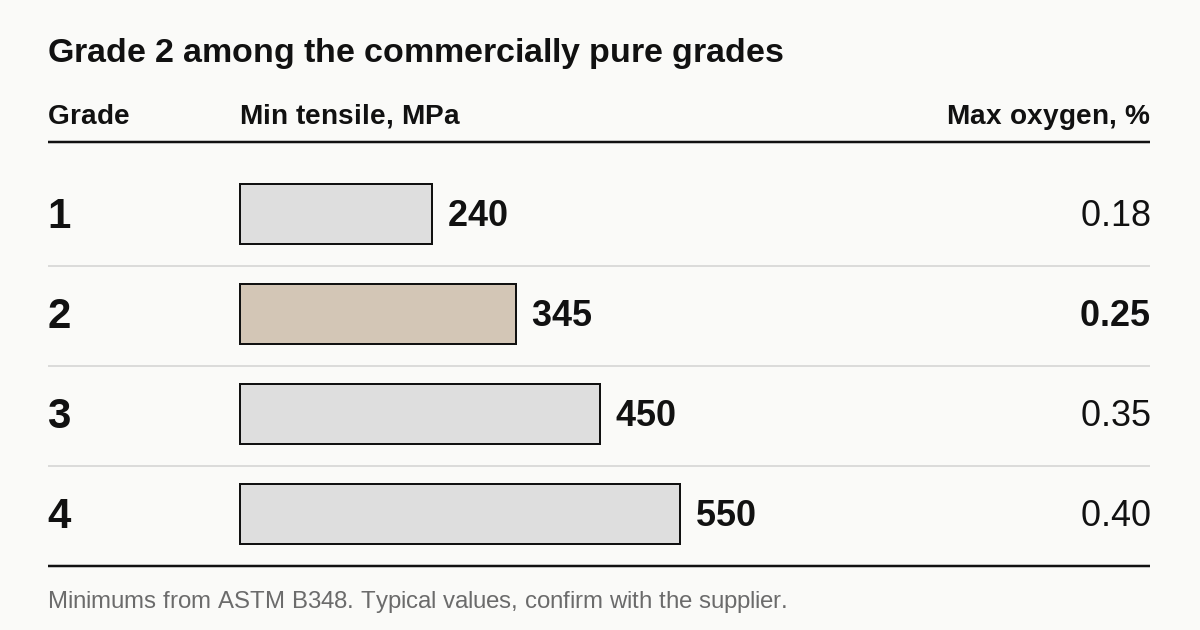
Typical limits as published for B348 Grade 2. Grade 1 caps oxygen at 0.18 percent, Grade 4 allows 0.40 percent, which is why Grade 4 is the strongest CP grade. Grade 2H has the same chemistry as Grade 2 with a higher guaranteed tensile strength of 400 MPa, mainly for pressure vessels.
Mechanical and physical properties
| Property | Specification minimum (B348 bar) | Typical |
|---|---|---|
| Tensile strength | 345 MPa | 400 to 480 MPa |
| Yield strength (0.2 percent) | 275 MPa, 450 MPa max | 300 to 400 MPa |
| Elongation | 20 percent | 22 to 30 percent |
| Reduction of area | 30 percent | 40 to 55 percent |
| Hardness | not specified | about 80 to 82 HRB, roughly 160 HV |
| Elastic modulus | not specified | about 103 to 105 GPa |
| Thermal conductivity | not specified | about 16 to 22 W/m K |
| Thermal expansion, 20 to 100 °C | not specified | about 8.6 µm/m K |
| Density | not specified | 4.51 g/cm3 |
| Useful service temperature | not specified | to roughly 300 °C for strength, higher for corrosion only |
Grade 2 is about as strong as a mild steel at a little over half the weight. Its yield has a ceiling in B348 as well as a floor, so a heat that tests too strong is out of specification, which matters on formed parts. Thermal conductivity is two to three times that of Ti-6Al-4V, one reason it cuts more easily.
Corrosion behaviour by medium
Grade 2 is bought for corrosion. All titanium grades rely on the same thin oxide film, so Grade 5 is not more corrosion resistant, only stronger. The table gives the usual position; the actual concentration, temperature and contaminants decide, and the process engineer owns that call.
| Medium | Grade 2 behaviour, typical | Notes |
|---|---|---|
| Sea water, ambient, including high flow | Effectively immune to general and pitting corrosion | Far ahead of 316L, including in crevices |
| Hot brine and chloride above about 70 °C | Crevice corrosion can start | Grade 12 or Grade 7 are the usual step up |
| Wet chlorine, chlorine dioxide, hypochlorite | Resistant | Bleach plant and chlor alkali service |
| Dry chlorine gas | Not resistant, can ignite | Titanium needs moisture to keep its film |
| Nitric acid, oxidising acids | Generally resistant | Red fuming nitric acid is a fire hazard |
| Hot or strong hydrochloric and sulfuric acid | Attacked | Grade 7 resists far better in reducing acids |
| Hydrofluoric acid and fluoride solutions | Attacked | Avoid titanium |
| Hot concentrated caustic | Attacked at high temperature and strength | Check the service data |
A second point catches buyers: titanium is the noble partner in a galvanic couple. In sea water it makes aluminium, carbon steel or bronze bolted to it corrode faster. The titanium versus stainless guide and the Grade 7 and Grade 12 guide go further.
Standards and product forms
| Form | Standard | Notes |
|---|---|---|
| Bar and billet | ASTM B348 Grade 2 | Annealed. Pressure work also cites ASME SB-348 |
| Plate, sheet, strip | ASTM B265 Grade 2 | The most stocked flat titanium product |
| Heat exchanger tube | ASTM B338 Grade 2 | Seamless and welded |
| Pipe | ASTM B861 (seamless), B862 (welded) | Process piping |
| Forgings | ASTM B381 Grade F-2 | Flanges, fittings on repeat orders |
| Implant material | ASTM F67 Grade 2 | Dental and surgical CP parts, a separate certificate |
| German and European drawings | 3.7035, DIN or EN titles | Check the title block wording |
Grade 2 is common in bar and plate in most sizes, which keeps its lead time short. Material bought to ASTM F67 for an implant is a separate stock and certificate, and B348 bar does not satisfy an F67 callout. The ASTM B348 page covers the bar standard.
How Grade 2 machines
Grade 2 is the easiest titanium to cut, with a catch. It is soft and gummy rather than hard, so it smears and builds up on a dull edge if the feed drops.
| Behaviour | Grade 2, typical | Compared with Grade 5 |
|---|---|---|
| Carbide surface speed | around 80 m/min starting point | Roughly 1.5 times faster |
| Tool wear | Moderate | Lower |
| Chips | Long and stringy in turning | Needs chip breakers and high pressure coolant |
| Burrs | Heavier, softer burrs | More deburring time |
| Surface | Tears if the tool rubs | Keep tools sharp and feeds steady |
Shops that cut mostly Grade 5 sometimes run Grade 2 as slowly as Grade 5 out of habit. A shop that knows the difference quotes it faster. The speeds and feeds guide gives starting values, and the welding and alpha case guide covers the welded assemblies Grade 2 is often part of.
Where Grade 2 is used
- Chemical plant: valve bodies and trim, flanges, fittings, pump parts, agitator parts.
- Heat exchangers: tubesheets, channel covers, plate packs.
- Marine: sea water pump shafts and impellers, fittings, sensor housings.
- Electrochemistry: anode baskets, electroplating racks, electrolyser frames.
- Vacuum and instruments: non magnetic brackets and housings.
- Welded and formed assemblies, where Grade 5 would need more care and a stress relief.
When to switch from Grade 2
| If | Move to | Why |
|---|---|---|
| The part carries real load or must be thinner | Grade 5 | About 2.6 times the minimum tensile |
| A little more strength, still CP and welded | Grade 4 | 550 MPa minimum, same corrosion family |
| Hot brine crevices or reducing acids | Grade 12 or Grade 7 | Molybdenum and nickel, or palladium, protect the film |
| The part is deep drawn or explosion clad | Grade 1 | The most formable CP grade |
| A pressure design calls a higher allowable | Grade 2H | 400 MPa guaranteed minimum |
The titanium families page sorts all of these by family. The Grade 2 versus Grade 5 comparison works through the decision part by part.
What to write on the RFQ
- Grade and standard: Grade 2, ASTM B348 for bar or B265 for plate, or F67 for an implant part.
- Service line: the medium, concentration and temperature, so a shop can flag a Grade 7 or 12 case.
- Mating materials: what the part touches and how the joint is isolated.
- Welding: whether the part is welded after machining and to which procedure.
- Certificates: EN 10204 type 3.1 with the heat number, plus PMI if your plant requires it.
- Cleaning: coolant restrictions and final cleaning, because chloride residue matters in corrosion service.
Send the drawing through the RFQ form and shops that cut CP titanium reply within 24 business hours. Grade 2 sits beside the other grades on the grade reference.
Frequently asked questions
What is Grade 2 titanium?
Grade 2 is commercially pure titanium with a standard oxygen level, UNS R50400, Werkstoff 3.7035. It is unalloyed and sits between the softer Grade 1 and the stronger Grades 3 and 4. It is the most used CP grade for corrosion service.
What is Grade 2H titanium?
Grade 2H is Grade 2 with a higher guaranteed minimum tensile strength of 400 MPa (58 ksi) instead of 345 MPa. ASTM B348 says it is intended mainly for pressure vessel use, and Grade 2H material may always be certified as Grade 2.
Can Grade 2 titanium be heat treated for strength?
No. As a single phase alpha metal it gains no strength from solution treating and ageing. It can be annealed or stress relieved, and cold work raises its strength. If the part needs more strength, the choices are Grade 4 or an alloy such as Grade 5.
Is Grade 2 titanium magnetic?
No. Commercially pure titanium is non magnetic, which is one reason it appears in instrument and vacuum hardware as well as corrosion service.
Sources
- ASTM B348/B348M-25, Standard Specification for Titanium and Titanium Alloy Bars and Billets (scope, Grade 2 and 2H)
- ASTM F67-24, Unalloyed Titanium for Surgical Implant Applications
- Wikipedia, Titanium (properties of the element)
Last reviewed November 21, 2026. Figures are typical values from the standards and handbooks named above. The standard on your drawing and the mill certificate for your heat govern.
Need a quote for this part?
Send the drawing with the grade and specification lines. We send one itemised quote for the finished parts and reply within 24 business hours.
Get a titanium quote