Home / Titanium grades / Grade 4 Titanium Properties and Uses
Grade 4 Titanium Properties and Uses
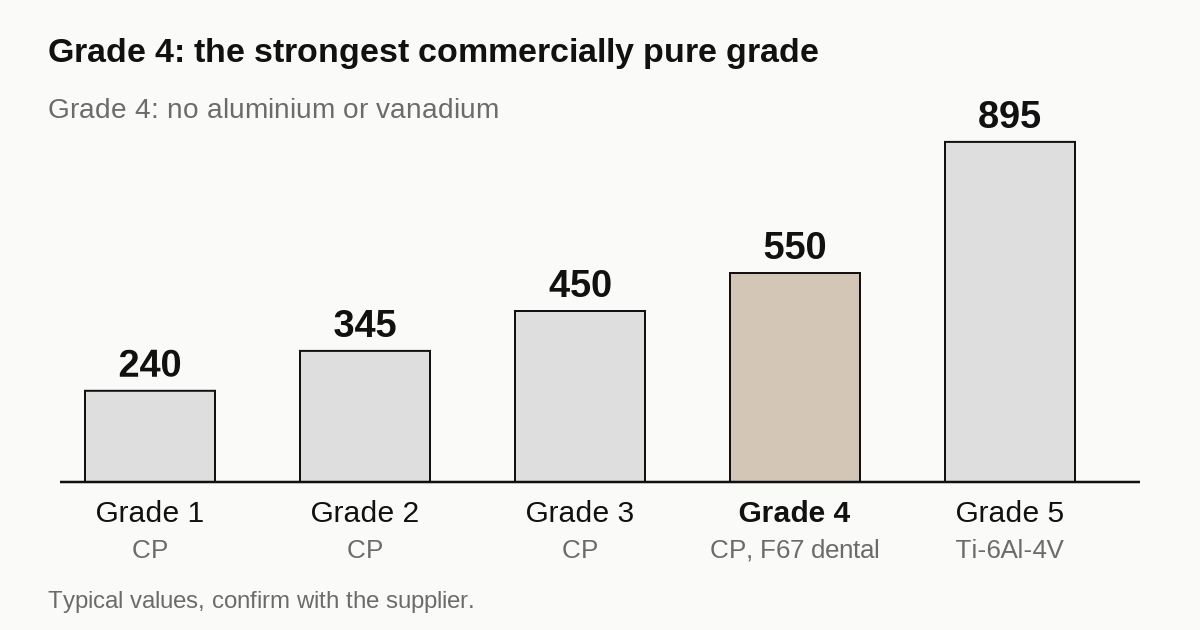
Grade 4 titanium is the strongest commercially pure grade: unalloyed titanium with up to 0.40 percent oxygen, a specification minimum tensile strength of 550 MPa, the corrosion behaviour of CP titanium, ready weldability and no aluminium or vanadium, which is why it is the usual material for dental implant fixtures and stronger CP fittings.
Key facts
| Item | Grade 4 |
|---|---|
| Family | Commercially pure (CP), alpha |
| UNS | R50700 |
| Werkstoff number | 3.7065 (DIN 17850 Ti 4) |
| Bar standard | ASTM B348 Grade 4 |
| Plate and sheet | ASTM B265 Grade 4 |
| Implant standards | ASTM F67 Grade 4, ISO 5832-2 |
| Min tensile, bar | 550 MPa (80 ksi) |
| Min yield, bar | 483 MPa (70 ksi) |
| Min elongation | 15 percent |
| Density | 4.51 g/cm3 typical |
| Heat treatable for strength | No, strength from oxygen, iron and cold work |
| Stock | Sometimes stocked, some sizes a mill order |
Specification values are from ASTM B348 for annealed bar and rounded. The Werkstoff number is shown as listed for DIN 17850; our grade cross reference still marks it unverified until checked against the standard text.
Composition limits
| Element | ASTM B348 Grade 4, weight percent max | Grade 2, for comparison |
|---|---|---|
| Oxygen | 0.40 | 0.25 |
| Iron | 0.50 | 0.30 |
| Nitrogen | 0.05 | 0.03 |
| Carbon | 0.08 | 0.08 |
| Hydrogen | 0.015 | 0.015 |
| Other elements | 0.10 each, 0.40 total | Same |
Typical limits as published for B348. Oxygen does the strengthening: every CP grade is the same metal with a different oxygen and iron allowance. Implant material to ASTM F67 is held to that standard’s own table, and its hydrogen and residual limits may differ slightly from B348, so certify to the document on the drawing.
Mechanical and physical properties
| Property | Specification (B348 bar) | Typical annealed | Typical cold worked dental bar |
|---|---|---|---|
| Tensile strength | 550 MPa min | 600 to 700 MPa | often 680 MPa and above |
| Yield strength (0.2 percent) | 483 MPa min, 655 MPa max | 500 to 600 MPa | often 520 MPa and above |
| Elongation | 15 percent min | 18 to 25 percent | lower than annealed |
| Reduction of area | 25 percent min | 35 to 50 percent | lower than annealed |
| Hardness | not specified | roughly 250 to 280 HV | higher |
| Elastic modulus | not specified | about 105 GPa | about 105 GPa |
| Thermal conductivity | not specified | about 17 W/m K | same |
| Density | not specified | 4.51 g/cm3 | same |
Cold worked values vary by supplier and condition. They are shown only to explain why dental bar certificates often read well above the annealed minimum; the condition must be stated on the order. Like Grade 2, Grade 4 has a ceiling on yield in B348 as well as a floor.
Standards and product forms
| Form | Industrial | Implant | Notes |
|---|---|---|---|
| Bar | ASTM B348 Grade 4 | ASTM F67 Grade 4, ISO 5832-2 | Small diameter ground bar for Swiss turning is the dental form |
| Plate and sheet | ASTM B265 Grade 4 | ASTM F67 | Flat CP parts, plates |
| Wire | ASTM B863 Grade 4 | ASTM F67 | Pins, wire forms |
| Forgings | ASTM B381 Grade F-4 | ASTM F67 lists forgings | Repeat shapes |
| Tube | ASTM B338 Grade 4 is uncommon | Usually Grade 2 or 9 |
ISO 5832-2 splits the strongest CP material into its own sub grades (check the current edition for the designations and limits). Industrial B348 bar does not satisfy an F67 or ISO 5832-2 callout even when the chemistry matches. The ASTM B348 page explains what the bar standard does and does not cover.
Where Grade 4 is used
- Dental implant fixtures and abutment screws, turned from small diameter bar. See the medical applications page.
- Surgical CP hardware where the device maker has chosen an unalloyed material.
- Stronger CP fittings in chemical and marine service, where Grade 2 would need a thicker wall.
- Welded process parts that need more strength than Grade 2 without a heat treatment step.
- Aerospace CP parts where the drawing names a commercially pure grade, bought to the aerospace specification it calls.
How Grade 4 machines
Grade 4 cuts more cleanly than Grade 2 because it is harder and less gummy, and it is far easier on tools than Ti-6Al-4V. Shops typically start carbide speeds between their Grade 2 and Grade 5 values and adjust from tool wear.
| Point | What to expect, typical |
|---|---|
| Surface speed | Between Grade 2 (around 80 m/min) and Grade 5 (around 50 m/min) |
| Chips | Shorter than Grade 2, still need chip control in turning |
| Burrs | Lighter than Grade 2, still present on exit edges |
| Threads | Gall against titanium mating parts like any grade |
| Swiss turning | The common route for dental parts, with ground bar |
Small CP parts lose most of their hidden time in deburring. The deburring guide covers edge break callouts, and the Grade 4 against Grade 5 comparison works through the strength trade.
Corrosion and joining
Grade 4 behaves like the other CP grades in corrosion service: excellent in sea water, wet chlorine and oxidising media, attacked by hydrofluoric acid and by hot reducing acids, at risk of crevice attack in hot brine. The Grade 2 page has the medium by medium table, which applies to Grade 4 too.
It welds readily with full trailing and back shielding. Because there is no heat treated strength to recover, the welded joint keeps close to base metal properties if contamination is kept out. The welding and alpha case guide covers discolouration limits.
Grade 4 against its neighbours
| Need | Grade 2 | Grade 4 | Grade 5 |
|---|---|---|---|
| Minimum tensile, bar | 345 MPa | 550 MPa | 895 MPa |
| Weldability | Excellent | Excellent | Fair, usually stress relieved |
| Cold forming | Good | Limited | Poor at room temperature |
| Alloying elements | None | None | Aluminium, vanadium |
| Heat treat step | None | None | Optional STA |
| Bar availability | Common | Sometimes stocked | Common |
If the design needs more than about 550 MPa, Grade 5 is the next step, and a part designed for Grade 5 strength rarely survives a change to Grade 4 without a redesign. The titanium families page shows where the CP grades sit in the whole range.
What to write on the RFQ
- Grade and standard: Grade 4 to ASTM B348 for industrial bar, or ASTM F67 or ISO 5832-2 for implant parts, with the edition.
- Condition: annealed or cold worked, and any minimum strength the drawing needs above the specification.
- Bar size: diameter and whether ground bar is required for Swiss turning.
- Stock: whether you supply bar or the shop buys it, because some sizes are a mill order. The stock forms and lead time guide explains how to ask.
- Certificates: mill certificate with the heat number, certificate of conformity naming the heat.
- Finishing: surface finish, passivation, anodize colour or marking, each with its specification.
Send the drawing through the RFQ form and shops that turn CP titanium reply within 24 business hours. All CP grades are on the grade reference.
Frequently asked questions
What is Grade 4 titanium?
Grade 4 is the strongest of the four commercially pure titanium grades, UNS R50700. It is unalloyed titanium with the highest permitted oxygen and iron, which gives a specification minimum tensile strength of 550 MPa in ASTM B348 while keeping CP corrosion behaviour.
Why is Grade 4 used for dental implants?
It is the strongest CP grade, it contains no aluminium or vanadium and ASTM F67 and ISO 5832-2 cover it for surgical implants. Dental bar is often supplied cold worked to a strength above the annealed minimum. The choice of material belongs to the device maker.
What is the Werkstoff number for Grade 4 titanium?
3.7065, the material number for Ti 4 in DIN 17850. European drawings may also use EN or aerospace titles. Check the exact designation on the drawing, because a material number alone does not name the specification or condition.
Is Grade 4 titanium weldable?
Yes. As a single phase alpha metal it welds well under full inert shielding, with no heat treatment needed for strength afterwards. The weld and heat affected zone must stay clean and shielded until they cool, as with any titanium.
Sources
- ASTM B348/B348M-25, Titanium and Titanium Alloy Bars and Billets (Grade 4, UNS R50700)
- ASTM F67-24, Unalloyed Titanium for Surgical Implant Applications (UNS R50250, R50400, R50550, R50700)
- Applus+ Laboratories materials portal, Ti4 3.7065 datasheet (DIN 17850 designation)
Last reviewed November 23, 2026. Figures are typical values from the standards and handbooks named above. The standard on your drawing and the mill certificate for your heat govern.
Need a quote for this part?
Send the drawing with the grade and specification lines. We send one itemised quote for the finished parts and reply within 24 business hours.
Get a titanium quote