Home / Specifications / AMS 4928: Ti-6Al-4V Bar and Forgings
AMS 4928: Ti-6Al-4V Bar and Forgings
AMS 4928 is the SAE aerospace material specification for Ti-6Al-4V in the annealed condition as bar, wire, forgings, flash welded rings and drawn shapes; it asks more of the mill than the commercial ASTM B348 standard, so “Ti-6Al-4V per AMS 4928” on a drawing means a specific, smaller pool of certified stock, not any Grade 5 bar.
Key facts
| Item | AMS 4928 |
|---|---|
| Issued by | SAE International, Aerospace Material Specification |
| First issued | July 1957 |
| Revisions seen on drawings | S (2011), T (2013), U (2014), V (2016), W (2017) |
| Newest revision listed by SAE | X, October 2025 (as of October 2026) |
| Alloy | Ti-6Al-4V (UNS R56400) |
| Condition | Annealed |
| Product forms | Bars, wire, forgings, flash welded rings, drawn shapes |
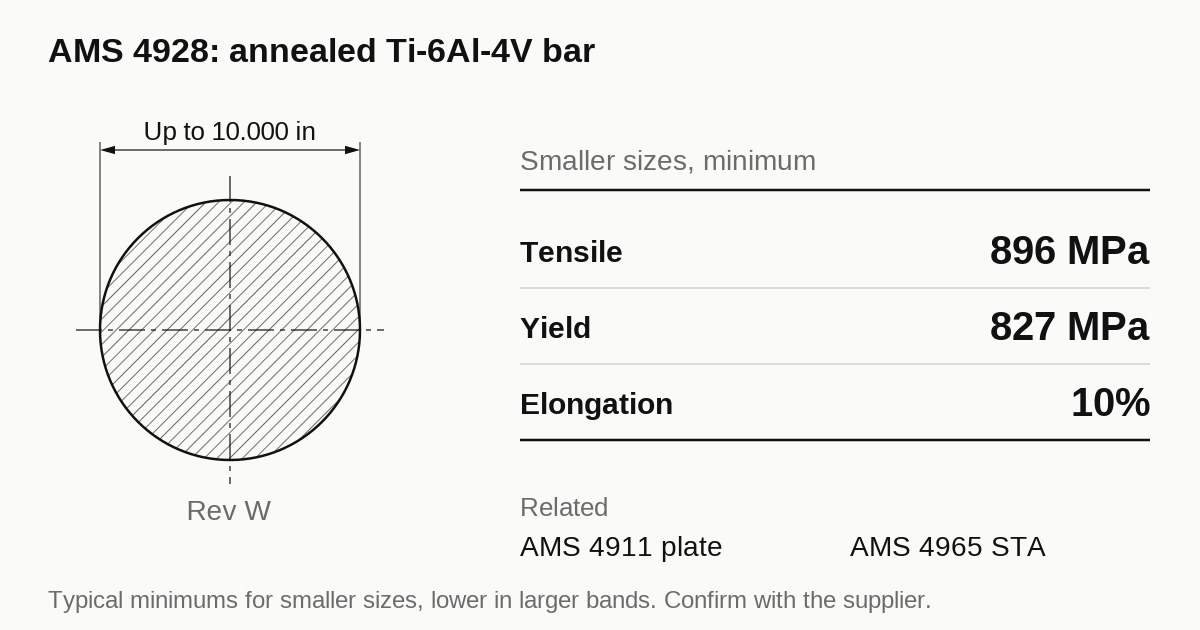
| Size range, revision W | Up through 10.000 in (254 mm) diameter or least distance between parallel sides; forging stock any size |
| Typical minimum tensile, smaller sizes | 130 ksi (896 MPa) |
| Typical minimum yield, smaller sizes | 120 ksi (827 MPa) |
| Plate and sheet equivalent | AMS 4911 |
| Heat treated equivalent | AMS 4965, solution heat treated and aged |
Scope and revision data are from SAE’s listing. Property figures are typical published values for the smaller size bands and step down for larger sections; read the table in the revision the drawing names.
What the specification controls
A material specification is a contract between the buyer and the mill. AMS 4928 sets out what the mill must make, test and report before a heat can be sold against it. In broad terms it covers:
| Area | What AMS 4928 sets, in outline |
|---|---|
| Chemistry | Heat analysis limits for aluminium, vanadium, iron, oxygen, carbon, nitrogen, hydrogen, yttrium and residuals |
| Melting | Permitted melting practice for the ingot |
| Condition | Annealed, with the anneal stated |
| Mechanical properties | Tensile, yield, elongation and reduction of area minimums by size band |
| Microstructure | Product worked in the alpha beta range, with stated microstructure criteria |
| Surface | Free of alpha case and surface contamination as delivered |
| Quality | Freedom from defects, with ultrasonic inspection where the specification or order requires it |
| Tolerances | By reference to the applicable AMS tolerance specification |
| Reports | Certified results and the specification revision on the report |
The detailed numbers, test frequencies and size limits are in the purchased document. This page summarises scope and structure only; it does not reproduce the text.
Typical chemistry against ASTM B348 Grade 5
| Element, weight percent | ASTM B348 Grade 5 | AMS 4928, typical published limits |
|---|---|---|
| Aluminium | 5.50 to 6.75 | 5.50 to 6.75 |
| Vanadium | 3.50 to 4.50 | 3.50 to 4.50 |
| Iron max | 0.40 | 0.30 |
| Oxygen max | 0.20 | 0.20 |
| Carbon max | 0.08 | 0.08 |
| Nitrogen max | 0.05 | 0.05 |
| Hydrogen max | 0.0125 to 0.015, check the edition | 0.0125 |
| Yttrium max | not listed | 0.005 |
| Other elements | 0.10 each, 0.40 total | 0.10 each, 0.40 total |
AMS values are shown as typically published and should be checked against the revision on your drawing; we do not hold the purchased text of every revision. The pattern is what matters: same alloy window, tighter limits on some residuals, plus requirements that B348 does not carry at all.
Mechanical properties and size bands
AMS 4928 sets tensile requirements by section size, because a large annealed bar cools more slowly and works less through its section. Typical published values for the smaller sizes are 130 ksi tensile, 120 ksi yield, 10 percent elongation and 25 percent reduction of area, with lower minimums in the heavier bands.
| Item | Smaller sizes, typical | Larger sizes |
|---|---|---|
| Tensile, min | 130 ksi (896 MPa) | Lower minimum, check the size table |
| Yield, min | 120 ksi (827 MPa) | Lower minimum, check the size table |
| Elongation, min | 10 percent | May change by size |
| Reduction of area, min | 25 percent | May be lower by size |
| Test direction | As stated for bar and forgings | As stated |
If a design depends on a property at the core of a large bar, the drawing owner should confirm which size band applies before the shop buys material. The Grade 5 reference page covers typical properties outside the specification.
The AMS family around 4928
Drawings rarely carry AMS 4928 alone. These are the companions that turn up in the same title block. Check the current revision of each before you name it.
| Specification | Covers | When you see it |
|---|---|---|
| AMS 4911 | Ti-6Al-4V sheet, strip and plate, annealed | The part is cut from plate |
| AMS 4965 | Ti-6Al-4V bars, wire, forgings and rings, solution heat treated and aged | Higher strength condition, up to 4 in per revision N |
| AMS 2631 | Ultrasonic inspection of titanium bar, billet and plate | Larger bar or fracture critical parts |
| AMS 2801 | Heat treatment of titanium alloy parts | The shop or its heat treater stress relieves or heat treats |
| AMS 2249 | Chemical check analysis limits | Incoming check analysis of the bar |
| AMS 2750 | Pyrometry | Furnace control at the heat treater |
The ASTM B348 page sets out the commercial standard for comparison, and the AMS 4928 and B348 guide works through three RFQ examples.
How to call out AMS 4928
A complete material note names alloy, specification, revision and condition. Revision letters change what the certificate has to show, so leaving them off invites the current one by default.
| Callout | Complete? | What the shop will do |
|---|---|---|
| “Titanium” | No | Ask, and lose a day |
| “Grade 5” | No | Buy B348 bar |
| “Ti-6Al-4V per AMS 4928” | Partly | Buy to the current revision, which may not be the one your customer approved |
| “Ti-6Al-4V bar per AMS 4928 rev W, annealed” | Yes | Buy certified bar to that revision |
| “Ti-6Al-4V per AMS 4928 or AMS 4965” | Ambiguous | Ask which condition the part needs |
When the drawing names a revision older than the one mills now certify to, the drawing owner decides whether the newer revision is acceptable. Get that decision in writing before material is bought.
Source approval and the certificate
Many aerospace customers add their own layer above AMS 4928: approved mill lists, approved distributors and flow down clauses on the purchase order. AMS conformance alone does not satisfy an approved source requirement.
A certificate against AMS 4928 should show:
- The specification number and revision.
- The heat number, matching the bar marking.
- Chemistry results for the listed elements, including hydrogen.
- Tensile results with the size and test direction.
- Microstructure and any ultrasonic inspection results required.
- The mill and the signature or stamp releasing the heat.
The mill certificate guide covers how a shop checks those lines, and the aerospace applications page the wider document chain for flight hardware.
Stock, lead time and cost
AMS 4928 bar is held by fewer distributors than B348 Grade 5, and many sizes are mill orders, especially in the larger diameters the revision W range opened. Price per kilo is higher than commodity Grade 5 because of the testing and the smaller pool. Ask for stock lead time and machining lead time separately; the stock forms and lead time guide shows how.
What to write on the RFQ
- Material line: Ti-6Al-4V per AMS 4928, revision letter, annealed.
- Form and size: bar diameter, forging drawing or ring size the shop buys.
- Companion specs: AMS 2631 class, AMS 2801 heat treatment or others named on the drawing.
- Approved sources: any mill or distributor list your customer imposes.
- Certificates: mill certificate showing the specification and revision, plus a certificate of conformity naming the heat.
- Substitution: whether B348 or a newer revision is acceptable, and who approved it.
Send the drawing through the RFQ form and shops that buy AMS titanium reply within 24 business hours. Other numbers are on the specification index.
Frequently asked questions
What does AMS 4928 cover?
AMS 4928 is the SAE Aerospace Material Specification for Ti-6Al-4V in the annealed condition, in the form of bars, wire, forgings, flash welded rings and drawn shapes. Revision W covers sizes up through 10.000 inches in diameter or least distance between parallel sides, plus forging stock of any size.
What is the current revision of AMS 4928?
SAE lists revision X, dated October 2025, as the newest as of October 2026, replacing revision W of December 2017. Drawings often name an older letter. The revision on the drawing or purchase order is the one the certificate must meet, so state it.
Is AMS 4928 the same as Grade 5?
It is the same alloy, Ti-6Al-4V, under a different document. Grade 5 is the ASTM name, usually bought to ASTM B348. AMS 4928 adds aerospace requirements on chemistry, microstructure, testing and records, so B348 Grade 5 bar is not AMS 4928 bar unless it is certified to both.
Which AMS spec is used for Ti-6Al-4V plate?
AMS 4911 covers Ti-6Al-4V sheet, strip and plate in the annealed condition. A part machined from plate takes the plate specification, even if the drawing was first written for bar.
Sources
- SAE AMS 4928W (December 2017), Titanium Alloy Bars, Wire, Forgings, Rings, and Drawn Shapes 6Al-4V Annealed: scope and revision history
- SAE AMS 4965N (August 2022), Titanium Alloy Bars, Wire, Forgings, and Rings 6.0Al-4.0V Solution Heat Treated and Aged
- ASTM B348/B348M-25, Titanium and Titanium Alloy Bars and Billets
Last reviewed November 19, 2026. Figures are typical values from the standards and handbooks named above. The standard on your drawing and the mill certificate for your heat govern.
Need a quote for this part?
Send the drawing with the grade and specification lines. We send one itemised quote for the finished parts and reply within 24 business hours.
Get a titanium quote