Home / Specifications / ASTM B348 Titanium Bar and Billet
ASTM B348 Titanium Bar and Billet
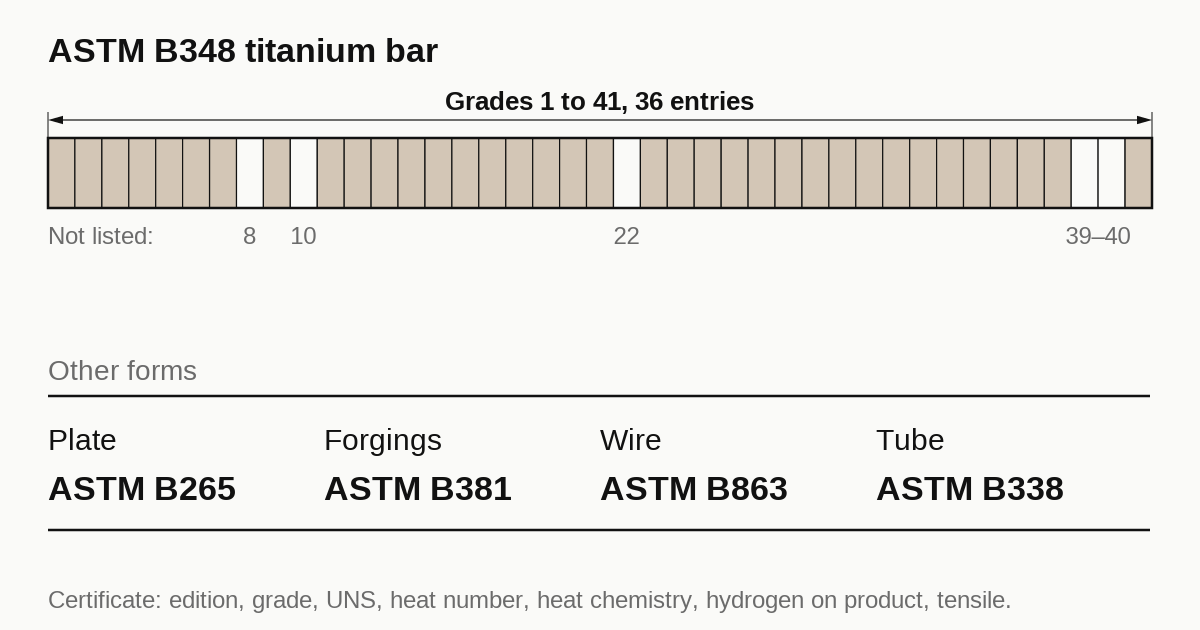
ASTM B348/B348M is the standard specification for annealed titanium and titanium alloy bars and billets; it lists 36 grade entries from unalloyed Grade 1 to the alloy Grade 41, sets chemistry, tensile minimums and testing for each and is what a shop buys to when a drawing says “Grade 5 bar” or “Grade 2 bar” with no aerospace or implant specification.
Key facts
| Item | ASTM B348/B348M |
|---|---|
| Full title | Standard Specification for Titanium and Titanium Alloy Bars and Billets |
| Issued by | ASTM International, Committee B10 |
| Active edition | B348/B348M-25 (as of October 2026) |
| Earlier editions seen on drawings | -21, -19, -13, -11 and older |
| Product forms | Bars and billets |
| Condition | Annealed |
| Supplied surface | Descaled, sandblasted, ground or rough turned |
| Grades | Grade 1 to Grade 41 (not every number), including H grades |
| Units | Inch-pound or SI, each standard on its own |
| Pressure equipment twin | ASME SB-348 |
Scope data are from the ASTM abstract of B348/B348M-25. Grade property figures below are typical published values and should be checked against the edition named on the drawing.
Grades covered
B348 groups every grade by UNS number. The 2025 edition lists:
| Group | Grades and UNS numbers |
|---|---|
| Unalloyed | Grade 1 R50250, Grade 2 R50400 (and 2H), Grade 3 R50550, Grade 4 R50700 |
| Main alloys | Grade 5 R56400 (Ti-6Al-4V), Grade 6 R54520 (Ti-5Al-2.5Sn), Grade 9 R56320 (Ti-3Al-2.5V), Grade 23 R56407 (Ti-6Al-4V ELI) |
| Palladium grades | Grade 7 R52400 (and 7H), Grade 11 R52250, Grade 16 R52402 (and 16H), Grade 17 R52252, Grade 18 R56322, Grade 20 R58645, Grade 24 R56405, Grade 25 R56403 |
| Ruthenium grades | Grade 26 R52404 (and 26H), Grade 27 R52254, Grade 28 R56323, Grade 29 R56404 |
| Nickel and other corrosion grades | Grade 12 R53400, Grades 13 to 15 R53413 to R53415, Grade 30 R53530, Grade 31 R53532, Grade 33 R53442, Grade 34 R53445 |
| Beta and other alloys | Grade 19 R58640 (Beta C), Grade 21 R58210, Grade 32 R55111, Grade 35 R56340, Grade 36 R58450 (Ti-45Nb), Grade 37 R52815, Grade 38 R54250, Grade 41 R56461 |
Grades 8, 10, 22, 39 and 40 do not appear in the bar standard. The grade reference cross references the common grades to Werkstoff and JIS numbers.
Typical minimum properties for common grades
| Grade | Tensile min | Yield min | Elongation min |
|---|---|---|---|
| Grade 1 | 240 MPa (35 ksi) | 138 MPa (20 ksi) | 24 percent |
| Grade 2 | 345 MPa (50 ksi) | 275 MPa (40 ksi) | 20 percent |
| Grade 2H | 400 MPa (58 ksi) | 275 MPa (40 ksi) | 20 percent |
| Grade 3 | 450 MPa (65 ksi) | 380 MPa (55 ksi) | 18 percent |
| Grade 4 | 550 MPa (80 ksi) | 483 MPa (70 ksi) | 15 percent |
| Grade 5 | 895 MPa (130 ksi) | 828 MPa (120 ksi) | 10 percent |
| Grade 7 | 345 MPa (50 ksi) | 275 MPa (40 ksi) | 20 percent |
| Grade 9 | 620 MPa (90 ksi) | 483 MPa (70 ksi) | 15 percent |
| Grade 12 | 483 MPa (70 ksi) | 345 MPa (50 ksi) | 18 percent |
| Grade 23 | 828 MPa (120 ksi) | 759 MPa (110 ksi) | 10 percent |
Typical published values, rounded. The CP grades also carry a maximum yield, so a CP heat can fail by being too strong. Reduction of area minimums and the exact values per edition are in the standard. A mill certificate for a real heat normally reads above these minimums.
What B348 requires of the mill
| Requirement | In outline |
|---|---|
| Chemistry | Heat analysis to the grade table. Elements intentionally added to the melt are identified, analysed and reported |
| Product analysis | Check analysis tolerances, with hydrogen determined on the product |
| Tension test | Specimens machined and tested at a specified strain rate through yield, then at an increasing rate |
| Condition | Annealed |
| Surface | Descaled, sandblasted, ground or rough turned, as ordered |
| Dimensions | Permissible variations for diameter, thickness, straightness and length by product type |
| Certification | Report of test results to the standard, with the heat identified |
This is a summary of the published abstract and of how the standard is structured, not a reproduction of its tables. Test lot definitions and frequencies are in the purchased document; ask the mill or distributor which edition they certify to.
What B348 does not cover
B348 is a commercial bar standard. It does not carry aerospace requirements such as microstructure criteria or approved source control, and it is not an implant standard.
| You need | Use instead |
|---|---|
| Plate, sheet or strip | ASTM B265 |
| Forgings | ASTM B381 |
| Wire | ASTM B863 |
| Heat exchanger tube | ASTM B338 |
| Seamless or welded pipe | ASTM B861, B862 |
| Aerospace Ti-6Al-4V bar | AMS 4928 annealed, AMS 4965 STA |
| Implant Ti-6Al-4V ELI | ASTM F136 |
| Implant CP titanium | ASTM F67 |
The AMS 4928 page compares the aerospace specification line by line. The AMS 4928 and B348 guide shows how a dropped spec number turns into a wrong certificate.
Bar, billet and the stock a shop buys
B348 distinguishes bar from billet by size and product route; billet is the larger semi finished product, often bought by forge shops and for large machined parts. For a machining buyer the practical points are these:
- Oversize stock. Shops buy bar a few millimetres above the finished size and turn off the supplied surface, so the permissible diameter variation affects stock allowance more than part tolerance.
- Surface condition. Rough turned or ground bar costs more than descaled bar but removes less material in the first operation. Ground bar is the norm for Swiss turning.
- Size availability. Grade 2 and Grade 5 are stocked in most diameters. Many other grades in the list are mill orders. The stock forms and lead time guide explains how to ask.
- Units. B348/B348M allows inch-pound or SI values. A certificate should state which system it reports, and the two must not be mixed.
How to call out B348 on a drawing
| Callout | Result |
|---|---|
| “Titanium bar” | Not quotable. Grade missing |
| “Grade 5 titanium” | Usually bought to B348, but the edition and form are unstated |
| “Ti-6Al-4V bar, ASTM B348 Grade 5, annealed” | Complete for general industrial work |
| “Titanium bar ASTM B348/B348M-25 Grade 2, ground” | Complete, with edition and surface condition |
| “ASTM B348 Grade 23” on an implant drawing | Incomplete. Implant parts need ASTM F136 material |
If the drawing names an older edition, the drawing owner decides whether certificates to the current edition are acceptable.
What the certificate should show
- The standard and edition, for example ASTM B348/B348M-25.
- The grade and UNS number.
- The heat number, matching the marking on the bar.
- Heat chemistry, including any intentionally added elements, and hydrogen on the product. The hydrogen maximum for Grade 5 differs between editions, so check the edition named on the drawing.
- Tensile results: tensile, yield, elongation and reduction of area.
- Condition (annealed), size and surface condition.
A certificate to EN 10204 type 3.1 is the usual request. The mill certificate guide covers what each document proves, and the Grade 5 page and Grade 2 page cover the two grades most bought to this standard.
What to write on the RFQ
- Standard and grade: ASTM B348 Grade number, with the edition if your customer fixes one.
- Form and size: bar diameter or flat size, and ground or rough turned if it matters.
- Condition: annealed, as B348 supplies it, or a later heat treatment the shop arranges.
- Certificates: EN 10204 type 3.1 with the heat number, and a certificate of conformity from the shop.
- Alternatives: whether ASME SB-348 or a dual certified heat is acceptable for pressure parts.
Send the drawing through the RFQ form and shops that buy B348 bar reply within 24 business hours. The specification index lists the companion standards.
Frequently asked questions
What is ASTM B348?
ASTM B348/B348M is the ASTM standard specification for annealed titanium and titanium alloy bars and billets. It covers commercially pure grades and alloys from Grade 1 to Grade 41, and it is the usual material standard for machined titanium parts outside aerospace and implants.
What is the current edition of ASTM B348?
ASTM lists B348/B348M-25 as the active edition as of October 2026, after the 2021 and 2019 editions. Values in inch-pound and SI units are each standard on their own and are not to be combined.
Does ASTM B348 cover forgings or plate?
No. B348 covers bars and billets. Forgings are ASTM B381, plate and sheet are ASTM B265, wire is ASTM B863 and heat exchanger tube is ASTM B338. A part cut from plate takes the plate standard.
What is the difference between Grade 2 and Grade 2H in ASTM B348?
Grade 2H is identical to Grade 2 except for a higher guaranteed minimum tensile strength of 58 ksi (400 MPa). It is intended mainly for pressure vessel use and may always be certified as Grade 2. The same applies to Grades 7H, 16H and 26H.
Sources
- ASTM B348/B348M-25, Standard Specification for Titanium and Titanium Alloy Bars and Billets: scope, grade list and abstract
- ASTM B348/B348M-21 (previous edition)
- SAE AMS 4928W, Ti-6Al-4V annealed bar, for comparison
Last reviewed November 20, 2026. Figures are typical values from the standards and handbooks named above. The standard on your drawing and the mill certificate for your heat govern.
Need a quote for this part?
Send the drawing with the grade and specification lines. We send one itemised quote for the finished parts and reply within 24 business hours.
Get a titanium quote