Home / Applications / Titanium Medical Device Parts
Titanium Medical Device Parts
Titanium medical parts are machined from implant grade material, mostly Ti-6Al-4V ELI to ASTM F136, commercially pure titanium to ASTM F67 and Ti-6Al-7Nb to ASTM F1295, plus Grade 5 for many instruments; the cutting is standard titanium work, and the cost and risk sit in material certification, lot traceability, cleaning, passivation, marking and packaging.
Key facts
| Item | Typical for medical titanium |
|---|---|
| Load bearing implant alloy | Ti-6Al-4V ELI, ASTM F136 (UNS R56401), ISO 5832-3 |
| CP implant material | Grades 1 to 4, ASTM F67, ISO 5832-2 |
| Vanadium free alloy | Ti-6Al-7Nb, ASTM F1295, ISO 5832-11 |
| Instruments | Grade 5 or Grade 23, per the device file |
| Common machining route | Swiss turning for screws and pins, 5 axis milling for plates and bodies |
| Surface steps | Cleaning, passivation, colour anodize, blasting or electropolishing as specified |
| Identification | Laser marking of part number and lot, UDI where the owner requires it |
| Traceability | Heat to lot to part, through every operation |
| Quality system asked for | ISO 13485, a question for the shop, not a claim of ours |
| Regulatory approval | The device owner’s, never the shop’s |
These are typical patterns. The device owner’s drawing, specifications and quality agreement govern each part.
Material standards and what each one covers
| Standard | Material | UNS | Typical parts | Note |
|---|---|---|---|---|
| ASTM F136 | Ti-6Al-4V ELI, wrought annealed | R56401 | Bone screws, spinal rods, plates, hip and knee parts | Active edition F136-26 as of October 2026 |
| ASTM F67 | Unalloyed titanium Grades 1 to 4 | R50250, R50400, R50550, R50700 | Dental fixtures, CP plates and meshes | Covers strip, sheet, plate, bar, billet, forging and wire |
| ASTM F1295 | Ti-6Al-7Nb | R56700 | Hip stems, screws where vanadium is excluded | A different alloy, not a substitute |
| ISO 5832-3 | Ti-6Al-4V wrought | International implant callout | Not identical to F136 | |
| ISO 5832-2 | Unalloyed titanium | International CP callout | Grade split differs from F67 | |
| ISO 5832-11 | Ti-6Al-7Nb | International counterpart to F1295 | Check the edition | |
| ASTM B348 | Industrial bar, Grade 5 or Grade 23 | R56400, R56407 | Some instruments and non contact parts | Never for an implant callout |
Implant standards and industrial standards are not interchangeable even when the chemistry looks the same. The Grade 23 ELI page compares the F136 and B348 limits, and the Grade 4 page covers the strongest CP grade used in dental work.
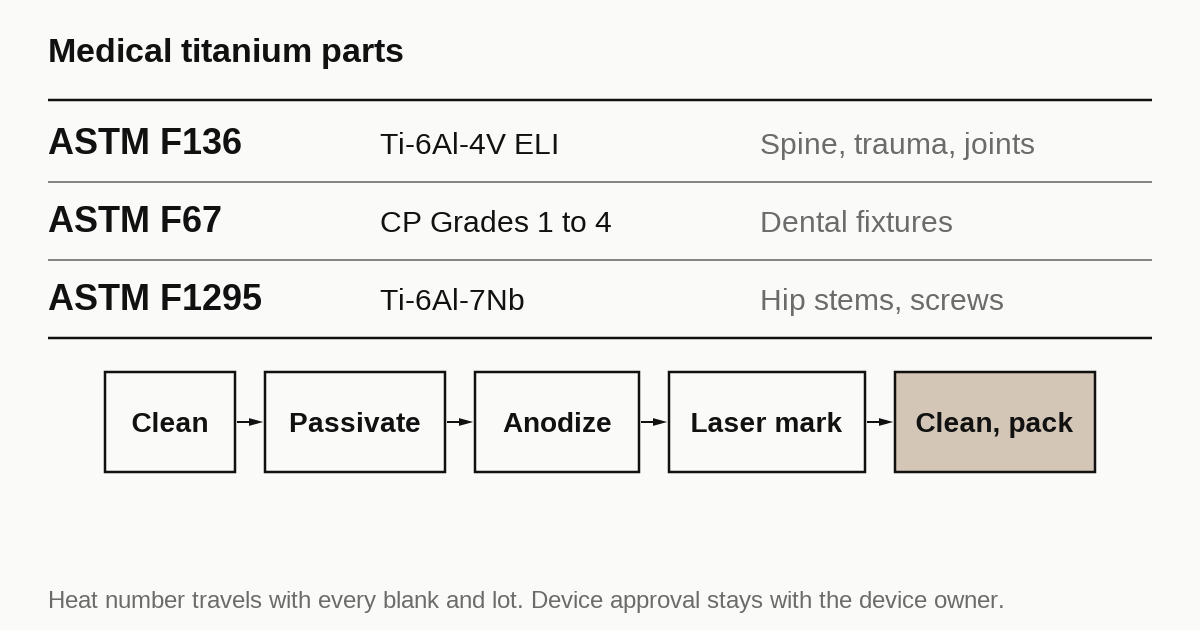
Parts by device type
| Device area | Typical machined titanium parts | Usual material | Machining route |
|---|---|---|---|
| Spine | Pedicle screw bodies, set screws, rods, connectors, cages | F136 Ti-6Al-4V ELI | Swiss turning, 5 axis milling |
| Trauma | Bone plates, cortical and cancellous screws, nails | F136, some F67 CP | Milling, Swiss turning, thread whirling |
| Joint replacement | Femoral stems, acetabular shells, tibial trays | F136, F1295 | Forgings machined, 5 axis milling |
| Dental | Implant fixtures, abutments, abutment screws | F67 Grade 4, F136 | Swiss turning from ground bar |
| Cranio maxillofacial | Plates, mesh, micro screws | F67 CP | Fine milling, Swiss turning |
| Instruments | Handles, drill guides, trial and sizing parts, retractors | Grade 5, Grade 23 | Milling, turning, colour anodize |
Volumes range from a few hundred parts per size for plates and trials to thousands for common screws, usually in many sizes per family. Lot size and the number of sizes change the quote as much as the part geometry.
Cleaning, passivation and surface lines
These steps are where medical work separates from industrial work. Each should be named on the drawing or in the quality agreement with its specification or procedure.
| Step | Purpose | What the drawing should say |
|---|---|---|
| Coolant and process control | Keep chlorides and unapproved fluids off the part | Approved coolants, or none restricted |
| Cleaning | Remove oil, coolant, particles | The owner’s validated cleaning procedure, or its reference |
| Passivation | Remove embedded iron, restore the oxide | ASTM F86 practice or the owner’s procedure |
| Blasting | Matte finish, or textured bone contact surfaces | Media type and size, surface to treat |
| Colour anodize | Size and component colour coding | Type and colour, with the specification such as AMS 2488 |
| Electropolishing | Smoother, cleanable surface | Stock removal allowed, surfaces to treat |
| Laser marking | Part number, lot, UDI | Content, location, depth and whether before or after passivation |
| Final clean and packaging | Particle and residue limits, protection | Bagging, labelling, cleanroom class if any |
The anodizing guide explains Type II against Type III, and the surface finish guide covers Ra callouts on implant surfaces.
Lot traceability
A medical part must trace back to the heat of material it came from and forward to the lot it shipped in. The shop’s record has to show:
- The mill certificate to the implant standard and edition, with the heat number.
- Segregated storage, so F136 bar never mixes with Grade 5 bar of the same diameter.
- Transfer of the heat number to each blank or bar end before the original marking is lost.
- The lot number assigned and carried through every operation and outside process.
- A certificate of conformity, or device history record content, tying parts to lot and heat.
The medical parts guide walks through where this chain usually breaks.
What the buyer owns and what the shop owns
| The device owner | The machine shop |
|---|---|
| Device design, risk analysis, regulatory approval | Machining to the drawing |
| Choice of material and standard | Buying material certified to that standard |
| Biocompatibility and sterilisation validation | Following the specified cleaning and passivation |
| Specifications for surface, marking, packaging | Executing them and keeping records |
| Supplier approval and audits | Supplying records and access as agreed |
No part of this split moves to the shop because the shop holds a certificate. ISO 13485 status, cleanroom capability and validation experience are questions we put to shops; we never claim them.
Common drawing and RFQ mistakes
| Mistake | Consequence | Fix |
|---|---|---|
| “Ti-6Al-4V” with no standard | Shop quotes B348 bar | Name ASTM F136 and the edition |
| F136 named on an instrument that does not need it | Higher stock cost, longer lead time | Let the device file decide |
| Passivation left as “passivate” | Process undefined, records unusable | Name the practice or procedure |
| Marking sequence not stated | Mark applied after final clean, part recleaned | Say before or after passivation |
| Colour anodize without a colour standard | Colour disputes between lots | Supply a colour sample or voltage reference |
| Sizes and lot rules unstated | Quote cannot price set ups | List the sizes and lot quantity per size |
What to write on the RFQ
- Material: standard and edition, for example Ti-6Al-4V ELI to ASTM F136-26, or Grade 4 to ASTM F67.
- Certificates: mill certificate with heat number, certificate of conformity naming lot and heat.
- Traceability: lot rules and what records travel with the parts.
- Processes: cleaning, passivation, anodize and marking, plus any blasting or electropolishing, each with its reference.
- Packaging: bagging, labels, cleanroom requirement if any.
- Quality system: whether your file requires ISO 13485 at the supplier.
- Sizes and quantities: sizes per family and quantity per size per release.
Send the drawing through the RFQ form and shops used to medical lot control reply within 24 business hours. Other sectors are on the applications overview.
Frequently asked questions
Which titanium standards apply to medical parts?
For implant material, ASTM F67 covers unalloyed Grades 1 to 4, ASTM F136 covers Ti-6Al-4V ELI and ASTM F1295 covers Ti-6Al-7Nb. ISO 5832-2, 5832-3 and 5832-11 are the international counterparts. Instruments are often made from Grade 5 to an industrial standard where the device file allows it.
Can a machine shop make a titanium part an approved medical device?
No. Approval belongs to the device owner and its regulator. A shop machines a component to the device owner's drawing and specifications and supplies the records the owner's quality system needs. Neither we nor the shop make an implant claim.
Do titanium implant parts need passivation?
Usually the device owner specifies a cleaning and passivation step, commonly to ASTM F86 practice or its own validated procedure, to remove embedded iron and residues from machining. The step, its parameters and its records are part of the drawing package, not a shop choice.
Why are titanium medical parts anodized in colours?
Colour coding of sizes and components, mostly by Type III colour anodizing, which changes the oxide thickness and therefore the interference colour. Type II anodizing is a different, grey finish used for wear and anti galling. The drawing should name the type, the colour and the specification.
Sources
- ASTM F67-24, Unalloyed Titanium for Surgical Implant Applications
- ASTM F136-26, Wrought Ti-6Al-4V ELI Alloy for Surgical Implant Applications (UNS R56401)
- ISO 5832-3:2021, Implants for surgery, Metallic materials, Wrought titanium 6-aluminium 4-vanadium alloy
- Wikipedia, Titanium biocompatibility
Last reviewed November 25, 2026. Figures are typical values from the standards and handbooks named above. The standard on your drawing and the mill certificate for your heat govern.
Need a quote for this part?
Send the drawing with the grade and specification lines. We send one itemised quote for the finished parts and reply within 24 business hours.
Get a titanium quote