Home / Buyers by country / Buying Machined Titanium Parts for the US Market
Buying Machined Titanium Parts for the US Market
US buyers of machined titanium parts draw to ASTM and SAE AMS specifications, often on inch drawings with ASME Y14.5 tolerancing, and as of October 2026 they price imported parts against a changed tariff picture, DFARS specialty metals rules on defence work and ITAR or EAR rules on the drawing itself; this page sets out what to check, with sources, and is not legal or customs advice.
Key facts, as of October 2026
| Item | Position as of October 2026 | Check with |
|---|---|---|
| Main material standards | ASTM B348, B265, B381, F136, F67; SAE AMS 4928, 4911, 4965 | The drawing |
| Drawing convention | Inch common on aerospace and defence, ASME Y14.5 GD&T | The drawing owner |
| IEEPA tariffs | Struck down by the Supreme Court, 20 February 2026 | Customs broker, on refunds |
| Section 122 surcharge | 10 percent, expired 24 July 2026 | Customs broker |
| Section 301 forced labor action | 10 or 12.5 percent on goods from 60 economies, with exemptions, from July 2026 | USTR notice and broker, for the origin |
| Section 232 and titanium | No 232 tariff names titanium; critical minerals and aircraft actions set no tariff and directed negotiations | Commerce and USTR updates |
| Normal duty | HTSUS rate for the part’s classification | Customs broker |
| Defence contracts | Titanium is a DFARS specialty metal, 252.225-7009 | Contracting officer, prime |
| Export control | ITAR or EAR applies to the part and its drawing | Export compliance team |
| Medical devices | FDA QMSR, aligned with ISO 13485, effective 2 February 2026, applies to device makers | Regulatory team |
The trade rows summarise the Congressional Research Service’s tariff fact sheet dated 8 October 2026 (status at 30 September 2026) and the primary notices listed under Sources. Rates and actions change; confirm with a licensed customs broker before pricing a landed cost.
Demand profile
Titanium machining demand in the US is led by the industries that already write titanium into their specifications:
| Industry | Typical titanium parts | Documents the buyer expects |
|---|---|---|
| Commercial aerospace | Brackets, fittings, manifolds, engine mount hardware | AMS material, AS9102 first article, special process certificates |
| Defence | Airframe, vehicle and naval hardware | DFARS specialty metals compliance, ITAR or EAR classification |
| Medical devices | Implant screws, plates, rods, instruments | ASTM F136 or F67 material, lot traceability, cleaning records |
| Semiconductor and vacuum equipment | CP chamber parts, fixtures, fasteners | Cleanliness, outgassing and surface requirements |
| Energy and chemical process | Grade 2, 7 and 12 valve, pump and heat exchanger parts | ASTM or ASME SB material, PMI on request |
| Motorsport and consumer | Grade 5 hardware, cases, frames | Mill certificate, finish samples |
The aerospace applications page and the medical applications page cover the two largest groups in depth.
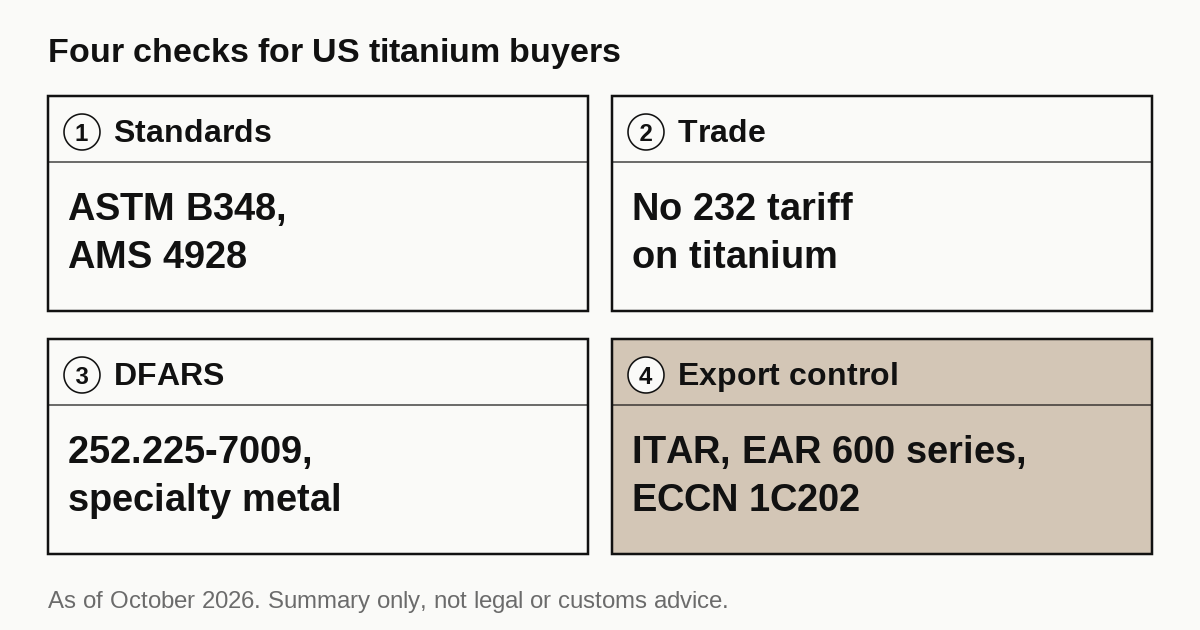
Standards US buyers draw to
| Need | Usual US callout | Reference page |
|---|---|---|
| General bar | ASTM B348 Grade 2 or Grade 5 | ASTM B348 |
| Plate and sheet | ASTM B265, AMS 4911 for aerospace | |
| Aerospace bar | AMS 4928 annealed, AMS 4965 STA | AMS 4928 |
| Forgings | ASTM B381, AMS forging specifications | |
| Implant material | ASTM F136, F67, F1295 | Grade 23 ELI |
| Pressure equipment | ASME SB-348, SB-265 under the Boiler and Pressure Vessel Code | |
| Tolerancing | ASME Y14.5 | |
| First article | AS9102 | |
| Mill certificate | Certified test report to the specification, EN 10204 3.1 accepted by many buyers |
US drawings usually name the specification and revision in the title block material note. Copy it exactly onto the RFQ. Grade names alone, such as “Grade 5”, leave the specification to the shop’s assumption, and the Grade 5 page explains why that assumption is usually B348.
Tariffs and trade actions to check
IEEPA tariffs. On 20 February 2026 the Supreme Court held, in Learning Resources, Inc. v. Trump, that IEEPA does not authorise tariffs. The reciprocal and other IEEPA duties fell with it. Importers who paid them should ask their broker about refunds.
Section 122. A 10 percent temporary import surcharge under Section 122 of the Trade Act of 1974 applied from 24 February 2026 and expired on 24 July 2026 at the statutory 150 day limit.
Section 301. USTR announced final action on 23 July 2026 in its forced labor investigations: additional duties of 10 percent or 12.5 percent on goods from 60 economies, with product and country exemptions and a net of MFN structure for some partners. Whether a titanium part pays it depends on its country of origin and any exemption. Other country specific Section 301 actions also exist; check the origin.
Section 232. No Section 232 action in force names titanium. The steel, aluminium and copper actions cover those metals and their listed derivatives. Titanium is on the USGS 2025 list of critical minerals, and the January 2026 proclamation on processed critical minerals and derivative products imposed no tariff and directed negotiations instead, leaving later measures such as price floors open. The July 2026 proclamation on commercial aircraft, jet engines and parts also set no tariff, directing negotiations with an update due by 5 January 2027. Earlier, a 2020 presidential memorandum on titanium sponge accepted a national security finding but imposed no tariff.
Normal duty. Titanium mill products and articles fall in HTSUS chapter 81, heading 8108, but a finished machined part is often classified by what it is, for example as an aircraft, medical or machinery part. Some civil aircraft parts can enter duty free under the civil aircraft provisions. Classification is the importer’s responsibility; confirm it, and the current rate, with a customs broker using the HTSUS.
DFARS specialty metals on defence work
Titanium and titanium alloys are specialty metals under DFARS 252.225-7009, which implements 10 U.S.C. 4863. On contracts that carry the clause, the titanium in delivered items must be melted or produced in the United States, its outlying areas or a qualifying country. The clause on acquisition.gov is dated January 2023 as of October 2026.
| Point | What it means for a titanium part |
|---|---|
| Scope | Applies when the clause is in the prime contract and flowed down |
| Melt source | The mill certificate must show where the titanium was melted |
| Qualifying countries | Listed in DFARS 225.003; check the current list |
| Minimal content | Noncompliant specialty metal up to 2 percent of the total specialty metal weight in the end item may be allowed |
| COTS exception | Does not cover mill products such as bar or plate not yet built into an end item |
| Required form | 10 U.S.C. 4863 refers to the form of the mill product, such as bar, billet, plate or sheet |
The practical consequence: say on the RFQ whether the part is for a DFARS covered contract, so the shop buys bar with a compliant melt source and the certificate shows it. The mill certificate guide covers the certificate lines.
ITAR and EAR on the drawing
US export control attaches to the part, its drawing and its end use. Under ITAR (22 CFR Parts 120 to 130), drawings for defence articles are technical data, and sending them to a foreign person can be an export. Under the EAR, many former munitions aircraft parts sit in the 600 series of the Commerce Control List, and releasing controlled technology to a foreign person is an export even inside the US.
The material can be listed on its own. ECCN 1C202.b covers titanium alloys capable of an ultimate tensile strength of 900 MPa or more at 20 °C in the form of tubes or cylindrical solid forms, including forgings, with an outside diameter of more than 75 mm. Annealed Ti-6Al-4V bar above that diameter meets the description. The control applies to exports from the US; it matters to US buyers who supply bar to a shop abroad or re export parts.
We are not a law firm. We do not accept RFQs for controlled defence articles, and an ITAR drawing should never go through our form. The titanium export control guide covers the order of review step by step.
Documents and conventions US buyers expect
- Certificate of conformity naming part number, revision, quantity, heat number and specification.
- Mill certificate to the specification and revision on the drawing, with melt source shown on defence work.
- First article report to AS9102 when the purchase order calls it.
- Special process certificates for heat treatment, NDT and finishing, naming the processor.
- Country of origin marking on imported parts or their packaging, as US customs rules require.
- Inch dimensions reported in the drawing’s units, with ASME Y14.5 symbols read as the drawing defines them.
- Incoterms stated on the quote, with the importer of record named. US buyers often ask for DDP or FCA; DDP puts the duty and the import filing on the seller.
Medical device buyers
The FDA’s Quality Management System Regulation took effect on 2 February 2026 and incorporates ISO 13485:2016 by reference into 21 CFR Part 820. It applies to finished device manufacturers, who in turn control their suppliers through purchasing controls. A machine shop making a component is controlled by its customer’s quality system; whether the shop holds ISO 13485 is a question for the shop, never a claim we make. The medical applications page covers the material and lot lines.
What to write on the RFQ for a US part
- Material line: alloy, specification and revision, exactly as the title block writes it.
- Units: inch or metric, and the drawing standard, usually ASME Y14.5.
- Contract flags: DFARS specialty metals clause yes or no; other flow downs.
- Export status: EAR99, ECCN or “not yet classified”; no ITAR drawings.
- Documents: CoC, mill certificate, AS9102 if needed, special process certificates.
- Commercial terms: Incoterm, importer of record and delivery point.
Send the drawing through the RFQ form and shops used to US paperwork reply within 24 business hours. Other markets are on the buyers by country page.
Frequently asked questions
Are there US tariffs on imported titanium parts in October 2026?
As of October 2026 no Section 232 tariff names titanium. The IEEPA tariffs were struck down in February 2026, the 10 percent Section 122 surcharge expired on 24 July 2026 and a Section 301 action now adds 10 or 12.5 percent on goods from 60 economies with exemptions. Normal HTSUS duty also applies. Confirm the position for your part and origin with a licensed customs broker.
Is titanium a specialty metal under DFARS?
Yes. DFARS 252.225-7009, which implements 10 U.S.C. 4863, lists titanium and titanium alloys as specialty metals. On covered defence contracts the titanium must be melted or produced in the United States, its outlying areas or a qualifying country, unless an exception such as the 2 percent minimal content rule applies.
Is a titanium part export controlled in the US?
It depends on the part and its drawing, not on the grade name. A part for a defence article can be ITAR controlled, many aircraft parts are in the EAR 600 series and titanium alloy bar of 900 MPa capability above 75 mm diameter is listed under ECCN 1C202. Classify with your export compliance team before a drawing is shared.
Do US buyers want inch or metric drawings?
Both appear. Aerospace, defence and older industrial drawings are mostly inch with ASME Y14.5 tolerancing. Medical and newer designs are often metric. The certificate units should match what the specification allows, for example inch-pound or SI under ASTM B348/B348M, never a mix.
Sources
- Congressional Research Service R49481, Active Presidential Tariff Actions in 2026 (status as of September 30, 2026)
- Cornell LII, Learning Resources, Inc. v. Trump (2026), IEEPA tariffs
- USTR, Takes Action in Forced Labor Section 301 Investigations (July 23, 2026)
- White House, Proclamation adjusting imports of processed critical minerals and their derivative products (January 14, 2026)
- Federal Register 2026-14334, Adjusting Imports of Commercial Aircraft, Jet Engines, and Aircraft and Engine Parts (July 15, 2026)
- GovInfo, Presidential memorandum on the effects of titanium sponge imports on national security (February 27, 2020)
- USGS, Interior Department releases final 2025 List of Critical Minerals
- Acquisition.gov, DFARS 252.225-7009 Restriction on Acquisition of Certain Articles Containing Specialty Metals
- US Code, 10 U.S.C. 4863, Requirement to buy strategic materials critical to national security from American sources
- eCFR, 15 CFR Part 774 Supplement No. 1, Commerce Control List (ECCN 1C202 titanium alloys)
- eCFR, 22 CFR Part 120, ITAR purpose and definitions
- FDA, Quality Management System Regulation (QMSR)
- USITC, Harmonized Tariff Schedule of the United States
- ASTM B348/B348M-25, Titanium and Titanium Alloy Bars and Billets
Last reviewed November 26, 2026. Figures are typical values from the standards and handbooks named above. The standard on your drawing and the mill certificate for your heat govern.
Need a quote for this part?
Send the drawing with the grade and specification lines. We send one itemised quote for the finished parts and reply within 24 business hours.
Get a titanium quote